Logarithmic Functions Explained for AP Calculus AB
Introduction to Logarithmic Functions
Logarithmic Functions are more than just algebraic tools in AP Calculus AB; they are necessary for figuring out growth rates, solving hard differentiation problems, and figuring out integrals. This guide goes into great detail about their definitions, properties, and uses in Calculus.
What is a Logarithmic Function?
Logarithmic functions play a fundamental role in AP Calculus AB because they are the inverse of exponential functions and frequently appear in differentiation, integration, and limit problems.
If an exponential equation is given by b^{y} = x, then its inverse logarithmic form is written as \log_{b}(x) = y,
where:
- b is the base of the logarithm,
- x is the argument,
- y represents the power to which the base must be raised.
In AP Calculus AB, the most important logarithmic function is the natural logarithm, which uses base e.
Understanding the Domain and Range
Consider the logarithmic function f(x) = \log_{b}(x).
Domain
The domain of a logarithmic function consists only of positive real numbers: x > 0
This is because no real exponent of a positive base can produce a negative number or zero.
Range
The range of a logarithmic function is: (-\infty, \infty).
Vertical Asymptote
All logarithmic functions have a vertical asymptote at: x = 0.
This asymptotic behavior is essential when analyzing limits and sketching curves in calculus.
Graphical Behavior of Logarithmic Functions
Consider the logarithmic function: f(x) = \log_b(x), \quad b>0,\; b\neq 1
The graphical behavior of this function depends on the value of the base b.
Common Graphical Properties
- The domain is x>0.
- The range is (-\infty, \infty).
- The graph passes through the point (1,0).
- The y-axis x=0 is a vertical asymptote.
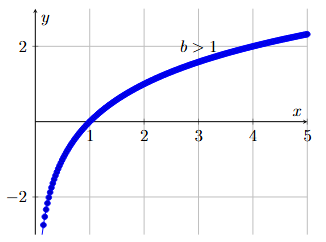
Case 1: Graph of f(x)=\log_b(x) for b>1
When the base is greater than 1, the logarithmic function is increasing.
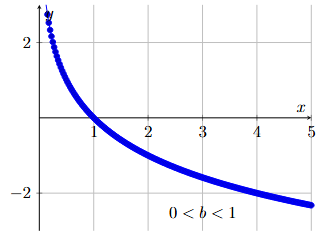
Case 2: Graph of f(x)=\log_b(x) for 0<b<1
When the base lies between 0 and 1, the logarithmic function is decreasing.
Asymptotic Behavior
As x \to 0^{+}, \log_b(x) \to -\infty for b>1, and \log_b(x) \to +\infty for 0<b<1.
As x \to \infty, the opposite behavior occurs in each case.
Graph of the Natural Logarithmic Function
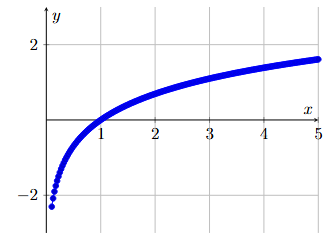
Below is the graph of the natural logarithmic function y=\ln(x), which is the most commonly used logarithmic function in AP Calculus AB.
Behavior Near the Asymptote
As x \to 0^{+}, \ln(x) \to -\infty.
This confirms that the graph approaches the vertical asymptote at x=0 but never touches it. Understanding this behavior is critical for evaluating limits and sketching logarithmic graphs accurately in AP Calculus AB.
Behavior for Large Values of x
As x \to \infty, \ln(x) \to \infty, but the rate of increase is slow compared to exponential functions.
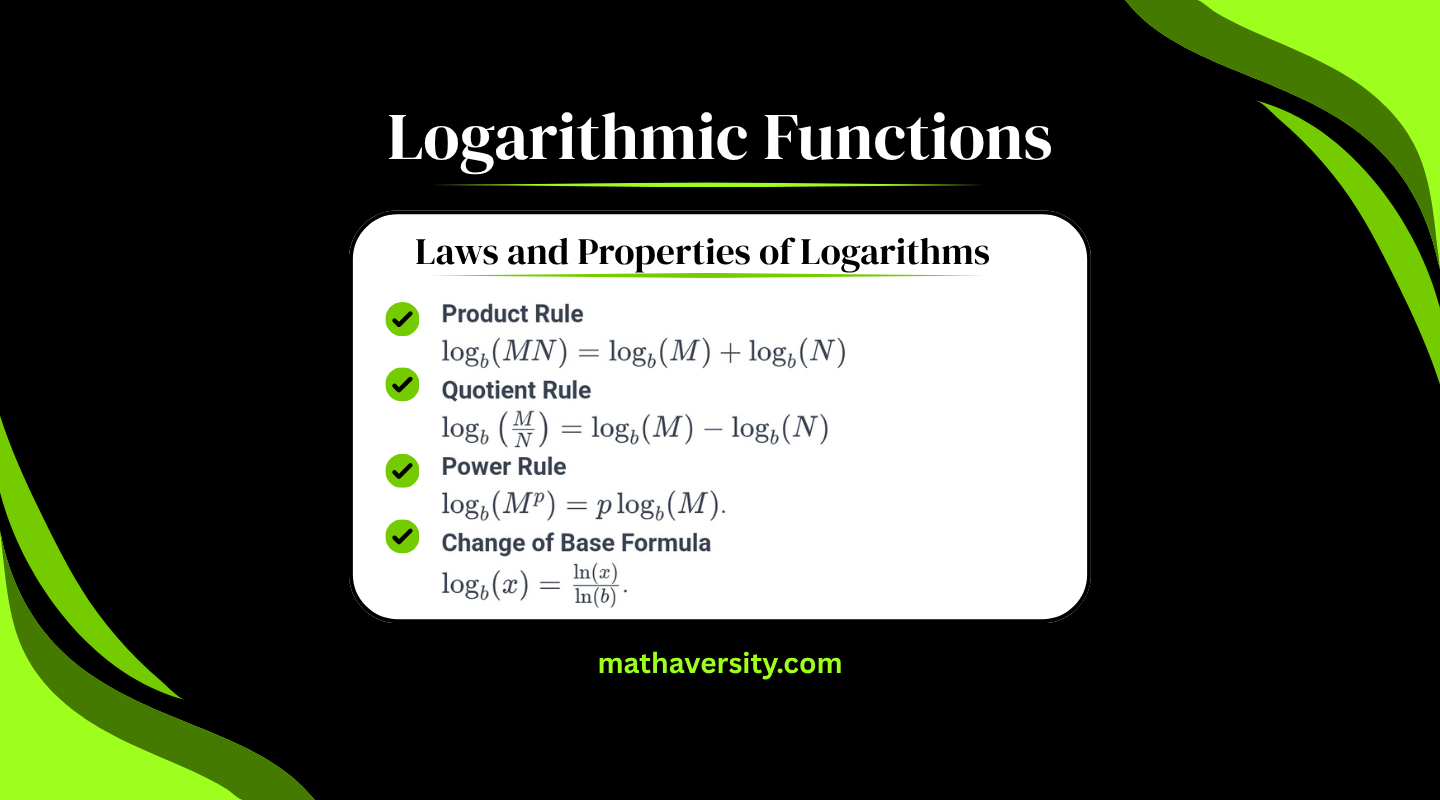
Laws and Properties of Logarithms
Logarithmic properties allow complex expressions to be simplified before differentiation or integration.
- Product Rule
- \log_b(MN) = \log_b(M) + \log_b(N)
- Quotient Rule
- \log_b\left(\frac{M}{N}\right) = \log_b(M) - \log_b(N)
- Power Rule
- \log_b(M^p) = p \log_b(M).
- Change of Base Formula
- \log_b(x) = \frac{\ln(x)}{\ln(b)}.
These rules are heavily tested in AP Calculus AB exams.
Natural Logarithm and the Constant e
The natural logarithm is defined as: \ln(x) = \log_e(x), where e \approx 2.71828.
- The natural logarithm is particularly important because:
- Its derivative has a simple form
- It appears naturally in growth and decay models
- It simplifies integration problems.
Derivatives of Logarithmic Functions
Derivative of Natural Logarithm
\dfrac{d}{dx}[\ln(x)] = \dfrac{1}{x}, \quad x>0
Derivative of Logarithm with Base b
\dfrac{d}{dx}[\log_b(x)] = \dfrac{1}{x \ln b}
- These derivative formulas are frequently used in:
- Related rates problems
- Optimization problems
- Implicit differentiation
Logarithmic Differentiation
Logarithmic differentiation is a powerful technique used when standard differentiation rules are difficult to apply.
Let y = [f(x)]^{g(x)}.
Taking natural logarithms: \ln(y) = g(x)\ln(f(x)).
Differentiating both sides: \frac{1}{y}\dfrac{dy}{dx} = g'(x)\ln(f(x)) + g(x)\dfrac{f'(x)}{f(x)}.
Finally, multiply both sides by y to find \dfrac{dy}{dx}.
Limits Involving Logarithmic Functions
Logarithmic limits frequently appear in AP Calculus AB.
Limit as x \to 0^+
\lim_{x \to 0^+} \ln(x) = -\infty
Limit as x \to \infty
\lim_{x \to \infty} \ln(x) = \infty
Logarithmic expressions are also commonly used with L'Hospital's Rule.
Solved Example
Simplify the following expression: 3\log_{5}(2x) - 2\log_{5}(x^2) + \log_{5}(10)
Solution
Step 1: Apply the power rule of logarithms.
2\log_{5}(x^2) = \log_{5}(x^4)
So the expression becomes:
3\log_{5}(2x) - \log_{5}(x^4) + \log_{5}(10)
Step 2: Apply the power rule again.
3\log_{5}(2x) = \log_{5}((2x)^3) = \log_{5}(8x^3)
Now the expression is:
\log_{5}(8x^3) - \log_{5}(x^4) + \log_{5}(10)
Step 3: Use the quotient rule.
= \log_{5}\left(\frac{8x^3}{x^4}\right) + \log_{5}(10)
= \log_{5}\left(\frac{8}{x}\right) + \log_{5}(10)
Step 4: Use the product rule.
= \log_{5}\left(\frac{80}{x}\right)
Conclusion
A crucial component of AP Calculus AB is logarithmic functions. Students can solve challenging calculus problems effectively and precisely if they have a solid grasp of their properties, graphs, derivatives, and applications.
We at mathaversity are experts at making calculus easy to understand, simple, and relevant to everyday life.
- Quick Links:
- What is a Logarithmic Function?
- Understanding the Domain and Range
- Graphical Behavior of Logarithmic Functions
- Laws and Properties of Logarithms
- Natural Logarithm and the Constant e
- Derivatives of Logarithmic Functions
- Logarithmic Differentiation
- Limits Involving Logarithmic Functions
- Solved Example
- Conclusion