AP Calculus BC Score Calculator
AP® Calculus BC Score Calculator 2026
Estimate your exam score with precision
Multiple Choice
Free Response Questions
Score Breakdown
Predicted AP® Score
Estimated Score
Enter your scores to see your predicted AP score
AP® Calculus BC Score Calculator 2026: Predict Your AP Score Instantly
Wondering what your practice MCQ count and FRQ points actually add up to on the 1–5 AP scale? This AP Calculus BC score calculator guide walks through exactly how the exam is structured, how the composite score is built, how your separate AB subscore is calculated, and how all of it lands on your final AP score.
What Is AP Calculus AB?
The AP Calculus BC exam runs 3 hours and 15 minutes and is a hybrid digital exam: multiple choice is answered in the College Board's Bluebook app, while free-response answers are handwritten in a paper exam booklet — the exact same shell as AP Calculus AB, just loaded with more advanced content.
| Section | Format | Time | Weight |
|---|---|---|---|
| I — Multiple Choice, Part A | 30 questions, no calculator | 60 minutes | 50% of score |
| I — Multiple Choice, Part B | 15 questions, graphing calculator required | 45 minutes | |
| II — Free Response, Part A | 2 questions, graphing calculator required | 30 minutes | 50% of score |
| II — Free Response, Part B | 4 questions, no calculator | 60 minutes |
AP Calculus BC exam format Section Format Time Weight I — Multiple Choice, Part A 30 questions, no calculator 60 minutes 50% of score I — Multiple Choice, Part B 15 questions, graphing calculator required 45 minutes II — Free Response, Part A 2 questions, graphing calculator required 30 minutes 50% of score II — Free Response, Part B 4 questions, no calculator 60 minutes
What Is the Format of the AP Calc BC Exam?
Beyond the section timing above, a few format details matter specifically for BC test-takers using this AP Calculus BC score calculator:
- AB Subscore: alongside your 1–5 BC score, you automatically receive a separate 1–5 AB subscore, calculated from the roughly 60% of exam questions that cover AB-level content only. Some colleges will accept this subscore for Calculus I placement even if your full BC composite doesn't clear their Calculus II threshold.
- Calculator windows: a graphing calculator is permitted only on multiple-choice Part B and free-response Part A. Part A of multiple choice and Part B of free response are strictly no-calculator, and Desmos is never allowed on the actual exam — only College Board–approved physical calculators (TI-84, TI-Nspire, Casio, etc.).
- Answer choices: each multiple-choice question offers four answer choices, and there's no penalty for a wrong guess.
- FRQ mix: at least two of the six free-response questions use a real-world modeling context, and scoring guidelines award partial credit for valid methods and reasoning, not just a correct final answer.
How Is the AP Calculus BC Exam Scored?
Every AP Calculus BC score moves through the same three-step pipeline:
- Step 1 — Raw Score: each correct MCQ adds 1 raw point (out of 45); each FRQ is hand-graded 0–9 by trained AP Readers against a published rubric (54 raw points across all six).
- Step 2 — Composite Score: both raw scores are scaled to a shared 108-point composite.
- Step 3 — AP Score: the composite is mapped to the 1–5 AP scale using that year's conversion table, finalized after all exams are equated.
Your 45 possible MCQ points scale up by a factor of 1.2 to max out at 54 points, matching the FRQ section's 54-point max (6 questions × 9 points), so both halves contribute exactly 50%. There's no penalty for a wrong multiple-choice answer, so every question is worth answering — blanks and wrong guesses both score zero.
Why Are AP® Calculus BC Scores Curved?
AP Calculus BC isn't graded on a curve against the students in your specific test room. It goes through equating, a statistical adjustment that keeps a given AP score representing the same level of college readiness every year, even when one year's test form runs slightly harder or easier than another's.
That's also why this AP Calculus BC score calculator, like every other one online, can only ever produce a close estimate. Composite cutoffs shift a few points year to year based on national performance, and the College Board doesn't publish the final table until scores are released in July.
What Is a Good AP® Calculus BC Score?
A 4 or 5 is a strong result on any AP exam, but on AP Calculus BC specifically, a 5 is the single most common outcome — a reflection of BC's highly self-selected, already advanced student pool rather than an easier exam.
| Score | 2025 % of Students | What It Signals |
|---|---|---|
| 5 | 44% | Extremely well qualified; fluent across all 10 units, including series and parametric/polar content |
| 4 | 22% | Well qualified; strong command of core BC extensions with minor gaps |
| 3 | 13% | Qualified; the standard "passing" score accepted by many colleges |
| 2 | 15% | Possibly qualified; partial understanding, rarely credit-eligible on its own |
| 1 | 6% | No recommendation; limited demonstrated mastery |
With 66% of students scoring a 4 or 5, a 5 is the realistic target for most well-prepared BC students, while a 3 still represents solid, credit-eligible work at many schools.
What Is the Average AP® Calculus BC Score?
Based on the official May 2025 score distribution (5: 44%, 4: 22%, 3: 13%, 2: 15%, 1: 6%), the weighted mean AP Calculus BC score works out to roughly 3.8 out of 5 — noticeably higher than AP Calculus AB's 3.21 mean, and one of the highest averages of any AP exam.
Run your own practice numbers through the AP Calculus BC score calculator above to see how your projected composite compares to that average, section by section.
How Do I Get a 5 on AP® Calculus BC?
Historical composites suggest roughly 68–70 out of 108 points — about 63–65% — is typically enough for a 5, meaningfully lower than the raw percentage many students assume they need. A few habits separate 5-scorers from everyone else:
- Don't let BC-only content eat your AB fluency. Roughly 60% of the exam is still AB-scope material, so shaky derivative or integral basics cost more points than a shaky Taylor series problem.
- Drill convergence tests until they're automatic. Series convergence (ratio test, alternating series, comparison tests) shows up repeatedly across both MCQ and FRQ, and it's one of the most commonly under-practiced BC topics.
- Show every labeled step on FRQs. Readers award points for correct setup and reasoning independently of the final numeric answer.
- Practice full 3-hour-15-minute exams. BC's faster pace and denser content make fatigue-driven errors late in the free-response section more common than on AB.
What AP Calculus BC Adds Beyond AB Content
AP Calculus BC covers every AB topic and then extends into two additional units, roughly 25–30% of the multiple-choice section:
| Area | Key Topics |
|---|---|
| Advanced Integration | Integration by parts, partial fractions, improper integrals, L'Hôpital's rule, arc length |
| Parametric, Polar & Vector Functions | Derivatives and integrals of parametric and polar curves, vector-valued functions and motion |
| Infinite Sequences & Series | Convergence tests, power series, Taylor and Maclaurin series, error bounds |
Because roughly 60% of the exam is still shared AB content, a student who's genuinely strong in AB-level differentiation and integration is already most of the way to a competitive BC score before touching series or parametric functions.
Score Distribution
The most recently released official AP Calculus BC score distribution, from the May 2025 exam administration, covered 160,436 students:
| AP Score | % of Students |
|---|---|
| 5 | 44% |
| 4 | 22% |
| 3 | 13% |
| 2 | 15% |
| 1 | 6% |
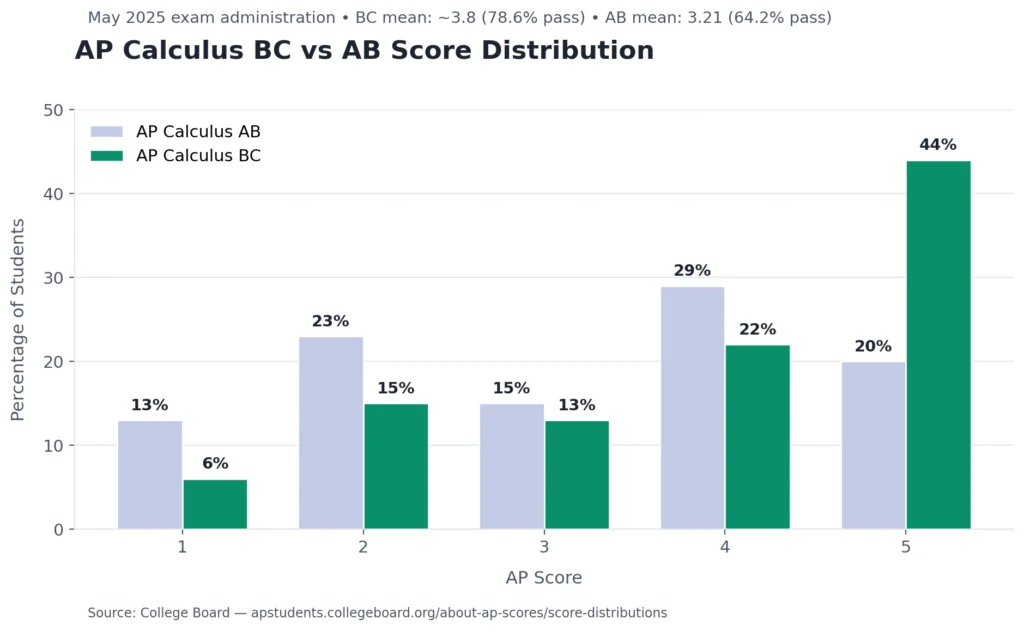
AP Calc BC Score Breakdown: What Each Score Means
| AP Score | College Board Label | What It Usually Means for College |
|---|---|---|
| 5 | Extremely well qualified | Equivalent to an A in college Calculus I & II; typically places directly into Calculus III at most schools |
| 4 | Well qualified | Equivalent to A-/B/B+; usually earns full BC credit, sometimes placement-only at the most selective schools |
| 3 | Qualified | Equivalent to B-/C+/C; often earns Calculus I credit or placement, sometimes not full BC credit |
| 2 | Possibly qualified | Rarely credit-eligible; the separate AB subscore may still help with Calculus I placement |
| 1 | No recommendation | No credit; typically requires retaking the exam or starting from Calculus I in college |
Because the AB subscore is calculated independently, a student who scores a 2 or 3 on the full BC exam can still walk away with a usable AB subscore for introductory placement purposes.
BC vs AB: Score Goal Calculator
If you're deciding between the two exams, or trying to set a realistic target score, the comparison below uses each exam's own official 2025 data:
| AP Score | College Board Label | What It Usually Means for College |
|---|---|---|
| 5 | Extremely well qualified | Equivalent to an A in college Calculus I & II; typically places directly into Calculus III at most schools |
| 4 | Well qualified | Equivalent to A-/B/B+; usually earns full BC credit, sometimes placement-only at the most selective schools |
| 3 | Qualified | Equivalent to B-/C+/C; often earns Calculus I credit or placement, sometimes not full BC credit |
| 2 | Possibly qualified | Rarely credit-eligible; the separate AB subscore may still help with Calculus I placement |
| 1 | No recommendation | No credit; typically requires retaking the exam or starting from Calculus I in college |
A useful way to set your BC score goal: since roughly 60% of the BC exam is AB-scope content, run your current AB-level practice accuracy through our AP Calculus AB score calculator first. A strong projected AB score is a reliable floor for your BC AB subscore — from there, your BC-only unit practice (series, parametric, polar, vectors) determines how much higher your full BC composite climbs.
AP Calculus BC College Credit Policy
If you're deciding between the two exams, or trying to set a realistic target score, the comparison below uses each exam's own official 2025 data:
| AP Score | College Board Label | What It Usually Means for College |
|---|---|---|
| 5 | Extremely well qualified | Equivalent to an A in college Calculus I & II; typically places directly into Calculus III at most schools |
| 4 | Well qualified | Equivalent to A-/B/B+; usually earns full BC credit, sometimes placement-only at the most selective schools |
| 3 | Qualified | Equivalent to B-/C+/C; often earns Calculus I credit or placement, sometimes not full BC credit |
| 2 | Possibly qualified | Rarely credit-eligible; the separate AB subscore may still help with Calculus I placement |
| 1 | No recommendation | No credit; typically requires retaking the exam or starting from Calculus I in college |
Because BC credit policies vary so widely — and some schools treat the AB subscore differently from the full BC score — always confirm your target college's exact rule through the College Board's own AP Credit Policy Search tool before assuming your AP Calculus BC score calculator result will translate directly into credit.
AP Score Calculators: Know Where You Stand for 2027
With the College Board's confirmed May 2027 format update — 42 MCQs in 100 minutes instead of 45 in 105 — students prepping now are studying for content that carries forward unchanged into a slightly shorter multiple-choice section. An AP Calculus BC score calculator lets you check where your current practice performance stands under both the current and upcoming timing, since the weighting and content pool aren't changing, only the question count and pacing.
Why do You Need an AP Score Calculator?
The College Board never publishes an exact raw-to-composite conversion table before exam day, so most students are left guessing what a graded practice exam actually means. An AP Calculus BC score calculator removes that guesswork by applying the same weighting formula the real exam uses, instantly, every time you finish a practice set — instead of you re-deriving the 1.2-multiplier math by hand.
How These Calculators Actually Work
Every reliable AP Calculus BC score calculator follows the same three inputs and math:
- MCQ raw score — correct answers out of 45, scaled by 1.2 to a 54-point maximum.
- FRQ raw score — the sum of all six 0–9 rubric scores, already maxing at 54 points.
- Composite mapping — the 0–108 composite is compared against a curve estimate built from recently released official scoring worksheets and score distributions, producing a projected 1–5 AP score (plus, for BC, a separate AB subscore estimate based on the AB-scope portion of your answers).
The Smart Way to Prep for AP Exams in 2027
Since course content isn't changing for 2027, only the multiple-choice question count and timing, the highest-leverage prep strategy stays the same regardless of which exam year you're sitting for:
- Start with a full-length diagnostic to identify your weakest units before building a study plan around strengths you already have.
- Weight your study time by exam weighting, not by personal interest — series and parametric/polar content is BC-only but still a large share of the exam, so it can't be an afterthought.
- Grade every practice FRQ against the official rubric not just your final answer, since most points come from labeled steps and justification language.
- Re-run your AP Calculus BC score calculator estimate every few weeks to confirm your improvement is showing up in both the MCQ and FRQ components, not just one.
Further Preparation and Things to Remember for the Exam
- Bring an approved calculator plus fresh batteries — Desmos and other apps are never permitted on the real exam, only for practice on AP Classroom or Khan Academy.
- Review the official Mathematical Practices the exam assesses, not just content, since FRQ rubrics reward specific reasoning language as much as correct numbers.
- Work several years of released FRQs under timed conditions, available with full scoring guidelines on AP Central's past exam questions page.
- Don't neglect Part A (no-calculator) pacing — it's the section where students most often run out of time relative to Part B.
Why Should I Use This AP® Calculus BC Score Calculator?
Because exact composite-to-AP-score cutoffs aren't published in advance, this AP Calculus BC score calculator is built from the most recently released official scoring worksheets and cross-referenced against several years of published national score distributions, rather than a rough guess — and it accounts for the separate AB subscore that other calculators often skip.
Instead of manually running the 1.2-multiplier formula every time you finish a practice set, you get an instant, section-by-section estimate of both your full BC score and your AB subscore, so you know exactly where your remaining study time will move the needle most. If you're deciding between exams or taking both, our AP Calculus AB score calculator and AP Computer Science A score calculator use the same underlying methodology.
Real Questions Students Ask About AP Scoring
Mathaversity's More Tools
Retirement Calculator
Plan your financial future and estimate your retirement savings easily.
Open CalculatorFinal Grade Calculator
Calculate the grade you need on your final exam to reach your target course grade.
Open Calculator