- Call now to book a trial session!
- +18787865635

Retirnment Calculator | Updated for 2026
How much do you need to retire?
📊 Retirement Analysis
How can you save for retirement?
🏦 Savings Plan
How much can you withdraw after retirement?
💰 Withdrawal Analysis
How long can your money last?
📅 Longevity Analysis
Important Notes:
- • These calculations are estimates and should not be considered financial advice
- • Actual returns may vary based on market conditions
- • Consider consulting with a financial advisor
- • Tax implications are not included
Retirement Calculator 2026: Free & Simple Way to Find Your Retirement Number
How much do you actually need saved to retire comfortably? This retirement calculator guide walks through everything that goes into that number — savings benchmarks by age, inflation, Social Security, pensions, 401(k)s, IRAs, and the withdrawal math that turns a lump sum into decades of income — so you can use the calculator above with real context instead of guessing.
What Is Retirement?
Retirement is the point at which you stop relying on a paycheck from work and start living off income you've built in advance — savings, investments, pensions, and Social Security. It isn't a single fixed age; it's a financial milestone you reach whenever your income sources can reliably cover your expenses without a job, and it's exactly what a retirement calculator is designed to help you pinpoint.
That's exactly what a retirement calculator is built to answer: not "how old will I be," but "do I have enough, and when will I have enough." Everything below feeds directly into that calculation.
How Does a Retirement Calculator Work?
A retirement calculator projects your current savings and future contributions forward, using an assumed rate of return and inflation rate, until it estimates how much you'll have at your target retirement age. It then compares that projected balance against your expected annual expenses to tell you whether you're on track.
Where r is your expected annual rate of return and n is the number of years until retirement. A good retirement calculator also adjusts that future dollar figure back into today's purchasing power, since a $2 million balance in 30 years won't buy what $2 million buys today.
How Much to Save for Retirement
A widely used industry rule of thumb is to save enough to replace 70–80% of your pre-retirement income each year, since certain costs (commuting, payroll taxes, retirement contributions themselves) disappear once you stop working.
From there, most financial guidance points to a savings rate rather than a single dollar figure:
- Save 15% of your gross income toward retirement each year, including any employer match, starting as early as possible.
- Aim for roughly 10–11x your final salary saved by age 67, per Fidelity's and T. Rowe Price's commonly cited benchmarks.
- Use the 4% rule as a target-balance shortcut — multiply your desired annual retirement income by 25 to estimate the total nest egg you'd need.
Run your own numbers through the retirement calculator above rather than relying on a generic percentage; your actual target depends heavily on your expected Social Security benefit, any pension, and how many years you expect retirement to last.
Retirement Savings Benchmarks by Age
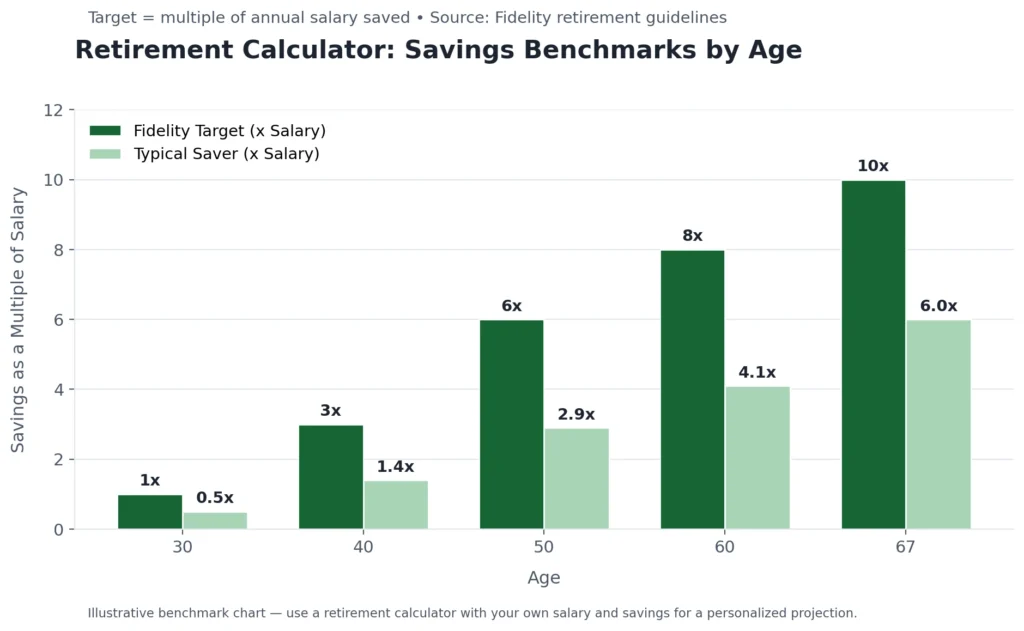
Fidelity's widely cited salary-multiplier framework gives a rough checkpoint for whether you're on pace:
| Age | Savings Target |
|---|---|
| 30 | 1x annual salary |
| 40 | 3x annual salary |
| 50 | 6x annual salary |
| 60 | 8x annual salary |
| 67 | 10x annual salary |
Plug your own age and salary into the retirement calculator above to see how you compare to these targets today. Real-world balances usually fall short of these targets, and that's normal. According to Vanguard's How America Saves 2026 report, the average 401(k) balance across 4.6 million accounts was $167,970 at the end of 2025 — but the median was only $44,115. Because a small number of very large accounts pull the average sharply upward, the median is the more realistic number to compare yourself against.
The Impact of Inflation on Retirement Savings
A retirement calculator that ignores inflation will overstate how far your savings actually go. Inflation is the single most underestimated variable in retirement planning, because it works against you twice: it erodes the purchasing power of money you've already saved, and it raises the cost of everything you'll need to buy for the next 20–30 years of retirement.
At a typical long-run inflation rate of 3% per year, prices roughly double every 24 years. That means a retirement budget of $60,000 a year today would need to be closer to $120,000 a year in nominal terms by the time someone retiring today reaches their mid-80s.
This is why every serious retirement calculator runs its projections in two layers: growing your savings at your expected investment return, then discounting the result by inflation so the final number reflects real, spendable purchasing power — not just a large-looking figure in future dollars.
The 4% Rule and Safe Withdrawal Rates
The 4% rule is a widely used starting point for how much you can withdraw from savings each year without running out of money over a roughly 30-year retirement. It works by withdrawing 4% of your portfolio in year one, then adjusting that dollar amount for inflation every year after.
For example, a $1,000,000 portfolio following the 4% rule produces approximately $40,000 in the first year of withdrawals. Combined with an average Social Security retirement benefit of roughly $2,064 a month ($24,774 a year) as of the 2026 COLA, that's a combined income near $64,700 a year — without touching the principal aggressively.
The 4% rule is a helpful planning shortcut, not a guarantee; actual safe withdrawal rates shift based on market returns early in retirement, how long you live, and how flexible your spending can be in a down year.
Common Sources of Retirement Funds
Most retirees don't rely on a single source of income. A typical retirement budget draws from some combination of:
- Employer-sponsored retirement plans — 401(k), 403(b), 457(b), or a Thrift Savings Plan.
- Individual Retirement Accounts (IRAs) — Traditional or Roth, opened independently of an employer.
- Pensions — a defined-benefit plan that pays guaranteed income, increasingly rare outside government and union jobs.
- Social Security — a federal benefit based on your lifetime earnings history.
- Taxable brokerage accounts and savings — money outside tax-advantaged retirement accounts, often used for early-retirement bridge income.
- Real estate and other assets — rental income, home equity, or a business sale.
A reliable retirement calculator should let you account for each of these separately, since they're taxed differently and become available at different ages.
Pensions, 401(k)s, IRAs, and Other Savings Plans
These are the core building blocks most people plug into a retirement calculator, and each works differently:
| Account Type | How It Works | Tax Treatment |
|---|---|---|
| Traditional 401(k)/403(b) | Employer-sponsored; often includes a matching contribution | Pre-tax contributions; taxed on withdrawal |
| Roth 401(k) | Employer-sponsored, after-tax version | After-tax contributions; qualified withdrawals are tax-free |
| Traditional IRA | Opened independently at a brokerage | Contributions may be tax-deductible; taxed on withdrawal |
| Roth IRA | Opened independently at a brokerage | After-tax contributions; qualified withdrawals are tax-free |
| Pension (Defined Benefit) | Employer guarantees a fixed monthly payout based on salary and years of service | Payouts are generally taxed as ordinary income |
| SEP IRA / SIMPLE IRA | Designed for self-employed workers and small businesses | Pre-tax contributions; taxed on withdrawal |
An employer 401(k) match is effectively free money and should almost always be captured in full before contributing elsewhere — it's the highest guaranteed "return" available in most retirement plans, and this retirement calculator lets you factor it in as part of your total contribution rate.
2026 Contribution Limits for Retirement Accounts
The IRS adjusts contribution limits annually for inflation. Here's what applies for 2026:
| Account | Standard Limit | Catch-Up (Age 50+) | Total (50+) |
|---|---|---|---|
| 401(k) / 403(b) / 457(b) | $24,500 | +$8,000 | $32,500 |
| 401(k), ages 60–63 (super catch-up) | $24,500 | +$11,250 | $35,750 |
| Traditional or Roth IRA | $7,500 | +$1,100 | $8,600 |
| SIMPLE IRA | $18,100 | +$4,000 (+$5,250 ages 60–63) | Up to $23,350 |
One notable 2026 change: under SECURE 2.0, employees who earned more than $150,000 in FICA wages the prior year must now make any age-based catch-up contributions on a Roth (after-tax) basis rather than pre-tax, if their plan offers Roth catch-up contributions.
Other Sources of Retirement Income
Beyond tax-advantaged accounts and Social Security, several other income streams commonly show up in a complete retirement plan:
- Part-time or consulting work in early retirement, often used to delay drawing down savings.
- Rental property income, which can provide inflation-adjusted cash flow since rents tend to rise with the cost of living.
- Annuities, which convert a lump sum into guaranteed periodic payments, trading flexibility for predictability.
- Health Savings Account (HSA) funds, which after age 65 can be withdrawn for any purpose (taxed as income if non-medical) without the usual HSA penalty.
- Inheritance or downsizing proceeds, such as selling a larger home and investing the difference.
A thorough retirement calculator should let you layer each of these income sources on top of your core savings projection, since combining several partial income streams is how most real retirement budgets actually work.
Social Security: When and How to Claim
Social Security benefits are calculated from your 35 highest-earning working years, and the age you claim has a major impact on your monthly check. You can claim as early as 62, at your full retirement age (66–67 depending on birth year), or as late as 70.
| Claiming Age | Effect on Monthly Benefit |
|---|---|
| 62 (earliest) | Reduced by up to 30% compared to full retirement age |
| 66–67 (full retirement age) | 100% of your calculated benefit |
| 70 (latest) | Increased by roughly 8% per year of delay past full retirement age |
Following the 2026 cost-of-living adjustment, the average monthly benefit for a retired worker rose by about $56 to approximately $2,064, or about $24,774 a year. Include your own estimated benefit — available on the Social Security Administration's my Social Security account portal — as a fixed income floor when using a retirement calculator, since it's one of the few genuinely inflation-protected income sources most retirees have.
When Can You Retire? Understanding Retirement Age
There's no single "correct" retirement age — it's the age at which your projected income sources can sustainably cover your expenses. A few reference points matter for planning:
| Age | Milestone & Impact |
|---|---|
| 59½ | Earliest penalty-free withdrawal age for most retirement accounts (avoids the 10% early-withdrawal penalty). |
| 62 | Earliest eligibility for Social Security retirement benefits, though monthly payouts are permanently reduced. |
| 65 | Medicare eligibility begins; critical for healthcare planning if retiring prior to employer coverage ending. |
| 66–67 | Full retirement age (FRA) for Social Security, depending on your year of birth. |
| 73 | Required Minimum Distributions (RMDs) must generally begin for tax-deferred traditional accounts (rises to 75 for individuals born 1960 or later). |
This retirement calculator lets you test multiple target ages side by side, since retiring even two or three years earlier or later can change your required savings by a meaningful margin.
Catching Up If You're Behind on Retirement Savings
If your retirement calculator results come back below where you'd like to be, a few levers tend to move the needle fastest:
- Max out catch-up contributions if you're 50 or older — an extra $8,000 in a 401(k) or $1,100 in an IRA for 2026, or up to $11,250 if you're between 60 and 63.
- Increase your savings rate gradually, such as directing half of every future raise toward retirement accounts instead of lifestyle spending.
- Delay claiming Social Security if possible — each year of delay past full retirement age (up to 70) adds roughly 8% to your monthly benefit for life.
- Consider working 1–3 additional years, which shortens the number of retirement years you need to fund and gives your existing savings more time to grow.
- Review investment allocation to confirm it still matches your actual time horizon, since being too conservative too early is a common, quiet source of underperformance.
This retirement calculator lets you test multiple target ages side by side, since retiring even two or three years earlier or later can change your required savings by a meaningful margin.
Common Retirement Planning Mistakes to Avoid
| Pitfall | Key Risk & Financial Impact |
|---|---|
| Ignoring Inflation | Planning around current costs without adjusting forward erodes real purchasing power over a multi-decade horizon. |
| Missing Employer Match | Contributing less than the full match threshold leaves free employer dollars and guaranteed immediate returns on the table. |
| Underestimating Longevity | Designing a plan capped at a 20-year horizon risks running short, given the significant probability of living past age 90. |
| Relying on Average Balances | Benchmarking against mean savings figures skews perception upward due to high net worth outliers, unlike more realistic median metrics. |
| Early Social Security Claiming | Defaulting to age 62 claims locks in permanently reduced monthly payments compared to the increased lifetime value of waiting. |
| Omitting Healthcare Expenses | Excluding medical and long-term care inflation creates a major budgetary shortfall during early and late retirement stages. |
How to Use This Retirement Calculator
Getting a projection takes just a few inputs:
- Current age and target retirement age — sets the number of years your savings have to grow.
- Current retirement savings balance — across all 401(k), IRA, and other retirement accounts combined.
- Monthly or annual contribution amount — including any employer match.
- Expected rate of return and inflation rate — defaults are provided, but you can adjust either to run more conservative or optimistic scenarios.
- Estimated Social Security and/or pension income — to see your full income picture, not just your savings balance alone.
Why You Should Use This Retirement Calculator
Getting a projection takes just a few inputs: Generic advice like "save 15% of your income" is a reasonable starting point, but it doesn't account for your actual Social Security estimate, your current balance, your target retirement age, or how inflation will erode your specific spending plan over the decades ahead.
Getting a projection takes just a few inputs: This retirement calculator runs the same present-value and compound-growth math used throughout this guide, using 2026 IRS contribution limits and the current Social Security COLA, so the number you see reflects your real situation rather than a one-size-fits-all rule of thumb. Revisit it every year or after any major income change to keep your plan current.
Frequently Asked Questions
Mathaversity's More Tools
Retirement Calculator
Plan your financial future and estimate your retirement savings easily.
Open CalculatorFinal Grade Calculator
Calculate the grade you need on your final exam to reach your target course grade.
Open Calculator