AP Computer Science A Calculator | 2026
AP® Computer Science A Score Calculator
Predict your 2026 AP CSA exam results instantly
Multiple Choice
Free Response Questions
Score Breakdown
Predicted AP® Score
Estimated Grade
Enter your raw scores to see your prediction.
AP Computer Science A Score Calculator 2026: Your Free & Instant Score Predictor
Not sure what your practice multiple-choice and free-response points actually add up to on the 1–5 AP scale? This AP Computer Science A score calculator guide walks through exactly how the exam is structured, how the composite score is built, and how that composite maps onto your final AP score.
Whether you're plugging numbers into the AP Computer Science A score calculator above for the first time or double-checking a practice exam you just graded, everything below matches how that tool estimates your result.
What Is AP Computer Science A?
AP Computer Science A (AP CSA) is the College Board's introductory, college-level programming course taught entirely in Java. It's built around three big ideas — Modularity, Variables, and Control — and covers everything from primitive data types and Boolean logic through arrays, ArrayLists, writing your own classes, 2D arrays, and recursion.
It's often confused with AP Computer Science Principles (AP CSP), but the two courses test very different skills. AP CSA is about writing and tracing real Java code under time pressure; AP CSP is a broader, language-agnostic look at computing concepts, the internet, data, and the societal impact of computing. If you're deciding between the two, or taking both, jump to the AP Computer Science Principles score calculator section below.
Every AP CSA student sits the same end-of-course exam in May, and this AP Computer Science A score calculator is built to mirror exactly how that exam converts your answers into a final 1–5 score.
How Is the AP Computer Science A Exam Structured?
The AP Computer Science A exam runs 3 hours and is delivered fully digitally through the College Board's Bluebook testing app. It's split into two sections of equal length but unequal weight.
| Section | Format | Time | Weight |
|---|---|---|---|
| I — Multiple Choice | 40 questions | 90 minutes | 55% of score |
| II — Free Response | 4 questions, 9 points each (36 raw points) | 90 minutes | 45% of score |
| Total | 44 scored questions | 3 hours | 100% |
Section I mixes standalone multiple-choice questions with occasional two-question sets built around the same code snippet. You'll be asked to trace code, predict output, spot errors, and reason about class behavior — no calculator is permitted anywhere on the exam.
Section II's four free-response questions always appear in the same order: Methods and Control Structures, a full Class write-up, an ArrayList question, and a 2D Array question. A student who types working Java for all four still needs strong Section I accuracy, since multiple choice carries the larger share of the composite.
How Is the AP Computer Science A Exam Scored?
Every result this AP Computer Science A score calculator produces follows the same three-step process the College Board uses on exam day:
- Step 1 — Raw Score: each correct MCQ adds 1 raw point (out of 40); each FRQ is graded 0–9 by trained AP Readers using a published rubric (36 raw points across all four).
- Step 2 — Composite Score: both raw scores are scaled to a shared 100-point composite using their official weights.
- Step 3 — AP Score: the composite is mapped to the familiar 1–5 AP scale using that year's conversion table.
There's no penalty for a wrong multiple-choice answer, so every blank bubble is a guaranteed zero while a wrong guess costs nothing extra — always fill in every MCQ. On the free-response side, partial credit is generous: each FRQ's 9 points are spread across sub-parts, so an incomplete but logically correct method can still earn most of its points.
AP Computer Science A College Credit Policy
Most colleges award credit, advanced placement, or both for a qualifying AP CSA score, but the exact cutoff varies by school and sometimes by major.
| AP Score | College Board Label | Typical Credit Outcome |
|---|---|---|
| 5 | Extremely well qualified | Credit and placement at nearly every school that grants CS credit |
| 4 | Well qualified | Credit at most schools; required minimum for many selective CS programs |
| 3 | Qualified | Credit at many state and public universities; often the minimum bar |
| 2 | Possibly qualified | Rarely earns credit, though a small number of schools still award it |
| 1 | No recommendation | No credit |
A 3 is the generally accepted "passing" score, but competitive computer science departments frequently set their own bar at a 4 or 5 before waiving an intro programming requirement. Because policies differ so widely, always confirm your target school's exact rule through the College Board's own AP Credit Policy Search tool before assuming your AP Computer Science A score calculator result will translate into credit.
How Exactly Is the Calculator Helpful to Students?
The College Board doesn't publish an exact raw-to-composite conversion table before exam day, so most students are left guessing what their practice answers actually mean. This AP Computer Science A score calculator removes that guesswork.
Instead of manually working through the weighting formula every time you finish a practice set, you enter your MCQ correct count and your estimated FRQ points, and get an instant projected AP score — plus a section-by-section view of whether your next study hours are better spent on multiple choice speed or free-response partial credit.
AP Computer Science Principles Score Calculator
If you're also enrolled in (or considering) AP Computer Science Principles, don't run its results through this AP CSA tool — the two exams score completely differently. AP CSP's end-of-course exam is 70 multiple-choice questions worth 70% of the score, paired with two written-response questions tied to your Create performance task for the remaining 30%. There's no Java code-writing section at all.
Use our dedicated AP Computer Science Principles score calculator for that exam, and come back here for anything involving Java, FRQs, or the AP CSA composite.
Why Are AP® Computer Science A Scores Curved?
Strictly speaking, AP CSA isn't graded on a curve against other students in the room with you. It goes through a process called equating, which adjusts each year's raw-to-composite conversion so that a given AP score always represents the same level of college-level readiness, regardless of whether that particular test form happened to run slightly harder or easier than the year before.
That's also why this AP Computer Science A score calculator, and every other one online, can only ever produce an estimate. The exact cutoffs move a few composite points from year to year based on how the full national cohort performs, and the College Board doesn't publish that final table until scores are released in July.
Score Distribution 2025 & 2026
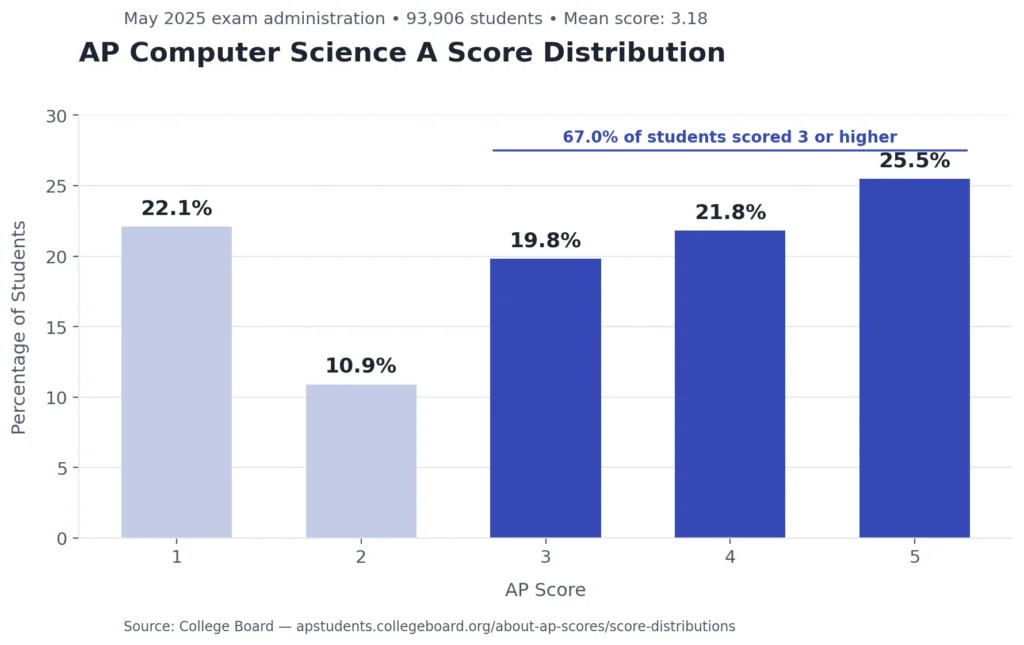
The most recently released official AP Computer Science A score distribution, from the May 2025 exam administration, covered 93,906 students:
| AP Score | % of Students |
|---|---|
| 5 | 25.5% |
| 4 | 21.8% |
| 3 | 19.8% |
| 2 | 10.9% |
| 1 | 22.1% |
That works out to a 67.0% pass rate (3 or higher) and a mean score of 3.18 — both slightly above the all-AP-subject averages, which tracks with AP CSA's self-selected, math-leaning student pool.
Notice the shape of that table: AP CSA is unusually bimodal, with a large cluster at 5 and a nearly equal-sized cluster at 1. Relatively few students land in the narrow 2–3 middle band compared to other AP subjects, which is exactly why closing even a small point gap in your practice scores can move you a full AP score band.
The 2026 AP CSA Exam: What Changed?
The 2025–26 school year brought the biggest AP Computer Science A course revision in years, first sat by students on the May 2026 exam. Here's what's actually different:
- Fully digital testing. AP CSA now runs entirely in the Bluebook app rather than on paper, with FRQ responses typed directly into a built-in code editor.
- Units consolidated from 10 to 4. The old ten-unit structure was streamlined into four larger, integrated units to reduce fragmentation and give teachers more time on core skills.
- Inheritance and polymorphism removed. The former Unit 9 on inheritance is no longer part of the required curriculum, aligning AP CSA more closely with how intro college programming courses are actually sequenced.
- Text files and data sets added. Students now work with Java's File and Scanner classes to read and process real data, a practical skill that wasn't previously tested.
- FRQ 3 narrowed to ArrayList only. The Array/ArrayList free-response question now focuses exclusively on ArrayList operations rather than mixing in raw-array manipulation.
The overall exam skeleton — 40 MCQs plus 4 FRQs across 3 hours, weighted 55/45 — hasn't changed. What changed is the content pool feeding those questions, which is exactly what this AP Computer Science A score calculator's projections have been recalibrated to reflect.
The 2026 AP Computer Science A Scoring Logic & Exam Format
Because the underlying exam skeleton stayed intact through the 2025–26 revision, the scoring logic behind this AP Computer Science A score calculator carries forward unchanged from prior years:
| Component | Raw Points | Scaled Weight |
|---|---|---|
| Section I — Multiple Choice | 0–40 | 55 composite points |
| FRQ 1 — Methods & Control Structures | 0–9 | 45 composite points (combined) |
| FRQ 2 — Class | 0–9 | |
| FRQ 3 — ArrayList | 0–9 | |
| FRQ 4 — 2D Array | 0–9 |
Run those numbers through the composite formula from earlier, and the 0–100 result gets mapped to your final 1–5 AP score. What actually shifted for 2026 is the content feeding both sections — more file and dataset questions, no inheritance-based MCQs, and an ArrayList-only FRQ 3 — not the arithmetic itself.
How Are You Projecting the Scoring Curve?
Because the College Board hasn't released an official raw-to-composite conversion table specific to the revised 2025–26 exam, this AP Computer Science A score calculator projects its curve from three inputs:
- The most recent officially released AP CSA scoring worksheet, which shows how a real past composite mapped to each AP score band.
- Five years of published score distributions (2020–2025), used to sanity-check where the 1/2/3/4/5 boundaries have historically fallen.
- The known content changes for 2025–26 — primarily the removal of inheritance from the MCQ pool — adjusted for conservatively, since removing a traditionally difficult topic tends to nudge raw scores up slightly.
What Is a Good AP® Computer Science A Score?
"Good" depends on your target school, but the national data gives a clear anchor point.
| Score | 2025 % of Students | What It Signals |
|---|---|---|
| 5 | 25.5% | Fluent, near error-free Java under time pressure; competitive everywhere |
| 4 | 21.8% | Strong command of core concepts with minor gaps; meets most selective-school bars |
| 3 | 19.8% | Solid working knowledge; the standard "qualified" passing score |
| 2 | 10.9% | Partial understanding; rarely credit-eligible |
| 1 | 22.1% | Limited demonstrated mastery of the course material |
A 4 or 5 is generally considered a strong outcome for AP CSA specifically, since the exam skews harder than the average AP subject and the 5 rate (25.5%) is actually higher than most other AP courses — a reflection of its self-selected, already CS-inclined test-taking pool.
What Is the Average AP® Computer Science A Score?
The most recent official mean AP Computer Science A score is 3.18 out of 5, based on the May 2025 administration. That's noticeably higher than the roughly 2.9–3.0 mean across all AP subjects combined.
Run your own practice numbers through the AP Computer Science A score calculator above to see exactly how your projected composite compares to that 3.18 national average, section by section.
How Should I Understand My AP® Computer Science A Score If I Don't Get a 3?
A 1 or 2 on AP CSA is not a reflection of your ability to eventually succeed in computer science — it's specific feedback about this one timed exam. A few things worth knowing if your projected or actual score lands below a 3:
Run your own practice numbers through the AP Computer Science A score calculator above to see exactly how your projected composite compares to that 3.18 national average, section by section.
How Should I Understand My AP® Computer Science A Score If I Don't Get a 3?
A 1 or 2 on AP CSA is not a reflection of your ability to eventually succeed in computer science — it's specific feedback about this one timed exam. A few things worth knowing if your projected or actual score lands below a 3:
- Scores below 3 don't appear on most college applications unless you choose to self-report them, and AP score reports can be sent selectively by exam.
- Many students below a 3 still pass the underlying course with a normal grade, since classroom grading and the AP exam are evaluated completely separately.
- Section-specific feedback matters more than the single digit. Use this AP Computer Science A score calculator's section breakdown to see whether MCQ accuracy or FRQ partial credit is the bigger gap, and target practice there specifically.
- Retaking the exam the following year is common and often produces a meaningfully higher score once inheritance-heavy anxiety (now removed from the curriculum) or FRQ syntax fluency has had another year to develop.
What Do Past AP CSA Free-Response Questions Look Like?
The four FRQ types repeat in the same order every year, just with new scenarios. Recent released exams have featured prompts like these:
| FRQ | Focus | Recent Example Theme | Points |
|---|---|---|---|
| FRQ 1 | Methods & Control Structures | Scheduling logic with time conflicts and accumulation | 7 |
| FRQ 2 | Class | A complete class with constructors, String handling, and methods | 7 |
| FRQ 3 | ArrayList | Pairing or filtering algorithm over a list of objects | 5 |
| FRQ 4 | 2D Array | Grid-based game logic with pair detection and state changes | 6 |
Official released free-response questions and their full scoring rubrics are published every year on AP Central's past exam questions page. Working through several years of these under real timed conditions is one of the highest-leverage ways to calibrate what your practice FRQ scores mean before you run them through this AP Computer Science A score calculator.
Why Should I Use This AP® Computer Science A Calculator?
Because the exact composite-to-AP-score cutoffs aren't published in advance, this AP Computer Science A score calculator is built from the most recent officially released scoring worksheet and cross-referenced against five years of published national score distributions, rather than a rough guess.
Instead of flipping through a static PDF conversion chart, you get an interactive, section-by-section estimate: exactly how many more MCQs you'd need right, or how many more FRQ points you'd need to earn, to move up an AP score band — so your remaining study time goes where it actually moves the needle.
Official released free-response questions and their full scoring rubrics are published every year on AP Central's past exam questions page. Working through several years of these under real timed conditions is one of the highest-leverage ways to calibrate what your practice FRQ scores mean before you run them through this AP Computer Science A score calculator.
AP Computer Science A Score Calculator: Frequently Asked Questions
Explore More Tools
Retirement Calculator
Plan your financial future and estimate your retirement savings easily.
Open CalculatorFinal Grade Calculator
Calculate the grade you need on your final exam to reach your target course grade.
Open Calculator