- Call now to book a trial session!
- +18787865635

Algebra 2 Workbook: Practice Problems, Answer Key & Step-by-Step Solutions
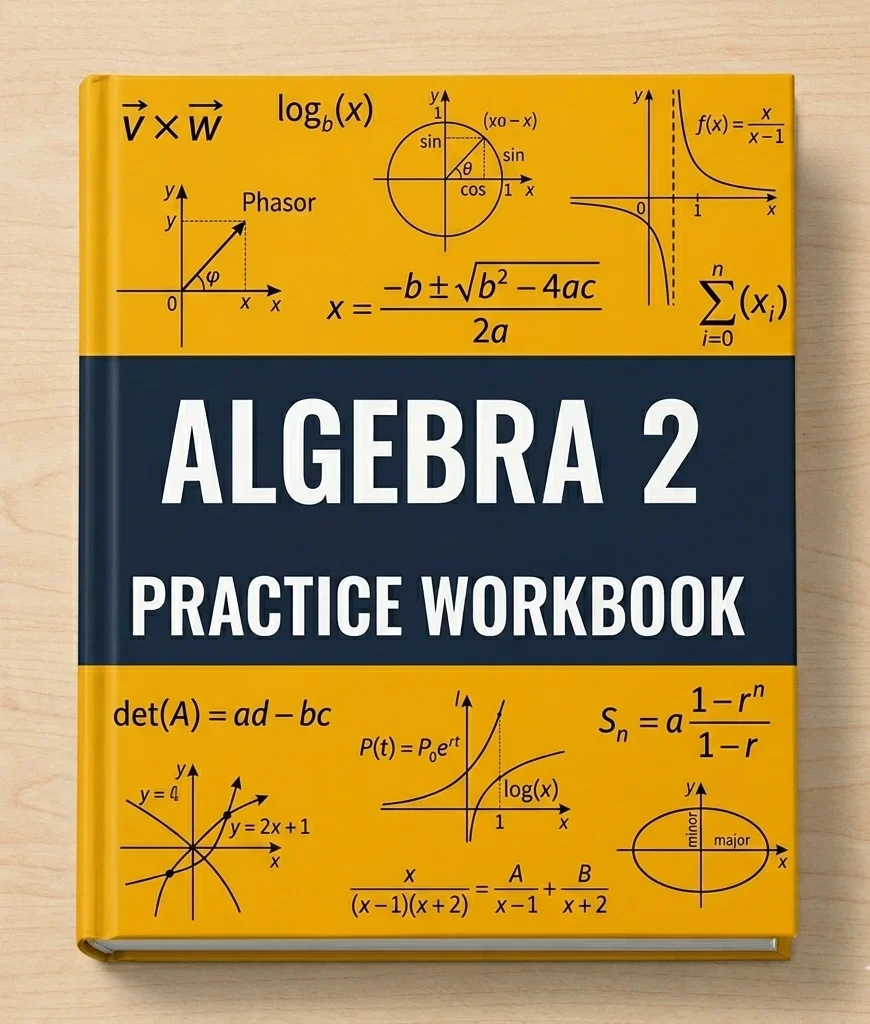
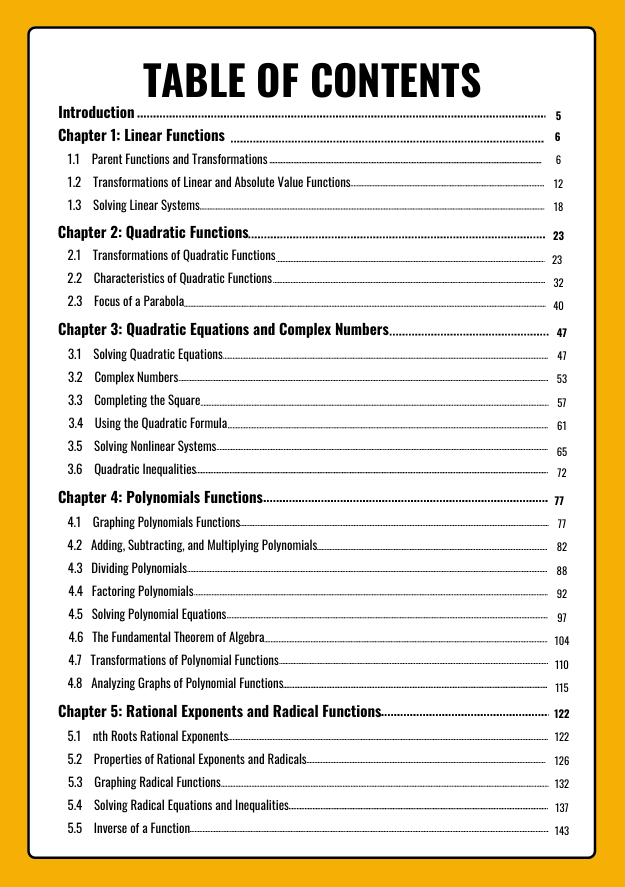
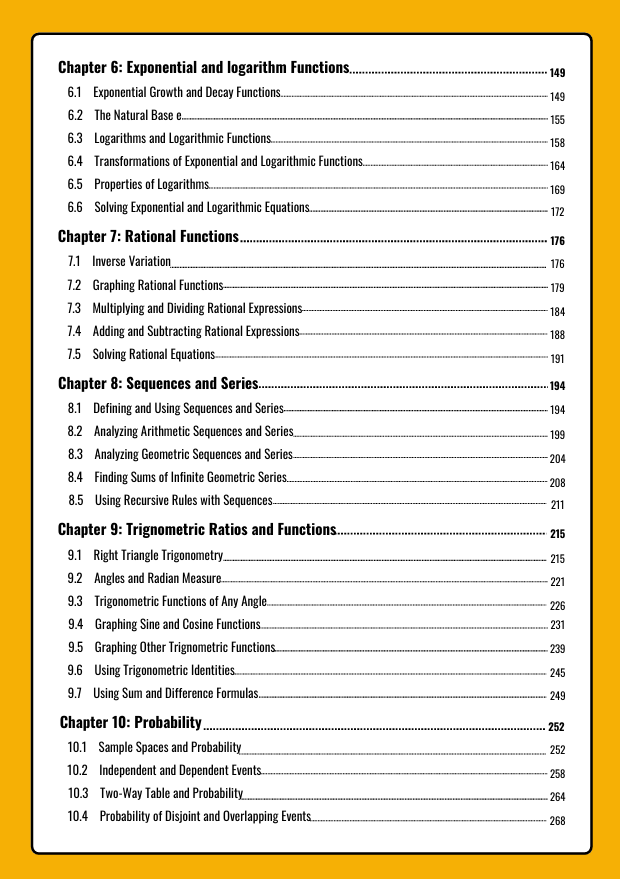
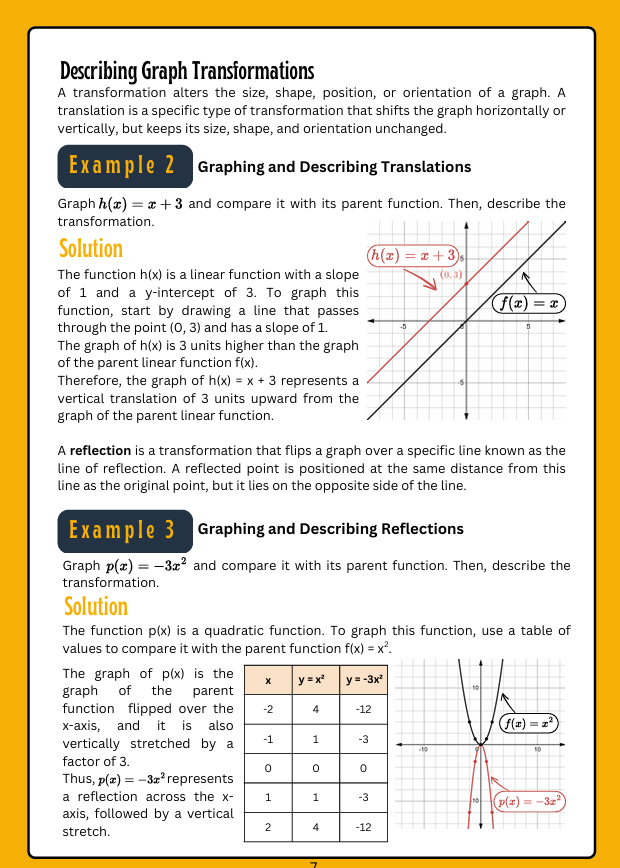
Algebra 2 Workbook: Practice Problems, Answer Key & Step-by-Step Solutions
$15.00 Original price was: $15.00.$9.00Current price is: $9.00.
Why Should You Choose This Algebra 2 Practice Workbook?
Algebra 2 is a critical step toward advanced mathematics and plays a key role in preparing students for college-level coursework and STEM-related studies. This workbook is thoughtfully designed to strengthen conceptual understanding and problem-solving skills through structured practice, making it suitable for independent learners as well as guided instruction by parents or teachers.What’s Included:
- Well-organized chapters covering the full Algebra 2 curriculum for a complete year of study.
- Extensive practice problems that progress from introductory concepts to more challenging applications.
- Clearly explained, worked examples to support learning and reinforce key ideas.
- Generous workspace for students to show steps and complete solutions.
- A clean, uncluttered layout optimized for both printed use and digital devices.
01
Solving Linear Equations
A strong understanding of linear equations is the foundation of success in Algebra 1. In this chapter, students learn how to solve equations step by step while developing critical algebraic reasoning skills. Beginning with simple one-step equations and progressing toward multi-step and absolute value equations, students gradually build confidence and mathematical fluency.
Topics Covered
- Solving Simple Equations
- Solving Multi-Step Equations
- Solving Equations with Variables on Both Sides
- Solving Absolute Value Equations
Students Will Learn To:
- Isolate variables confidently
- Simplify algebraic expressions correctly
- Develop strong problem-solving strategies
- Build a solid algebra foundation for future chapters
02
Solving Linear Inequalities
This chapter helps students understand how inequalities work and how they differ from equations. Students learn how to solve, graph, and interpret inequalities using clear step-by-step methods and visual models.
Special focus is given to graphing solution sets, compound inequalities, and absolute value inequalities so students can fully understand the meaning behind algebraic solutions rather than simply memorizing procedures. Real-world applications help students connect inequalities to practical situations.
Topics Covered
- Writing and Graphing Inequalities
- Solving Inequalities Using Addition or Subtraction
- Solving Inequalities Using Multiplication or Division
- Solving Multi-Step Inequalities
- Solving Compound Inequalities
- Solving Absolute Value Inequalities
Students Will Learn To:
- Graph inequalities accurately
- Interpret solution sets visually
- Solve compound and absolute value inequalities
- Understand inequality rules involving negative numbers
- Apply inequalities to real-life problems
03
Graphing Linear Functions
Graphing is one of the most important skills in Algebra 1, and this chapter helps students develop a deep understanding of linear relationships. Students learn how equations, tables, graphs, and functions are all connected.
The chapter introduces function notation, slope, graph transformations, and multiple graphing methods in a beginner-friendly way. Students gain confidence reading and interpreting graphs while developing visual problem-solving skills that are essential for higher mathematics.
Topics Covered
- Functions
- Linear Functions
- Function Notation
- Graphing Linear Equations in Standard Form
- Graphing Linear Equations in Slope-Intercept Form
- Transformations of Linear Functions
- Graphing Absolute Value Functions
Students Will Learn To:
- Interpret and analyze graphs
- Understand slope and rate of change
- Write and evaluate functions
- Connect equations with visual models
- Build graphing confidence step by step
04
Writing Linear Equations
This chapter teaches students how to create equations from graphs, points, slopes, and real-world data. Students develop mathematical modeling skills while learning how linear equations describe relationships in everyday situations.
With guided instruction and practical examples, students learn how to identify patterns, analyze trends, and write equations using multiple forms.
Topics Covered
- Writing Equations in Slope-Intercept Form
- Writing Equations in Point-Slope Form
- Writing Equations of Parallel and Perpendicular Lines
- Scatter Plots and Lines of Fit
- Analyzing Lines of Fit
- Arithmetic Sequences
- Piecewise Functions
Students Will Learn To:
- Write equations from graphs and data
- Analyze linear relationships
- Identify trends using scatter plots
- Understand parallel and perpendicular slopes
- Apply algebra to real-world situations
05
Solving Systems of Linear Equations
Systems of equations help students solve problems involving multiple relationships at the same time. In this chapter, students learn graphing, substitution, and elimination methods through structured examples and targeted practice.
Students also explore systems of inequalities and graphical solution regions, helping them develop stronger analytical thinking and problem-solving abilities.
Topics Covered
- Solving Systems by Graphing
- Solving Systems by Substitution
- Solving Systems by Elimination
- Solving Special Systems
- Solving Equations by Graphing
- Graphing Linear Inequalities
- Systems of Linear Inequalities
Students Will Learn To:
- Solve systems using multiple methods
- Interpret intersections graphically
- Analyze solution regions
- Compare algebraic techniques
- Solve application-based problems confidently
06
Exponential Functions and Sequences
This chapter introduces students to exponential relationships, sequences, and recursive patterns commonly used in science, finance, and real-world modeling.
Students learn how exponential growth and decay behave differently from linear functions while strengthening exponent and radical skills through guided examples and challenging exercises.
Topics Covered
- Properties of Exponents
- Radical and Rational Exponents
- Exponential Functions
- Exponential Growth and Decay
- Solving Exponential Equations
- Geometric Sequences
- Recursively Defined Sequences
Students Will Learn To:
- Apply exponent rules correctly
- Model exponential growth and decay
- Analyze patterns in sequences
- Solve exponential equations
- Connect algebra to real-world applications
07
Polynomial Equations and Factoring
Factoring and polynomial operations are essential Algebra 1 skills, and this chapter helps students master them through detailed explanations and progressive practice.
Students learn how to simplify polynomial expressions, multiply polynomials efficiently, recognize algebraic patterns, and factor equations completely.
Topics Covered
- Adding and Subtracting Polynomials
- Special Products
- Solving Polynomial Equations
- Factoring Trinomials
- Factoring Special Products
- Factoring Completely
Students Will Learn To:
- Simplify polynomial expressions
- Recognize factoring patterns quickly
- Solve polynomial equations accurately
- Build strong algebraic manipulation skills
- Prepare for advanced algebra concepts
08
Graphing Quadratic Functions
Quadratic functions introduce students to parabolas and nonlinear relationships. This chapter teaches students how different equation forms affect graph shape, position, and direction.
Visual learning strategies and graph analysis exercises help students understand transformations and compare quadratic, linear, and exponential functions.
Topics Covered
- Graphing f(x)=ax^2
- Graphing f(x)=ax^2+c
- Graphing f(x)=ax^2+bx+c
- Graphing Vertex Form
- Using Intercept Form
- Comparing Different Function Types
Students Will Learn To:
- Graph quadratic functions confidently
- Identify vertices and intercepts
- Understand graph transformations
- Compare different function behaviors
- Analyze nonlinear relationships visually
09
Solving Quadratic Equations
Students explore multiple methods for solving quadratic equations while strengthening critical thinking and algebraic reasoning skills.
This chapter explains graphing methods, square roots, completing the square, and the quadratic formula in a simple and structured way so students can confidently solve challenging quadratic problems.
Topics Covered
- Properties of Radicals
- Solving Quadratics by Graphing
- Solving Using Square Roots
- Completing the Square
- Quadratic Formula
- Solving Nonlinear Systems
Students Will Learn To:
- Solve quadratic equations using multiple methods
- Understand when to apply each strategy
- Simplify radical expressions
- Analyze nonlinear systems
- Build confidence with advanced algebra concepts
10
Radical Functions and Equations
This chapter introduces square root and cube root functions through graphing, transformations, and equation solving activities.
Students also explore inverse functions and learn how radical functions behave visually and algebraically.
Topics Covered
- Graphing Square Root Functions
- Graphing Cube Root Functions
- Solving Radical Equations
- Inverse Functions
Students Will Learn To:
- Graph radical functions accurately
- Solve radical equations step by step
- Understand inverse relationships
- Analyze nonlinear function behavior
- Strengthen graphical reasoning skills
11
Data Analysis and Displays
Students develop essential statistics and data analysis skills through graphs, plots, distributions, and data interpretation activities.
This chapter helps students organize, analyze, and interpret information using mathematical reasoning and visual models commonly used in science, business, and research.
Topics Covered
- Measures of Center and Variation
- Box-and-Whisker Plots
- Shapes of Distributions
- Two-Way Tables
- Choosing a Data Display
Students Will Learn To:
- Interpret and analyze data sets
- Compare distributions visually
- Use statistical measures correctly
- Select appropriate graphs and displays
- Strengthen graphical reasoning skills
Why Students Love This Workbook
- Easy-to-understand explanations
- Structured lessons with guided practice
- Large variety of practice problems
- Excellent for self-study and tutoring
- Helps improve grades and test performance
- Ideal preparation for Algebra 2
- Builds confidence through consistent practice
Frequently Asked Questions
What is included in the Algebra 1 Practice Workbook?
The Algebra 1 Practice Workbook includes comprehensive lessons, worked examples, practice exercises, graphing activities, and review problems covering all major Algebra 1 topics. Students can strengthen their understanding of equations, inequalities, functions, systems of equations, quadratics, polynomials, radicals, and data analysis.
Are the solutions detailed enough for self-study?
Absolutely. We provide full logical breakdowns for all 400+ problems. We show every algebraic transformation so students can use this as a self-paced masterclass without needing a tutor present.
Is this workbook suitable for SAT or ACT preparation?
Yes. The problems are designed to build the high-level critical thinking and abstract reasoning required for standardized testing. It is an excellent resource for students aiming for top-tier scores in college entrance exams.
How can this workbook help students improve in Algebra 1?
The workbook provides targeted practice, detailed examples, and progressive exercises that help students master Algebra 1 concepts. Regular use can improve problem-solving skills, mathematical confidence, and overall academic performance.
Can I use this for O-Level or A-Level transition?
Yes. The logical scaffolding provided in this workbook bridges the gap between basic algebra and university-level mathematics, making it perfect for students in international curricula.

Reviews
There are no reviews yet.