ACT® Score Calculator 2026
Our Mission for Academic Excellence
ACT® Score Calculator
Predict your 2026 Enhanced ACT® results instantly
Composite Scaled Score
Average of English, Math & Reading · Scale: 1–36
ACT® Score Calculator: Everything You Need to Know About the 2026 Enhanced ACT®
Not sure what your raw section answers actually add up to on the ACT's 1–36 scale? This ACT score calculator guide covers exactly how the exam is structured, how scoring and equating work, and how to convert an older ACT score into its Enhanced-ACT equivalent.
Whether you're using the ACT score calculator above for the first time or converting a practice test taken before April 2025, everything below maps directly to how that tool computes your composite.
How Is the ACT Structured?
In April 2025, ACT, Inc. rolled out the Enhanced ACT — a shorter format with fewer questions per section, more time per question, and Science removed from the composite. This ACT score calculator is built around that current format.
Here's the section-by-section breakdown of the current Enhanced ACT:
| Section | Questions | Time | Counts Toward Composite? |
|---|---|---|---|
| English | 50 | 35 min | Yes |
| Math | 45 | 50 min | Yes |
| Reading | 36 | 40 min | Yes |
| Science (optional) | 40 | 40 min | No — reported separately |
| Writing (optional) | 1 essay | 40 min | No — reported separately |
| Core total | 131 | ~2 hr 5 min | — |
Each section is still scored independently on the familiar 1–36 scale. If you also sit the optional Science section, you'll receive a separate Science score plus a STEM score, which averages Math and Science.
How ACT Scoring Works
Every ACT score — and every result this ACT score calculator produces — comes from the same three-step process:
- Step 1 — Raw Score: each correct answer adds 1 point to your raw score for that section. Nothing is deducted for wrong or skipped answers.
- Step 2 — Scaled Score: your raw score is converted to a scaled score (1–36) using that section's scoring curve, which accounts for small difficulty differences between test forms.
- Step 3 — Composite Score: your composite is the average of your English, Math, and Reading scaled scores, rounded to the nearest whole number.
Composite Score = (English + Math + Reading) ÷ 3
Science, if you take it, is reported on its own 1–36 scale and does not factor into the composite. Two students who answer the same number of questions correctly can still land different scaled scores if they sat different test forms — that's the equating process working as intended, and it's exactly why this ACT score calculator's estimates carry a small margin either way.
What's Being Tested on Each ACT Section?
English (50 questions, 35 min)
Grammar, usage, punctuation, sentence structure, and rhetorical skills, evaluated through passage-based questions. Expect to identify errors, tighten sentences, and improve a passage's overall organization and style.
Math (45 questions, 50 min)
Pre-algebra, elementary algebra, intermediate algebra, coordinate geometry, plane geometry, trigonometry, and some statistics. Answer choices dropped from five to four under the Enhanced ACT, which slightly improves your guessing odds.
Reading (36 questions, 40 min)
Comprehension and analysis across four passage types: prose fiction, social science, humanities, and natural science. Each passage now carries 9 questions instead of 10, but you get more time per passage than before.
Science — Optional (40 questions, 40 min)
Not really a test of memorized science facts — it evaluates your ability to interpret data, read graphs and tables, and reason through experimental scenarios. Take it if your target schools weigh it or if you want the separate STEM score.
Why Should I Use This ACT Score Calculator?
Because the ACT doesn't publish one fixed raw-to-scale table — the exact curve shifts slightly from form to form — this ACT score calculator is built from officially released practice test curves and recent national scoring data rather than a guess.
Rather than flipping to the answer key at the back of a practice booklet, you get an interactive breakdown by section: exactly how many more questions you'd need right in Math versus Reading to move your composite, and where your time is best spent before test day.
What Is a Good ACT Score?
"Good" is relative to where you're applying, but the national data gives useful anchor points.
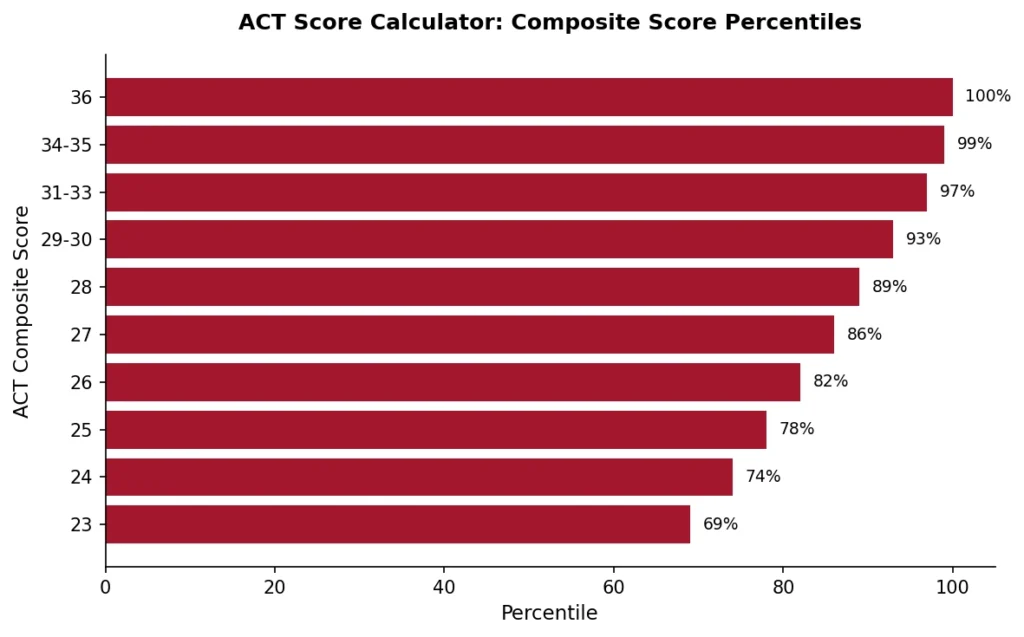
| Tier | Score | Percentile | Meaning |
|---|---|---|---|
| Average | 19–21 | National average | Meets minimum requirements for most colleges; not competitive at selective schools. |
| Above Average | 24+ | Top ~30% | Competitive for many universities; qualifies for merit scholarships at some schools. |
| Competitive | 28+ | Top ~10% | Competitive for most selective universities, especially paired with a strong GPA. |
| Elite | 33+ | Top ~3% | Common among admitted students at highly selective schools. |
| Composite | Percentile |
|---|---|
| 36 | 100% |
| 34–35 | 99% |
| 31–33 | 96–98% |
| 29–30 | 92–94% |
| 28 | 89% |
| 27 | 86% |
| 26 | 82% |
| 25 | 78% |
| 24 | 74% |
| 23 | 69% |
A 27 puts you in the 86th percentile, in line with averages at schools like Penn State and Syracuse. A 30 is within reach of several Ivy-adjacent schools (Penn, Dartmouth, Brown, Cornell) but usually falls short at Harvard, Yale, or Princeton without another standout element in the application. A 34–36 places you in the 99th–100th percentile, competitive at nearly any school in the country.
What Is the Average ACT Score?
Recent national norms put the typical ACT composite around 19–20, with section averages clustering close to that same range: English around 19–20, Math around 18–19, Reading around 20, and Science around 20.
Run your own numbers through the ACT score calculator above to see exactly how your raw answers compare to these national benchmarks section by section.
Because the tool uses ACT's official raw-to-scale conversion pattern rather than a simple straight-line average, it reflects the real, slightly curved relationship between raw and scaled scores — including the fact that a single extra correct answer near the top or bottom of a section's range can shift your scaled score more than a similar gain in the middle of the range.
Looking for Extra ACT Practice?
Once you know roughly where you stand from the ACT score calculator, targeted practice is what actually moves the number. A few reliable places to start:
- Full-length official ACT practice tests, taken under real timed conditions
- Section-specific drilling on your lowest-scoring area first, since gains there move your composite the most
- Timed passage sets for Reading and English to build pacing instincts
- A second full practice test 2–3 weeks before test day to confirm improvement and catch remaining pacing issues
ACT, Inc. also publishes free official practice tests in the current Enhanced ACT format. If you're also weighing the SAT, our SAT Score Calculator uses the same raw-to-scaled approach for that exam.
How Do You Figure Out Your ACT Superscore?
An ACT superscore takes your highest section scores across multiple test dates and averages them together, rather than using one single sitting's composite.
- Gather every ACT score report you have.
- For each section — English, Math, Reading (and Science, if applicable) — find your single highest scaled score across all sittings.
- Add those highest section scores together.
- Divide by 3 (Enhanced ACT, English/Math/Reading only) and round to the nearest whole number.
Why Is the ACT Exam Curved?
Technically, the ACT isn't curved relative to other test-takers on your specific date. It's adjusted through a process called equating, which scales scores across different test forms and dates so that a given scaled score always reflects the same level of ability, no matter which version of the test you happened to sit.
This is also why an ACT score calculator can show slightly different scaled scores for the same raw score depending on which practice test curve it's built from — the underlying difficulty of each form varies just enough to need equating in the first place. You can read ACT, Inc.'s own explanation of this process on the official ACT scoring page.
Raw Scores vs. Scale Scores: What's the Difference?
Your raw score is simply the number of questions you answered correctly in a section — nothing more. If you got 35 of 36 Reading questions right, your raw score is 35.
Your scale score is what that raw score becomes after running through the section's equating curve, expressed on the standard 1–36 scale. That same 35 out of 36 on Reading might translate to a scaled score of 32 or 33, depending on the specific test form's curve — which is exactly the conversion this ACT score calculator automates for you.
Converting Old ACT Scores to New ACT Scores
Since the Enhanced ACT cut the number of questions in English, Math, and Reading, an old raw score doesn't map onto the new format one-to-one. The tables below convert a pre-April-2025 raw score into its equivalent new-format raw score and scaled score, so you can compare an older practice test directly against this ACT score calculator's current scale.
ACT English: Old Raw Score to New Raw Score to Scaled Score Conversion
| Old Raw (Pre-2025) | New Raw (Post-2025) | Scaled Score |
|---|---|---|
| 72–75 | 48–50 | 36 |
| 65–71 | 43–47 | 31–35 |
| 56–64 | 37–42 | 25–30 |
| 45–55 | 30–36 | 19–24 |
| 33–44 | 22–29 | 14–18 |
| 20–32 | 13–21 | 10–13 |
| 9–19 | 6–12 | 6–9 |
| 0–8 | 0–5 | 1–5 |
This is a condensed view — the full point-by-point table runs from a raw score of 0 all the way to 75, with a corresponding scaled score for every increment.
ACT Math: Old Raw Score to New Raw Score to Scaled Score Conversion
| Old Raw (Pre-2025) | New Raw (Post-2025) | Scaled Score |
|---|---|---|
| 58–60 | 44–45 | 36 |
| 51–57 | 38–43 | 31–35 |
| 39–50 | 29–37 | 25–30 |
| 28–38 | 21–28 | 19–24 |
| 17–27 | 12–20 | 15–18 |
| 8–16 | 6–11 | 13–14 |
| 3–7 | 2–5 | 8–12 |
| 0–2 | 0–1 | 1–6 |
Note how much steeper the top of the Math curve is: missing just a couple of extra questions near the top raw scores can cost several scaled points.
ACT Reading: Old Raw Score to New Raw Score to Scaled Score Conversion
| Old Raw (Pre-2025) | New Raw (Post-2025) | Scaled Score |
|---|---|---|
| 38–40 | 34–36 | 36 |
| 33–37 | 30–33 | 31–35 |
| 28–32 | 25–29 | 25–30 |
| 18–27 | 16–24 | 19–24 |
| 13–17 | 12–15 | 14–18 |
| 8–12 | 7–11 | 11–13 |
| 3–7 | 3–6 | 6–10 |
| 0–2 | 0–2 | 1–4 |
Reading's curve moved the most of any section — both fewer questions and more time per passage, so its equating shifted more than English or Math did.
ACT Science: Old Raw Score to New Raw Score to Scaled Score Conversion
| Raw Score (Old = New) | Scaled Score |
|---|---|
| 36–40 | 34–36 |
| 31–35 | 28–33 |
| 25–30 | 23–26 |
| 17–24 | 17–22 |
| 10–16 | 13–16 |
| 5–9 | 8–12 |
| 0–4 | 1–7 |
Science didn't lose any questions in the Enhanced ACT redesign, so its raw-to-scaled curve is currently projected to stay the same as before — this will be revisited if ACT, Inc. releases updated Science norms based on who's opting into the now-optional section.
For ACTs Before 2025: Raw ACT Scores and Scaled ACT Scores
If you sat the ACT before April 2025, or you're working from an older-format practice test, use this table directly — no conversion needed.
| Scaled Score | English | Math | Reading | Science |
|---|---|---|---|---|
| 36 | 72–75 | 58–60 | 39–40 | 38–40 |
| 33 | 67 | 53 | 35–36 | 35 |
| 30 | 62–63 | 46–47 | 32 | 32 |
| 27 | 56–57 | 37–38 | 28 | 28–29 |
| 24 | 48–50 | 31–32 | 24–25 | 23–24 |
| 21 | 42–44 | 28–29 | 21–22 | 20–21 |
| 18 | 38–39 | 24–25 | 19 | 17–18 |
| 15 | 30–32 | 13–16 | 14–15 | 12 |
| 12 | 23–24 | 6–7 | 9–10 | 9 |
| 9 | 13–15 | — | 5 | 6 |
| 6 | 6 | — | — | — |
| 1 | 0–1 | 0 | 0 | 0 |
Under this legacy format, your composite was the average of all four section scores — English, Math, Reading, and Science — divided by 4, rather than the three-section average used by the Enhanced ACT today.
Test Strategy & Tips
Unlike computer-adaptive exams, the ACT is not adaptive — every test-taker on a given date receives the same fixed question set, so there's no benefit or penalty tied to how quickly you move through it.
- Pacing matters most. English now averages about 42 seconds per question, Math roughly 67 seconds, and Reading around 67 seconds per question — noticeably more breathing room than the legacy format.
- Guess freely. There's no penalty for wrong answers, so never leave a bubble blank — a random guess still has a 20–25% chance of landing correctly.
- Fewer questions means each one counts more. With English down from 75 to 50 questions, a single wrong answer now has a bigger impact on your scaled score than it did under the legacy format.
- Biggest score gains come from pacing and careless-error reduction not new content, for most students who've already covered the core material once.
- Practice under real timed conditions using official, current-format practice tests rather than older legacy-format ones, so your pacing instincts match what you'll actually face.
ACT Score Calculator: Frequently Asked Questions
Mathaversity's More Tools
Retirement Calculator
Plan your financial future and estimate your retirement savings easily.
Open CalculatorFinal Grade Calculator
Calculate the grade you need on your final exam to reach your target course grade.
Open Calculator