Continuity in calculus refers to how smoothly a function behaves close to a specific point. There are no sudden breaks, jumps, or gaps in the graph of a continuous function. Continuity is crucial in AP Calculus AB since it serves as the basis for derivatives, limits, and many important theorems.
Continuity at a Point
A function f(x) is said to be continuous at x=c if all three of the following conditions are satisfied:
f(c) is defined
\lim_{x \to c} f(x) exists
\lim_{x \to c} f(x)f(x) = f(c)
If any one of these conditions fails, the function is discontinuous at x=c.
Continuity on an Interval
A function is continuous on an open interval (a,b) if it is continuous at every point in that interval.
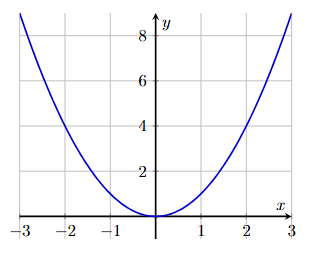
The following graph represents a continuous function f(x)=x^2, which is continuous for all real values of x.
Discontinuity
A function is discontinuous at a point where it fails to meet one or more conditions of continuity. Discontinuities often appear as holes, jumps, or vertical asymptotes in the graph.
Types of Discontinuities
Removable Discontinuity
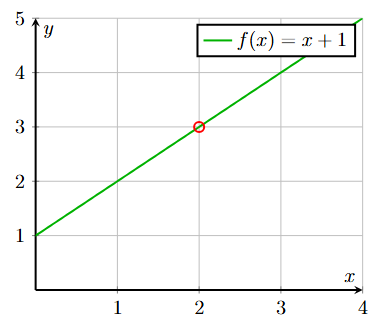
A removable discontinuity occurs when the limit exists, but the function value is missing or different from the limit.
Example Graph (Hole):
Jump Discontinuity
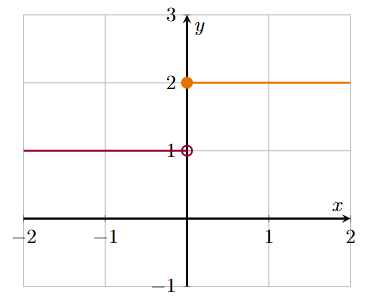
A jump discontinuity occurs when the left-hand and right-hand limits exist but are not equal.
Example Graph (Jump):
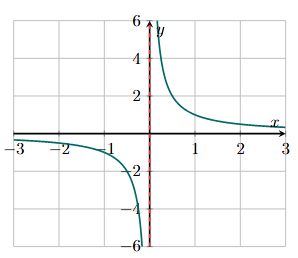
Infinite Discontinuity
An infinite discontinuity occurs when a function approaches positive or negative infinity near a point.
Example Graph (Vertical Asymptote):
Continuity and Differentiability
If a function is differentiable at a point, it must be continuous at that point. However, a continuous function may fail to be differentiable.
Example: The function f(x)=|x| is continuous at x=0 but not differentiable there.
Short Solved Example
Check the continuity of the function:
f(x) =
\begin{cases}
x^2, & x \neq 1 \\
3, & x = 1
\end{cases}
Since the limit does not equal the function value, the function is not continuous at x=1.
Conclusion
Continuity and discontinuity help us understand how functions behave near specific points. These concepts are fundamental in AP Calculus AB and are essential for analyzing limits, derivatives, and applying key calculus theorems.