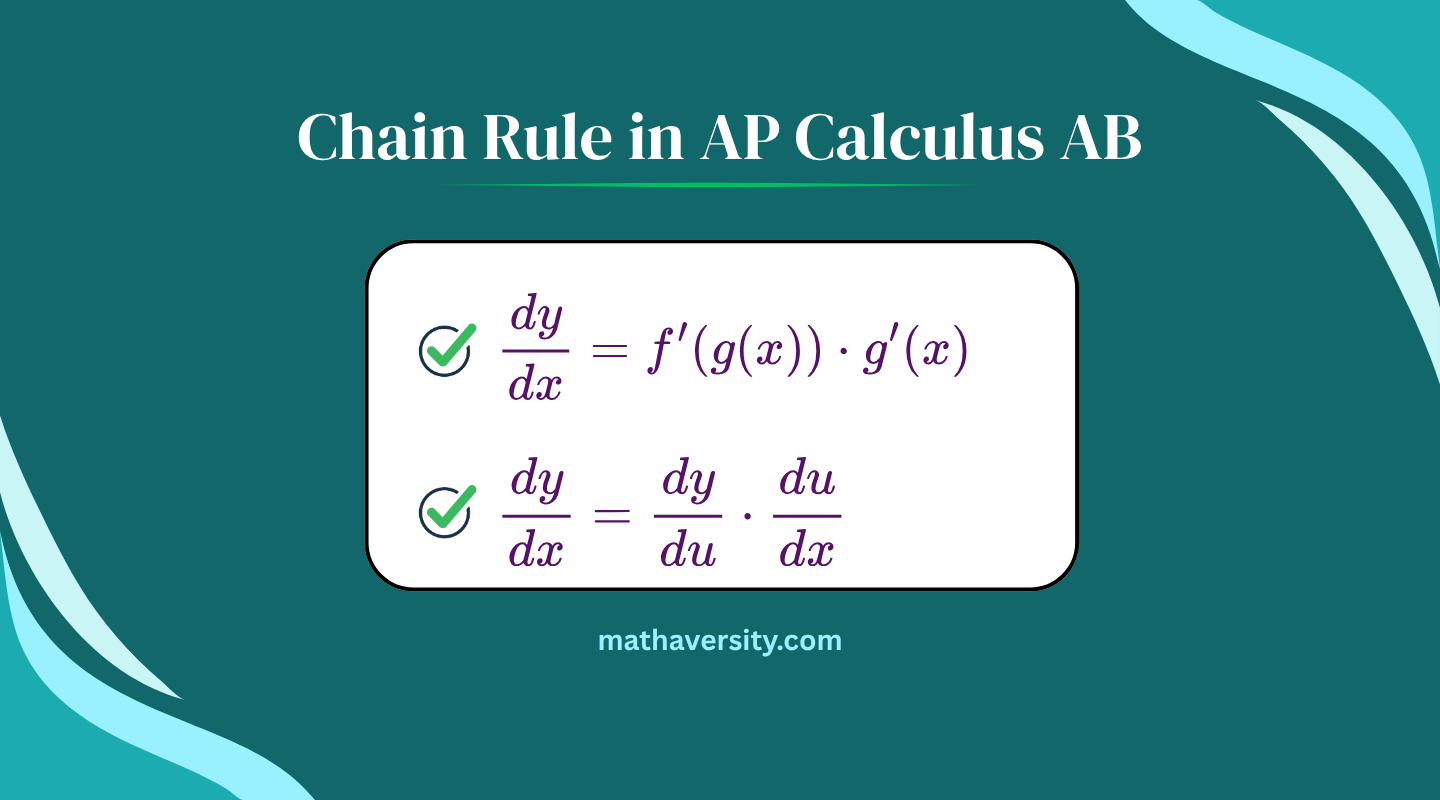
In AP Calculus AB, the chain rule is a fundamental differentiation technique used for composite functions.
A composite function occurs when one function is placed inside another, such as \sin(x^2) or e^{3x}.
In this article, we explain the chain rule step by step using clear definitions, worked examples, and practice-oriented explanations suitable for AP exam preparation.
Composite Functions
A composite function has the form: y = f(g(x))
This means the output of g(x) becomes the input of f(x).
Example:f(x) = \sin x, \quad g(x) = x^2
f(g(x)) = \sin(x^2)
To differentiate such functions, the chain rule must be applied.
Chain Rule Formula
If y = f(g(x)) , then the derivative of y with respect to x is:
When you try to solve algebraic word problems that have systems of equations
or complicated ratios, you make the most mistakes.
Example 1:
Differentiate: y = \sin(x^2)
Solution:
Outer function: \sin u
Inner function: u = x^2
\frac{dy}{dx} = \cos(x^2) \cdot 2x
Example 2:
Differentiate: y = e^{3x}
Solution:
Outer function: e^u
Inner function: u = 3x
\frac{dy}{dx} = e^{3x} \cdot 3
Example 3:
Differentiate: y = \ln(5x + 1)
Solution:
\frac{dy}{dx} = \frac{1}{5x+1} \cdot 5
Common Mistakes
Forgetting to multiply by the derivative of the inner function.
Incorrectly identifying inner and outer functions.
Applying the chain rule unnecessarily.
Practice Questions
Try solving the following:
1. Differentiate y = \cos(x^3)
2. Find \frac{dy}{dx} if y = \sqrt{2x+1}
3. Differentiate y = \ln(\sin x)
Free Practice Worksheets by Mathaversity
To strengthen your understanding of the chain rule, practice is essential. Mathaversity offers free AP Calculus AB worksheets designed according to the College Board syllabus.