Derivatives of Exponential and Logarithmic Functions
Introduction
Exponential and logarithmic functions are essential to both differentiation strategies and practical applications in AP Calculus AB. Models involving population growth, radioactive decay, compound interest, and inverse relationships often include these functions. Students are therefore expected to comprehend both the derivative formulas and the logic underlying them.
The definition of the derivative, the Chain Rule, and the basic characteristics of exponential and logarithmic functions are all directly expanded upon in this subject.
Exponential Functions
An exponential function is any function of the form f(x) = a^x \quad \text{where } a > 0 \text{ and } a \neq 1.
Unlike polynomial functions, the variable appears in the exponent. These functions model growth and decay processes where the rate of change is proportional to the current value of the function.
The Natural Exponential Function (e^x)
The number e (approximately 2.71828) is unique in Calculus. It is defined such that the slope of the tangent line to the curve y = e^x at x=0 is exactly 1. Because of this property, the derivative of e^x is the simplest in all of Calculus: it is its own derivative.
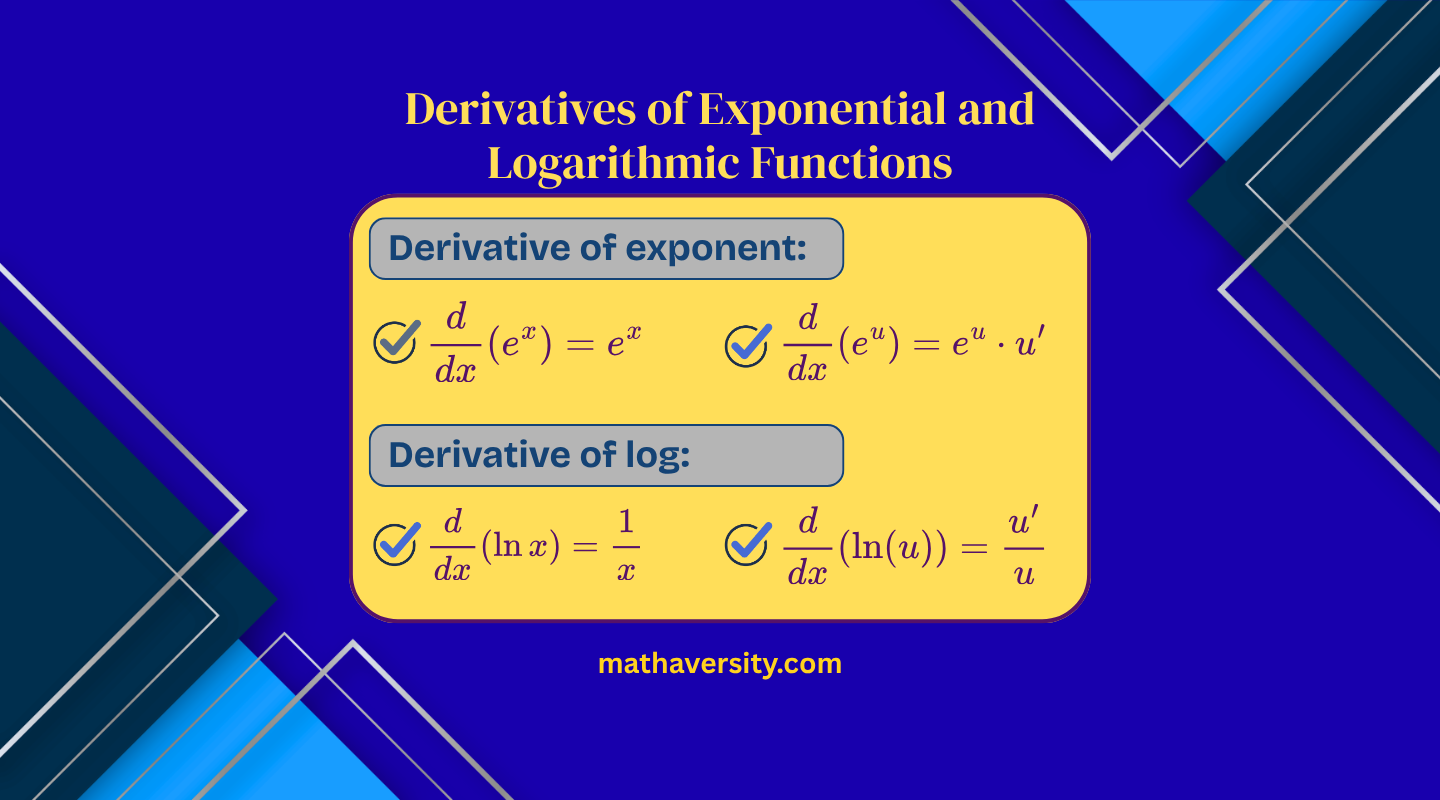
The Rule: \frac{d}{dx}(e^x) = e^x
Derivative of e^{u}
When the exponent is a function of x, the Chain Rule is applied:
\frac{d}{dx}\left(e^{u}\right) = e^{u} \cdot u'
Example
Differentiate: y = e^{3x^2 - 5x}
y' = e^{3x^2 - 5x}(6x - 5)
Derivatives of General Exponential Functions
When the base is any number aother than e, the derivative must be scaled by the natural log of the base. This is because a^xcan be rewritten as e^{x \ln a}. By applying the Chain Rule to this expression, we derive the general formula:
The Rule: \frac{d}{dx}(a^x) = a^x \ln(a)
Derivative of a^{u}
\frac{d}{dx}\left(a^{u}\right) = a^{u} \ln a \cdot u'
Example
Differentiate: y = 2^{x^3}
y' = 2^{x^3} \ln 2 \cdot 3x^2
Logarithmic Functions
Logarithmic functions are the "undoing" of exponential functions. The most frequent logarithm you will encounter in AP Calculus is the Natural Logarithm (\ln x), which has a base of e.
The Natural Logarithm (e^x)
The derivative of \ln x results in a simple rational expression. It is a common mistake for students to try to use the Power Rule here; remember that \ln x is a transcendental function and follows its own rule.
Derivative of \ln x
\frac{d}{dx}(\ln x) = \frac{1}{x}, \quad x > 0
To extend the domain, we often use:
\frac{d}{dx}(\ln |x|) = \frac{1}{x}, \quad x \neq 0
Derivative of \ln(u)
Using the Chain Rule:
\frac{d}{dx}(\ln(u)) = \frac{u'}{u}
Example
Differentiate: y = \ln(5x^2 - 3x)
y' = \frac{10x - 3}{5x^2 - 3x}
Logarithms with Other Bases
Logarithms with bases other than e can be rewritten using the change-of-base formula:
\log_a x = \frac{\ln x}{\ln a}
Derivative of \log_a x
\frac{d}{dx}(\log_a x) = \frac{1}{x \ln a}
Example
Differentiate: y = \log_3 x
y' = \frac{1}{x \ln 3}
Summary of Key Derivative Formulas

Step-by-Step Solved Examples
To master these, you must be comfortable combining these new rules with the Chain Rule, Product Rule, and Quotient Rule.
Example 1:
Find the derivative off(x) = e^{x^3 + 5x}.
Solution:
Identify the structure: This is a composition of functions where the "outer" function is e^u and the "inner" function is u = x^3 + 5x.
Apply the Chain Rule: The formula is \frac{d}{dx}(e^u) = e^u \cdot u'
Differentiate the inner function: \frac{du}{dx} = 3x^2 + 5
Combine: f'(x) = e^{x^3 + 5x} \cdot (3x^2 + 5)
Final Form:f'(x) = (3x^2 + 5)e^{x^3 + 5x}.
Example 2:
Differentiate the function:y = 2^{x^3}.
Solution:
Step 1: Recognize the Type of Function
This is an exponential function with base 2, not e. Therefore, we use the formula:
\frac{d}{dx}(a^{u}) = a^{u} \ln a \cdot u'
Here: a = 2 \quad \text{and} \quad u = x^3
Step 2: Differentiate the Exponent
u' = \frac{d}{dx}(x^3) = 3x^2
Step 3: Apply the Formula
Substitute into the derivative formula y' = 2^{x^3} \ln 2 \cdot 3x^2
Final Answer: Substitute into the derivative formula y' = 3x^2 \, 2^{x^3} \ln 2
Example 3:
Differentiate: y = \ln(5x^2 - 3x).
Solution:
Step 1: Identify the Outer Function
The outer function is the natural logarithm \ln(u), where: u = 5x^2 - 3x
Step 2: Apply the Chain Rule for Logarithms
Recall: \frac{d}{dx}(\ln(u)) = \frac{u'}{u}
Step 3: Differentiate the Inside Function
\frac{d}{dx}(5x^2 - 3x) = 10x - 3
Step 4: Form the Derivative
y' = \frac{10x - 3}{5x^2 - 3x}
Example 4:
Differentiate: y = x^2 e^{4x}.
Solution:
Step 1: Identify the Rule Needed
This function is a product of x^2 \quad \text{and} \quad e^{4x}. Therefore, we use the Product Rule:
(uv)' = u'v + uv'
Step 2: Differentiate Each Part
u = x^2 \Rightarrow u' = 2x
v = e^{4x} \Rightarrow v' = e^{4x}(4)
Step 3: Apply the Product Rule
y' = 2x e^{4x} + x^2 \cdot 4e^{4x}
Step 4: Factor for Simplicity
y' = 2xe^{4x}(1+ 2x^2)
Example 5:
Differentiate: y = \ln(x^2 + e^x).
Solution:
Step 1: Identify the Inner Function
u = x^2 + e^x
Step 2: Apply the Logarithmic Chain Rule
\frac{d}{dx}(\ln u) = \frac{1}{u} \cdot \frac{du}{dx}
Step 3: Differentiate the Inner Function
\frac{du}{dx} = 2x + e^x
Step 4: Substitute Back
y' = \frac{2x + e^x}{x^2 + e^x}
Conclusion
An essential part of AP Calculus AB is the study of derivatives of exponential and logarithmic functions. These guidelines are crucial for resolving differential equations, growth and decay issues, and optimization queries. Students who have a firm conceptual grasp of these derivatives can confidently tackle both exam problems and practical applications.
Mathaversity is ready to help you get the highest grades if you need
professional, targeted help to fill in the last gaps in your knowledge.