Absolute Maximum and Minimum Values
Introduction
One of the main goals of calculus is to comprehend how a function behaves over a specified interval. Finding the maximum and minimum values that a function can accept is frequently of interest to us. These numbers are referred to as the function's maximum and minimum values.
This subject is crucial to AP Calculus AB since it serves as the basis for optimization problems and practical applications. Students can precisely identify the point at which a function reaches its extreme values and provide analytical justification for their conclusions by using derivatives.
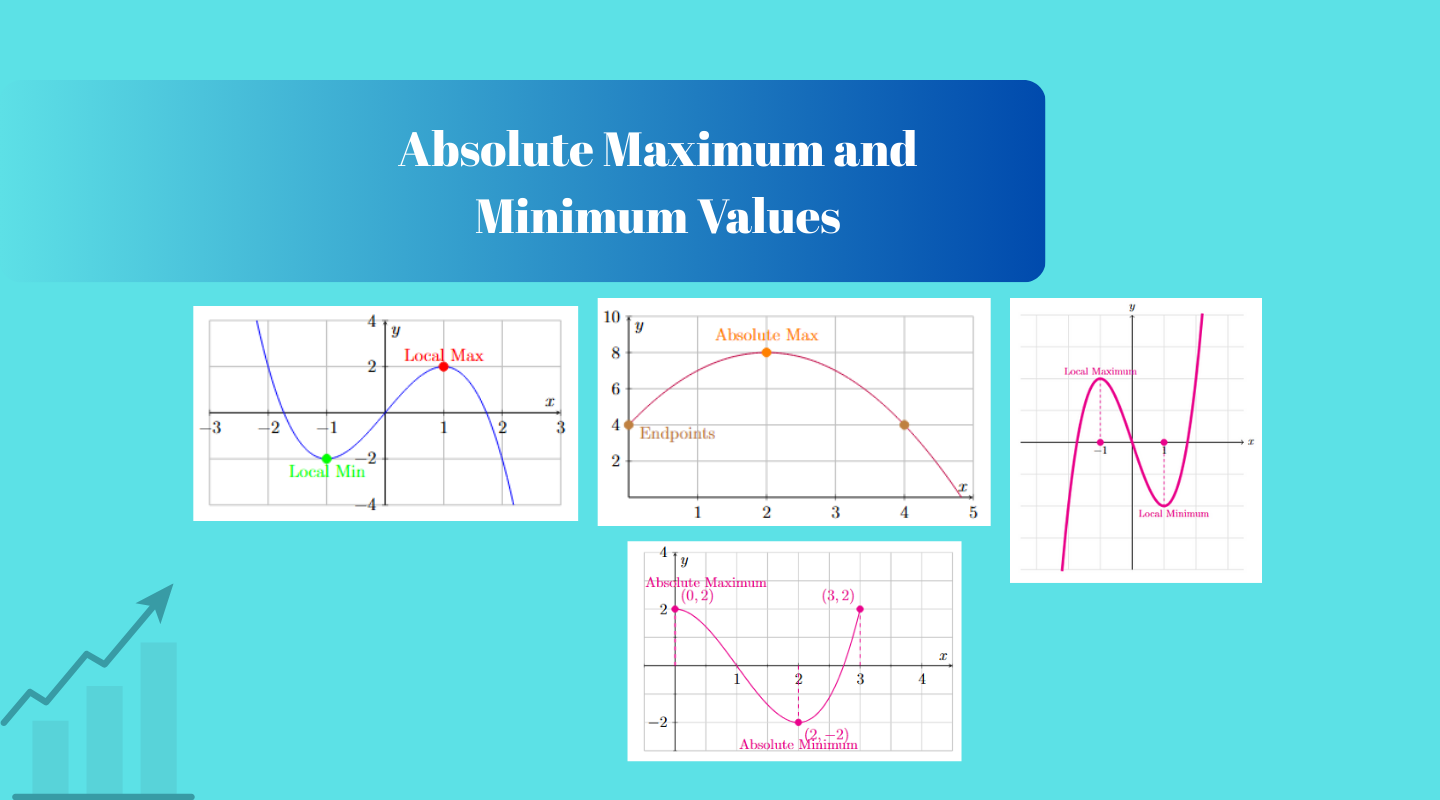
Concept of Maximum and Minimum Values
Let f(x) be a function defined on an interval I.
- A maximum value of f(x) is the greatest output value of the function on the interval.
- A minimum value of f(x) is the smallest output value of the function on the interval.
These values describe the extreme behavior of a function. It is important to note that a function may or may not attain maximum or minimum values depending on the interval and continuity of the function.
Absolute Maximum and Absolute Minimum
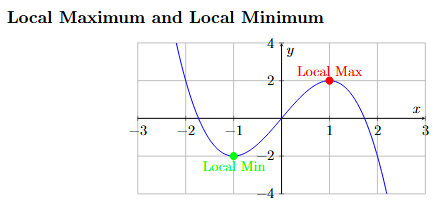
An absolute maximum of a function is the greatest value the function achieves over the entire interval.
An absolute minimum of a function is the least value the function achieves over the entire interval.
Absolute extrema are the highest and lowest points on the graph between x=a and x=b for a function defined on a closed interval [a,b].
Absolute extrema consider all points in the interval, including interior points and endpoints.
Local (Relative) Maximum and Minimum
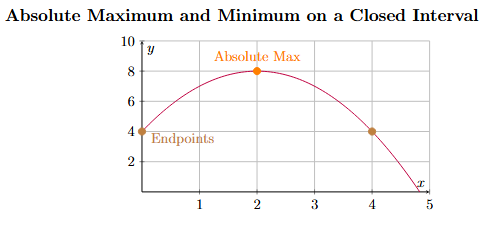
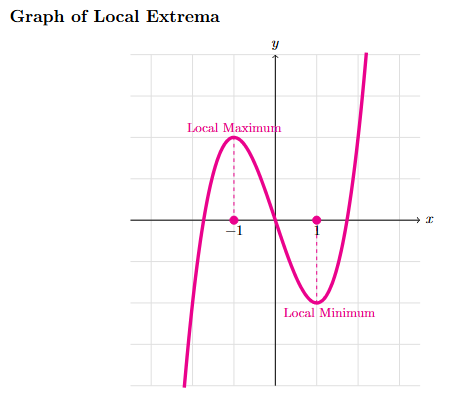
A function has a local maximum at x=c if the value f(c) is greater than the values of the function at nearby points.
A function has a local minimum at x=c if the value f(c) is smaller than the values of the function at nearby points.
Local extrema describe the behavior of a function in a small neighborhood and do not necessarily represent the highest or lowest values overall.
Increasing and Decreasing Behavior
Derivatives allow us to analyze whether a function is increasing or decreasing.
- If f'(x) > 0, the function is increasing.
- If f'(x) < 0, the function is decreasing.
A change from increasing to decreasing indicates a local maximum, while a change from decreasing to increasing indicates a local minimum.
Critical Points
A number x=c is called a critical point of a function if:
f'(c) = 0 \quad \text{or} \quad f'(c) \text{ does not exist}
Critical points identify potential locations of local maximum or minimum values. However, not all critical points result in extrema.
Extreme Value Theorem
The Extreme Value Theorem states:
"If a function is continuous on a closed interval [a,b], then the function must have at least one absolute maximum and at least one absolute minimum on that interval."
This theorem guarantees the existence of absolute extrema but does not specify where they occur.
Closed Interval Method
To find absolute maximum and minimum values on a closed interval [a,b], the Closed Interval Method is used.
Procedure
1.Compute the derivative f'(x).
2.Find all critical points in the open interval (a,b).
3.Evaluate f(x)at:
- Each critical point
- Each endpoint x=a and x=b
4.Compare all resulting values.
The largest value is the absolute maximum, and the smallest value is the absolute minimum.
Why Endpoints Are Important
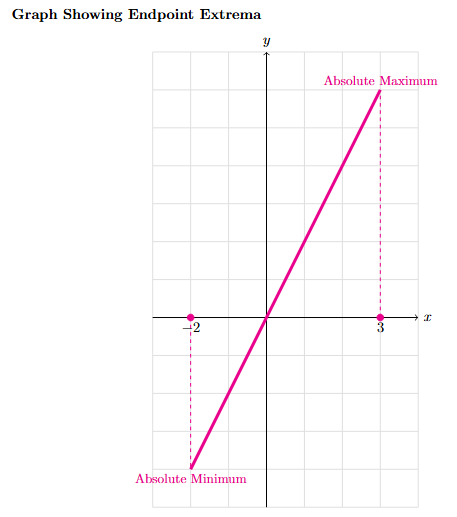
Endpoints may have absolute maximum and minimum values, particularly if a function is strictly increasing or decreasing over the interval.
One of the most frequent errors made by students in AP Calculus AB is ignoring endpoints.
Graphical Representation of Maximum and Minimum
Applications of Maximum and Minimum Values
Maximum and minimum values are widely used in practical applications such as:
- Maximizing profit or revenue
- Minimizing cost or material usage
- Engineering and design optimization
- Physics and economics problems
These applications demonstrate why this topic is essential in calculus.
Solved Examples on Maximum and Minimum Values
Example 1: Finding Absolute Maximum and Minimum
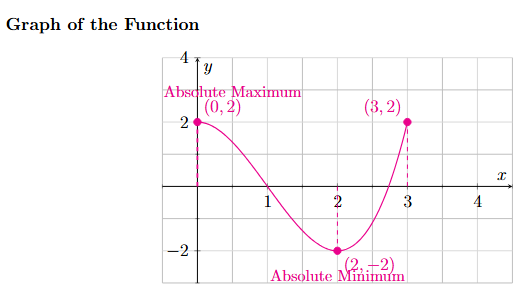
Find the absolute maximum and minimum values of the functionf(x) = x^3 - 3x^2 + 2 on the interval [0,3].
Solution:
Step 1: Find the derivative
f'(x) = 3x^2 - 6x.
Step 2: Find critical points
3x(x-2) = 0 \Rightarrow x = 0,\, 2.
The critical point in the open interval (0,3) is x=2.
Step 3: Evaluate the function at critical points and endpoints
f(0) = 2,\quad f(2) = -2,\quad f(3) = 2.
Step 4: Compare values
- Absolute Maximum Value = 2 at (x=0 and x=3)
- Absolute Minimum Value = -2 (at x=2)
Example 2: Identifying Local Maximum and Local Minimum
Find the local maximum and local minimum values of f(x) = x^3 - 3x.
Solution:
Step 1: Compute the derivative
f'(x) = 3x^2 - 3
Step 2: Find critical points
3(x^2 - 1) = 0 \Rightarrow x = \pm1
Step 3: Analyze increasing and decreasing behavior
- Function increases before x=1 and decreases after → local maximum
- Function decreases before x=-1 and increases after → local minimum
Step 4: Evaluate the function
f(1) = -2,\quad f(-1) = 2
- Local Maximum Value = -2 at x=1
- Local Minimum Value = 2 at x=-1
Example 3: Endpoint as an Absolute Extreme
Find the absolute extrema of yf(x) = 2x on the interval [-2,3].
Solution:
Step 1: Find the derivative
f'(x) = 2
Since the derivative is constant, there are no critical points.
Step 2: Evaluate endpoints
f(-2) = -4,\quad f(3) = 6
Conclusion
- Absolute Maximum Value = 6 at x=3
- Absolute Minimum Value = -4 at x=-2
Frequently Asked Questions
Q1: Can a function have more than one absolute maximum value?
A function can have only one absolute maximum value, but it may occur at more than one point.
Q2: Is every critical point an extreme value?
No. A critical point only indicates a possible extreme value. Further analysis is required.
Q3: Why must endpoints be checked?
Because absolute extrema can occur at endpoints of a closed interval.
Q4: Can a function have no maximum or minimum value?
Yes. If a function is not continuous or the interval is open, extrema may not exist.
Conclusion
The extreme behavior of functions on an interval is described by maximum and minimum values. Students can methodically ascertain these values by utilizing derivatives, critical points, and the Closed Interval Method. A key component of AP Calculus AB, this subject lays the groundwork for optimization issues and practical applications.