Mathaversity Tutors

Definite Integrals – Concepts, Applications & Improper Integrals

Introduction to Definite Integrals

The ideas of accumulation and rate of change are equally crucial in calculus. Integrals enable us to ascertain the total accumulation of a quantity over a period of time, whereas derivatives help us comprehend how quickly a quantity changes at a particular instant.

Definite integrals are thoroughly examined in AP Calculus BC and used in progressively more challenging contexts, including improper integrals, infinite intervals, motion analysis, and volume computations. To succeed on the AP exam and in advanced mathematics, one must have a thorough understanding of definite integrals.
Preliminary Idea: Area and Accumulation

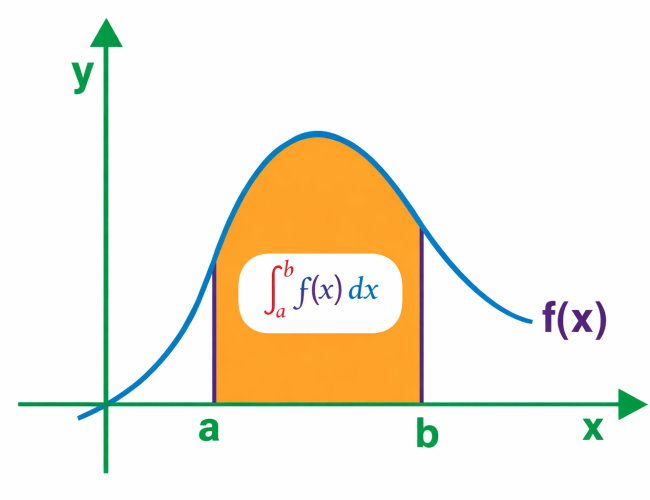
Let f(x) be a continuous function defined on a closed interval [a,b]. The accumulated area between the curve and the x-axis during that interval is intuitively represented by the definite integral.
The accumulation is positive if the function is above the x-axis. The accumulation is negative if it is below the x-axis. Calculus relies heavily on the concept of signed area.

Riemann Sums and Partitions

Before defining the definite integral formally, we approximate the area under a curve using a finite number of rectangles. This approximation process is based on the idea of partitioning an interval.

Partition of an Interval

Let f(x) be a function defined on a closed interval [a,b]. A partition of [a,b] is a set of points:
a = x_0 < x_1 < x_2 < \cdots < x_n = b
These points divide the interval into n subintervals. If the partition is equal, then each subinterval has the same width:
\Delta x = \dfrac{b-a}{n}
The width \Delta x represents the base of each rectangle used to approximate the area under the curve.

Sample Points

From each subinterval [x_{i-1}, x_i], we choose a point x_i^*, called a sample point.

The height of the rectangle over that subinterval is given by: f(x_i^*)

Different choices of sample points lead to different types of Riemann sums.

Types of Riemann Sums

General Formula for a Riemann Sum

Using a partition of n subintervals, the Riemann sum is written as:
\sum_{i=1}^{n} f(x_i^*)\,\Delta x
This sum represents the total area of all rectangles formed over the partition.

Connection to Definite Integrals

As the number of subintervals increases (n \to \infty), the partition becomes finer and the rectangles better approximate the curve.
In the limit, the Riemann sum becomes the definite integral:
\int_a^b f(x)\,dx = \lim_{n \to \infty} \sum_{i=1}^{n} f(x_i^*)\,\Delta x
This limit gives the exact accumulated area under the curve.

Definition of the Definite Integral

The definite integral of a function f(x) froma to b is defined as the limit of Riemann sums:
\int_a^b f(x)\,dx = \lim_{n \to \infty} \sum_{i=1}^{n} f(x_i^*) \Delta x
This definition provides a precise mathematical meaning to the idea of accumulation.

Geometric Interpretation

If f(x) \ge 0 on [a,b], then
\int_a^b f(x)\,dx
represents the area bounded by the curve, the x-axis, and the vertical lines x=a and x=b.
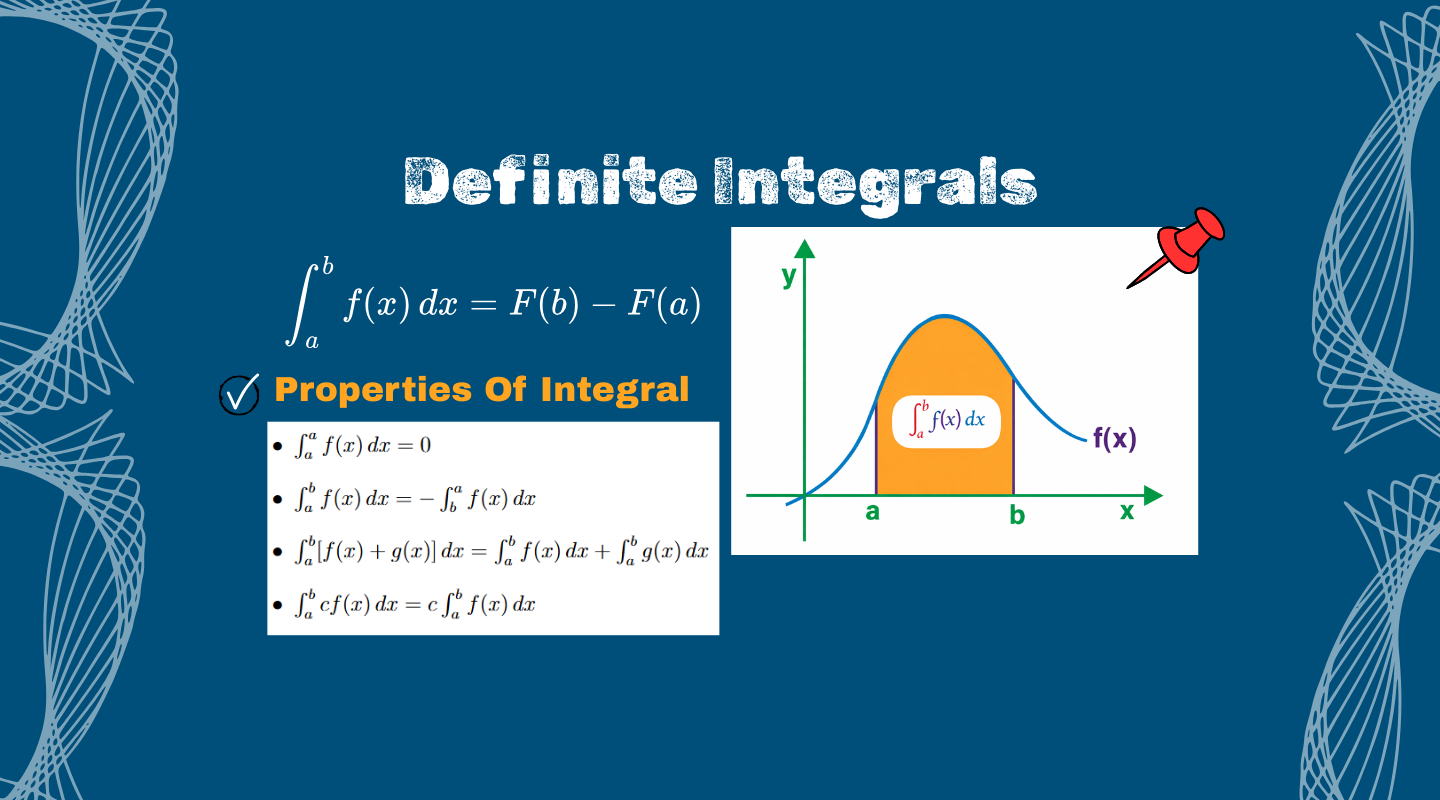
definite integrals

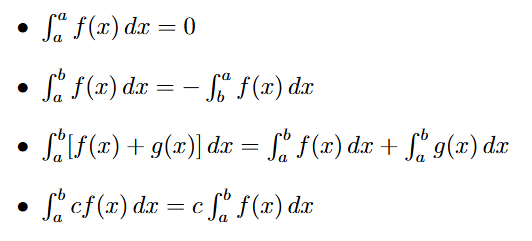
Properties of Definite Integrals

These properties simplify calculations and are frequently tested on the AP exam.

The Fundamental Theorem of Calculus

These properties simplify calculations and are frequently tested on the AP exam.

Part 1

If f is continuous on [a,b], then
\dfrac{d}{dx} \left( \int_a^x f(t)\,dt \right) = f(x)

Part 2

If F'(x)=f(x), then
\int_a^b f(x)\,dx = F(b)-F(a)
This theorem connects differentiation and integration and makes evaluating definite integrals efficient.

Evaluating Definite Integrals

Example

Evaluate the definite integral:
\int_{0}^{2} (4x^3 - 2x)\, dx

Solution

Step 1: Find the Antiderivative
We integrate term by term:
\int (4x^3 - 2x)\, dx
= \int 4x^3\, dx - \int 2x\, dx
= x^4 - x^2 + C
So, the antiderivative is:
F(x) = x^4 - x^2
Step 2: Apply the Fundamental Theorem of Calculus
According to the Fundamental Theorem of Calculus:
\int_{a}^{b} f(x)\,dx = F(b) - F(a)
\int_{0}^{2} (4x^3 - 2x)\, dx = F(2) - F(0)
Step 3: Substitute the Limits
F(2) = 2^4 - 2^2 = 16 - 4 = 12
F(0) = 0^4 - 0^2 = 0
Step 4: Final Answer
F(2) - F(0) = 12 - 0 = 12
\int_{0}^{2} (4x^3 - 2x)\, dx = 12

Average Value of a Function

The average value of a continuous function on [a,b] is
f_{\text{avg}} = \dfrac{1}{b-a} \int_a^b f(x)\,dx
This concept is widely used in physics and engineering.

Motion Along a Line

If v(t) is velocity:
AP BC questions often test the difference between these two quantities.

Improper Integrals (AP Calculus BC)

Infinite Intervals

\int_1^{\infty} \frac{1}{x^2}\,dx = \lim_{b\to\infty} \int_1^b x^{-2}\,dx = 1

Unbounded Functions

\int_0^1 \frac{1}{\sqrt{x}}\,dx = \lim_{a\to0^+} \int_a^1 x^{-1/2}\,dx = 2

Applications: Area Between Curves

\text{Area} = \int_a^b [f(x)-g(x)]\,dx
This application appears frequently in AP calculus BC free-response questions.

Applications: Volume of Solids

Disk Method

V = \pi \int_a^b [f(x)]^2\,dx

Washer Method

V = \pi \int_a^b \left(R^2 - r^2\right)\,dx

Common AP Exam Mistakes

Solved Problems on Definite Integrals (AP Calculus BC)

Problem 1: Evaluating a Polynomial Definite Integral

Evaluate the definite integral: \int_{1}^{3} (2x^3 - 5x^2 + 4)\,dx
Solution:
Step 1: Find the antiderivative
\int (2x^3 - 5x^2 + 4)\,dx = \dfrac{1}{2}x^4 - \dfrac{5}{3}x^3 + 4x
Step 2: Apply the Fundamental Theorem of Calculus
F(3) - F(1)
= \left(\dfrac{1}{2}(3)^4 - \dfrac{5}{3}(3)^3 + 4(3)\right) - \left(\dfrac{1}{2}(1)^4 - \dfrac{5}{3}(1)^3 + 4(1)\right)
Step 3: Simplify
= (40.5 - 45 + 12) - (0.5 - 1.67 + 4)
= 7.5 - 2.83 = 4.67
\int_{1}^{3} (2x^3 - 5x^2 + 4)\,dx = 4.67

Problem 2: Net Change Interpretation

The rate of change of a quantity is given by: R(t) = 6t - 4

Find the net change from t=0 to t=5.

Solution:
Step 1: Use the Net Change Theorem
\text{Net Change} = \int_{0}^{5} (6t - 4)\,dt
Step 2: Integrate
\int (6t - 4)\,dt = 3t^2 - 4t
Step 3: Evaluate the definite integral
(3(5)^2 - 4(5)) - (3(0)^2 - 4(0))
= (75 - 20) = 55
\text{Net Change} = 55

Problem 3: Area Between a Curve and the x-axis

Find the area between the curve f(x)=x^2-4 and the x-axis from x=-2 to x=2.
Solution:
Step 1: Identify where the curve crosses the x-axis
x^2 - 4 = 0 \Rightarrow x = \pm 2
Step 2: Set up the integral using absolute value
\text{Area} = \int_{-2}^{2} |x^2 - 4|\,dx
Since the function is below the x-axis on this interval:
\text{Area} = \int_{-2}^{2} (4 - x^2)\,dx
Step 3: Integrate
\int (4 - x^2)\,dx = 4x - \dfrac{1}{3}x^3
Step 4: Evaluate
\left[4x - \dfrac{1}{3}x^3\right]_{-2}^{2} = \left(8 - \dfrac{8}{3}\right) - \left(-8 + \dfrac{8}{3}\right)= \dfrac{32}{3}
\text{Area} = \dfrac{32}{3}

Problem 4: Motion Along a Line (Velocity Function)

A particle moves along a line with velocity: v(t) = t^2 - 4t.

Find:

(a) Displacement from t=0 to t=5

(b) Total distance traveled

Solution:
Step 1: Displacement
\int_{0}^{5} (t^2 - 4t)\,dt
= \left(\dfrac{1}{3}t^3 - 2t^2\right)_{0}^{5}
= \left(\dfrac{125}{3} - 50\right) = -\dfrac{25}{3}
Step 2: Find where velocity changes sign
t(t - 4) = 0 \Rightarrow t = 0, 4
Step 3: Total Distance
\int_{0}^{4} (4t - t^2)\,dt + \int_{4}^{5} (t^2 - 4t)\,dt
= \dfrac{64}{3} + \dfrac{13}{3} = \dfrac{77}{3}
\text{Total Distance} = \dfrac{77}{3}

Problem 5: Improper Integral

Determine whether the improper integral converges: \int_{1}^{\infty} \dfrac{1}{x^3}\,dx
Solution:
Step 1: Write as a limit
\lim_{b\to\infty} \int_{1}^{b} x^{-3}\,dx
Step 2: Integrate
\int x^{-3}\,dx = -\dfrac{1}{2x^2}
Step 3: Evaluate the limit
\lim_{b\to\infty} \left(-\dfrac{1}{2b^2} + \dfrac{1}{2}\right)= \dfrac{1}{2}
\text{The improper integral converges to} \dfrac{1}{2}

Frequently Asked Questions (FAQs)

Yes, including improper integrals and advanced applications.
Yes, when the function lies below the x-axis.
They extend integration to infinite domains and discontinuous functions.

Conclusion

One of the most effective tools in calculus is the infinite integral. Students in AP Calculus BC expand on fundamental area ideas to investigate motion analysis, infinite intervals, and more complex applications. For future success in mathematics, physics, and engineering as well as on the AP exam, mastery of definite integrals is crucial.
Mathaversity is ready to help you get the highest grades if you need professional, targeted help to fill in the last gaps in your knowledge.