Test for Convergence and Divergence – Complete Guide
Introduction
One of the most crucial topics in AP Calculus BC is figuring out whether an infinite series converges or diverges. Students can confidently solve multiple-choice and free response questions when they have a solid understanding of convergence tests.
An infinite series is written as: \sum_{n=1}^{\infty} a_n
The key question is: Does this infinite sum approach a finite number?
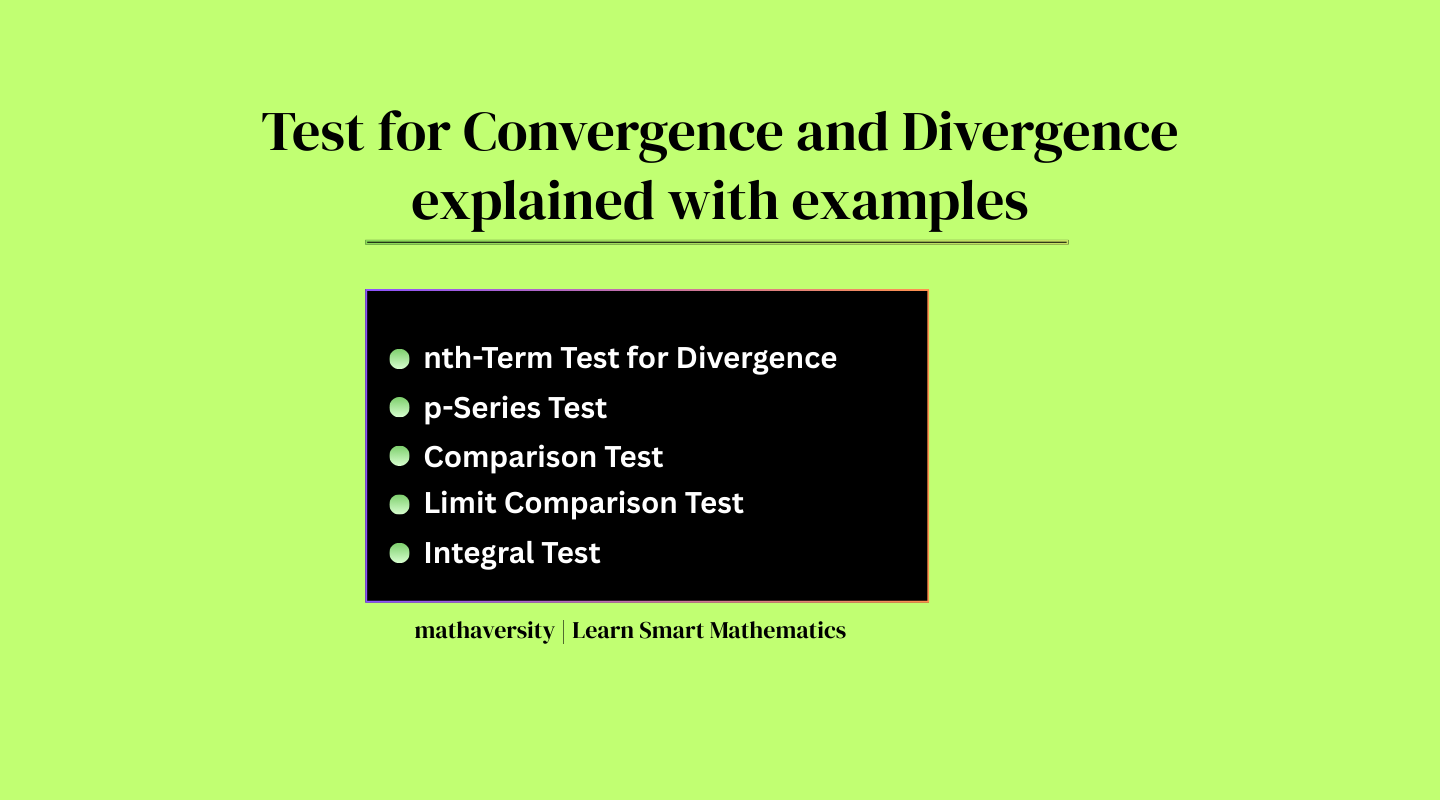
Convergence vs Divergence
A series \sum a_n converges if its sequence of partial sums approaches a finite limit.
It diverges if:
- The partial sums grow without bound, or
- The limit does not exist.
nth-Term Test for Divergence
Theorem
If \lim_{n \to \infty} a_n \neq 0 then \sum a_n \text{ diverges.}
A_i=\dfrac{1}{2}h\left[f(x_{i-1})+f(x_i)\right]
Example
Determine whether the series converges or diverges:
\sum_{n=1}^{\infty} \dfrac{n}{n+1}
Solution
Step 1: Identify the term
a_n = \dfrac{n}{n+1}
Step 2: Compute the limit
\dfrac{n}{n+1}
=
\dfrac{1}{1 + \dfrac{1}{n}}
\lim_{n \to \infty} \dfrac{1}{1 + \dfrac{1}{n}} = 1
Step 3: Conclusion
Since the limit is not zero, the series diverges.
Geometric Series
A geometric series has the form:
\sum_{n=0}^{\infty} ar^n
Convergence Rule
|r| < 1 \Rightarrow \text{Convergent}
Sum Formula
S = \dfrac{a}{1-r}
Example
Determine whether the following series converges or diverges. If it converges, find its sum:
\sum_{n=0}^{\infty} \left(\dfrac{1}{3}\right)^n
Solution
Step 1: Identify a and r
a = 1, \quad r = \dfrac{1}{3}
Step 2: Check convergence
|r| = \dfrac{1}{3} < 1
So the series converges.
Step 3: Compute the sum
S = \dfrac{a}{1-r}
=
\dfrac{1}{1 - \dfrac{1}{3}}
=
\dfrac{1}{\dfrac{2}{3}}
=
\dfrac{3}{2}
p-Series Test
A p-series has the form:
\sum_{n=1}^{\infty} \dfrac{1}{n^p}
p > 1 \Rightarrow \text{Convergent}
p \le 1 \Rightarrow \text{Divergent}
Example
Determine whether the following series converges or diverges:
\sum_{n=1}^{\infty} \dfrac{1}{n^2}
Solution:
Step 1: Identify p
p = 2
Step 2: Apply rule
Since 2 > 1, the series converges.
Comparison Test
If 0 \le a_n \le b_n and \sum b_n converges, then \sum a_n converges.
Example
Determine whether the following series converges or diverges:
\sum_{n=1}^{\infty} \dfrac{1}{n^2 + 5}
Solution:
Step 1: Compare denominators
For all n \ge 1:
n^2 + 5 > n^2
Step 2: Reverse inequality when taking reciprocals
\dfrac{1}{n^2 + 5} < \dfrac{1}{n^2}
Step 3: Use known convergence
\sum \dfrac{1}{n^2}
is a convergent p-series.
Step 4: Conclusion
By the Comparison Test, the series converges.
Limit Comparison Test
If \lim_{n\to\infty} \dfrac{a_n}{b_n} = L
where 0 < L < \infty, then both series behave the same.
Example
Determine whether the following series converges or diverges:
\sum_{n=1}^{\infty} \dfrac{3n^2 + 1}{n^3 + 2}
Solution:
Step 1: Identify dominant powers
The expression behaves like:
\dfrac{3n^2}{n^3} = \dfrac{3}{n}
Compare with b_n = \dfrac{1}{n}
Step 2: Compute limit
\lim_{n\to\infty}
\dfrac{(3n^2+1)/(n^3+2)}{1/n}
=
\lim_{n\to\infty}
\dfrac{3n^3 + n}{n^3 + 2}
Divide by n^3:
=
\lim_{n\to\infty}
\dfrac{3 + \dfrac{1}{n^2}}{1 + \dfrac{2}{n^3}}
=
3
Step 3: Conclusion
Since the limit is finite and positive, both series behave the same.
The harmonic series diverges, so the given series diverges.
Integral Test
If f(x) is continuous, positive, and decreasing, then
\sum a_n \text{ and } \int f(x) dx
behave the same.
Example
Determine whether the following series converges or diverges:
\sum_{n=1}^{\infty} \dfrac{1}{n}
Solution:
Step 1: Write improper integral
\int_1^{\infty} \dfrac{1}{x}\,dx
=
\lim_{b\to\infty}\int_1^b \dfrac{1}{x}\,dx
Step 2: Evaluate
=
\lim_{b\to\infty} [\ln x]_1^b
=
\lim_{b\to\infty} (\ln b - 0)
=
\infty
Step 3: Conclusion
Since the integral diverges, the series diverges.
Alternating Series Test
For a series of the form
\sum (-1)^n b_n
The series converges if:
- b_n > 0
- b_n is decreasing
- \lim_{n\to\infty} b_n = 0
Example
Determine whether the following series converges or diverges:
\sum (-1)^n \dfrac{1}{n}
Solution:
Let b_n = \dfrac{1}{n}
Step 1: Check positivity
b_n > 0
Step 2: Check decreasing
\dfrac{1}{n+1} < \dfrac{1}{n}
Step 3: Check limit
\lim_{n\to\infty} \dfrac{1}{n} = 0
Step 4: Conclusion
All conditions are satisfied. The series converges conditionally.
Alternating Series Test
L = \lim_{n\to\infty} \left| \dfrac{a_{n+1}}{a_n} \right|
If:
- L < 1: Convergent
- L > 1: Divergent
- L = 1: Inconclusive
Example
Determine whether the following series converges or diverges:
\sum_{n=1}^{\infty} \dfrac{n!}{5^n}
Solution:
Step 1: Form ratio
\left|\dfrac{a_{n+1}}{a_n}\right|
=
\dfrac{(n+1)!/5^{n+1}}{n!/5^n}
Step 2: Simplify
=
\dfrac{(n+1)!}{n!}\cdot \dfrac{5^n}{5^{n+1}}
=
(n+1)\cdot \dfrac{1}{5}
=
\dfrac{n+1}{5}
Step 3: Take limit
\lim_{n\to\infty} \dfrac{n+1}{5}
=
\infty
Step 4: Conclusion
Since the limit is greater than 1, the series diverges.
Frequently Asked Questions (FAQs)
Q1. Why must we check the nth-term test first?
Because if the limit of a_n is not zero, the series automatically diverges.
Q2. What if the limit equals zero?
The test is inconclusive.
Example: \sum \frac{1}{n}
Limit is zero, but the series diverges.
Q3. What is conditional convergence?
A series converges conditionally if it converges, but the absolute value series diverges.
Q4. Which tests are most common in AP Calculus BC?
Ratio Test, Alternating Series Test, Comparison Test, and Integral Test.
Final Strategy for Exams
- Always state the test name.
- Show limit calculations clearly.
- Justify decreasing conditions.
- Write a complete concluding sentence.
Mathaversity is ready to help you get the highest grades if you need
professional, targeted help to fill in the last gaps in your knowledge.