Exponential Functions in AP Calculus AB – Graphs, Properties, Growth & Decay
Introduction
An exponential function is a unique kind of math function where the variable is in the exponent position.
It shows how things grow and shrink in the real world, like changes in population, compound interest, and radioactive decay. It is also important in AP Calculus AB because of its special rate properties and how it acts when you differentiate it.
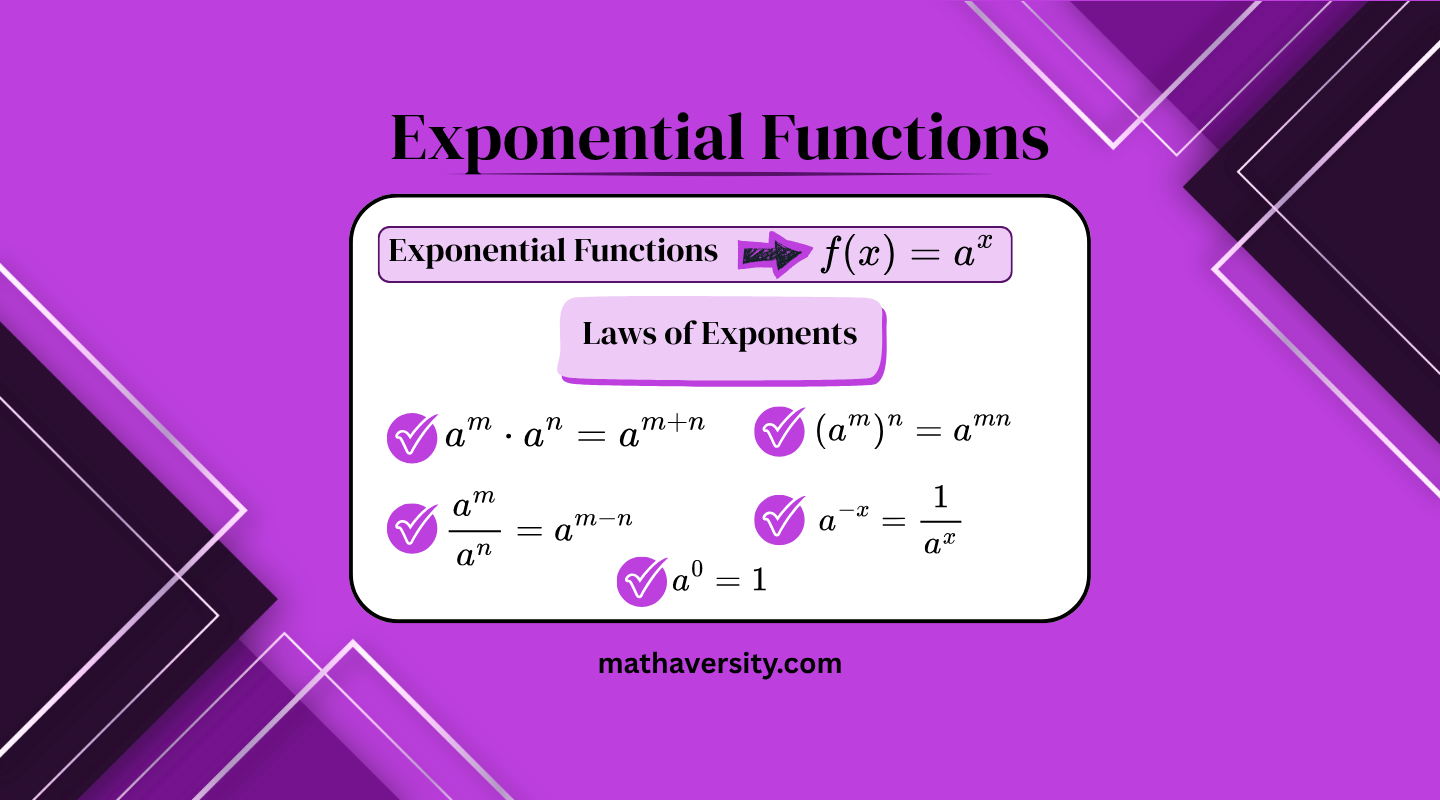
What Is an Exponential Function?
- where:
- a is a positive constant called the base
- x is the independent variable,
- a > 0 and a \neq 1.
Common Forms of Exponential Functions
1. General Form
2. Natural Exponential Function
Domain and Range
-
Domain (possible input values): All real numbers, (-\infty, \infty)
(you can plug any real 𝑥 into an exponential function).
-
Range (possible outputs): Only positive real number, (0, \infty)
(the function never produces zero or negative numbers).
Exponential Growth and Decay
Some examples of these kinds of situations are population growth, compound interest, radioactive decay, and depreciation.
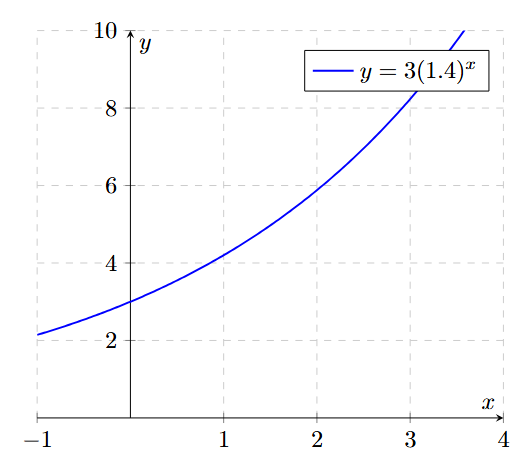
Exponential Growth
- where:
- a is the initial value
- r is the growth rate (as a decimal)
- x is time
- y is the final value
Growth Graph
Exponential Decay
- where:
- a is the initial value
- r is the decay rate (as a decimal)
- x is time
- y is the remaining value

Continuous Exponential Growth and Decay
- Continuous Growth: y = ae^{kx}, \quad k > 0
- Continuous Decay: y = ae^{-kx}, \quad k > 0
- These models are especially important in AP Calculus AB because they connect exponential functions with derivatives.
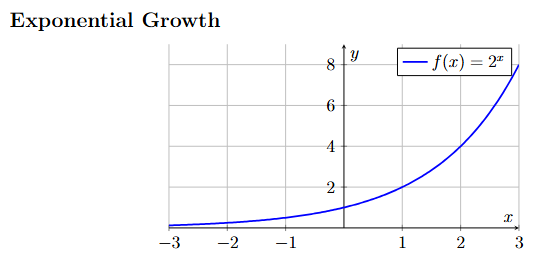
Graphs of Exponential Functions

Laws of Exponents
- a^{m} \cdot a^{n} = a^{m+n}
- \dfrac{a^{m}}{a^{n}} = a^{m-n}
- (a^{m})^{n} = a^{mn}
- a^{0} = 1
- a^{-x} = \dfrac{1}{a^{x}}
Derivatives of Exponential Functions
Derivative of e^{x}
Derivative of a^{x}
Solved Problems
Question 1:
Solution:
Question 2:
Solution:
Question 3:
Solution:
Questions and Answers
Q1: What is an exponential function?
Q2: What is the domain of an exponential function?
Q3: What is the range of an exponential function?
Q4: Why does the graph never touch the x-axis?
Q5: Are exponential functions continuous?
Conclusion
They show how things grow and die quickly, have special properties for derivatives, and are used a lot in calculus. Knowing how to work with exponential functions is a good start for learning more advanced calculus ideas.
- Quick Links:
- What Is an Exponential Function?
- Common Forms of Exponential Functions
- Domain and Range
- Exponential Growth and Decay
- Continuous Exponential Growth and Decay
- Graphs of Exponential Functions
- Laws of Exponents
- Derivatives of Exponential Functions
- Solved Problems
- Questions and Answers
- Conclusion