Mathaversity Tutors

Derivatives of Inverse Trigonometric Functions

Introduction

In AP Calculus AB, inverse trigonometric functions play a crucial role in differentiation problems involving algebraic expressions, implicit differentiation, and the chain rule. These functions frequently appear in both multiple-choice and free-response questions on the AP exam.

This blog provides a complete and structured explanation of derivatives of inverse trigonometric functions, including formulas, graphical interpretation, solved examples, common mistakes, and exam-oriented tips.

Review of Inverse Trigonometric Functions

Inverse trigonometric functions are defined as the inverse of basic trigonometric functions on restricted domains. These restrictions ensure that each inverse function is one-to-one.

Common inverse trigonometric functions include:

\sin^{-1}x,\; \cos^{-1}x,\; \tan^{-1}x,\; \cot^{-1}x,\; \sec^{-1}x,\; \csc^{-1}x
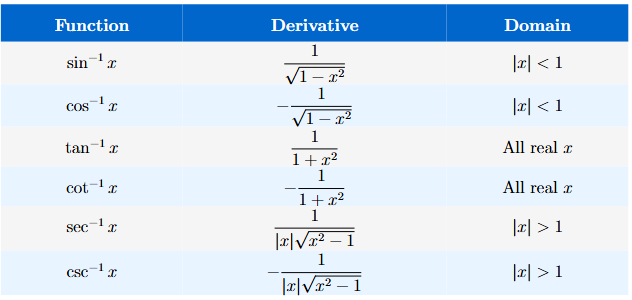
Each function has a specific domain that must always be considered when differentiating.

Why Are Derivatives of Inverse Trigonometric Functions Important?

Derivatives of inverse trigonometric functions are important because:
A strong conceptual understanding helps avoid common exam mistakes.

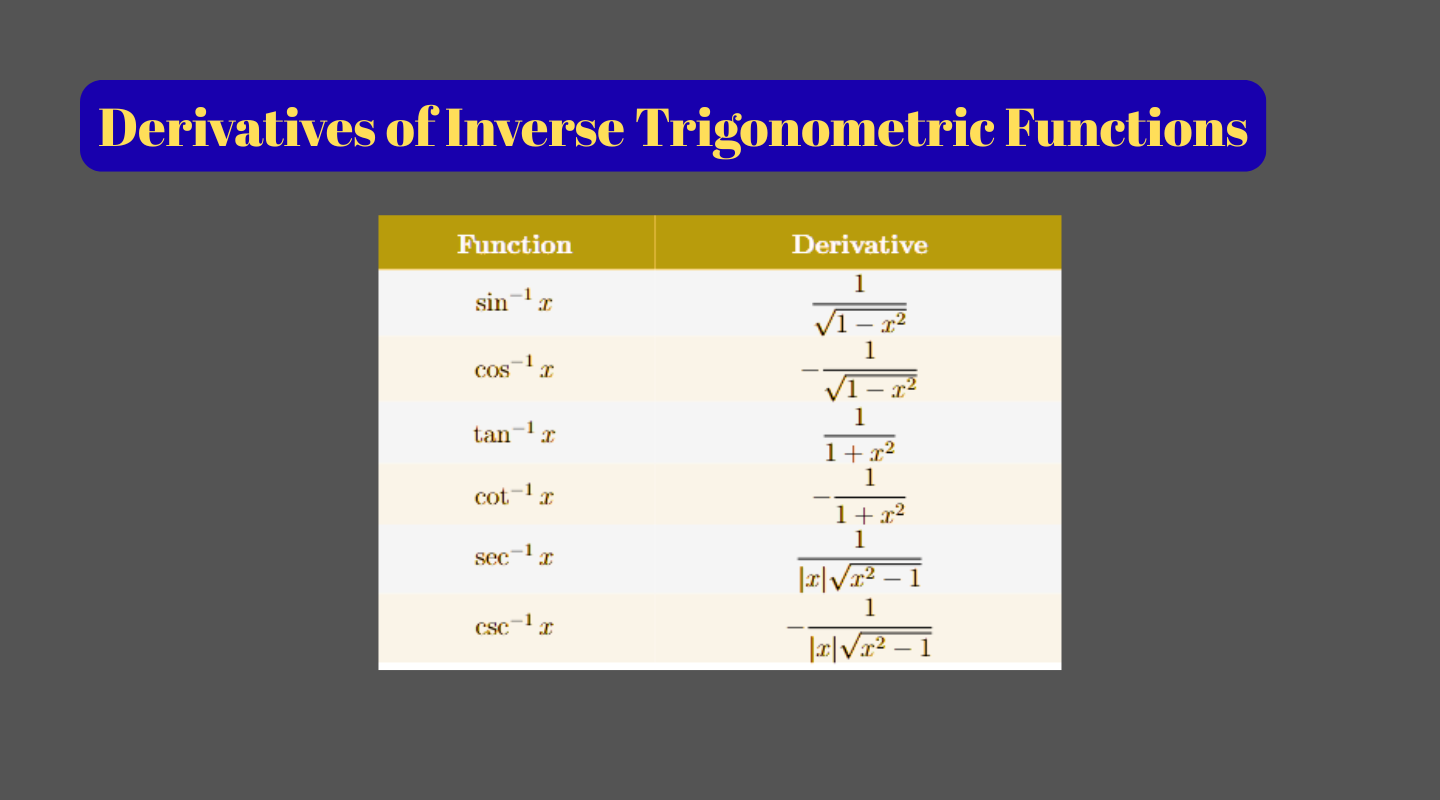
Derivative Formulas of Inverse Trigonometric Functions

Solved Examples

Example 1
Differentiate y=\tan^{-1}(3x^2)
Solution:
\frac{dy}{dx}=\frac{1}{1+(3x^2)^2}\cdot 6x
\frac{6x}{1+9x^4}
Example 2
Find the derivative of the function: y=\sin^{-1}\left(\frac{2x}{1+x^2}\right)
Solution:
Given: y=\sin^{-1}\left(\frac{2x}{1+x^2}\right)
\frac{dy}{dx} =\frac{1}{\sqrt{1-\left(\frac{2x}{1+x^2}\right)^2}} \cdot \frac{d}{dx}\left(\frac{2x}{1+x^2}\right)
Simplify inside the square root:
1-\left(\frac{2x}{1+x^2}\right)^2 =\frac{(1+x^2)^2-4x^2}{(1+x^2)^2}
1=\frac{1+2x^2+x^4-4x^2}{(1+x^2)^2} =\frac{(1-x^2)^2}{(1+x^2)^2}
\sqrt{1-\left(\frac{2x}{1+x^2}\right)^2} =\frac{1-x^2}{1+x^2}
Now differentiate the inner function using quotient rule:
\frac{d}{dx}\left(\frac{2x}{1+x^2}\right) =\frac{(1+x^2)(2)-(2x)(2x)}{(1+x^2)^2} =\frac{2-2x^2}{(1+x^2)^2}
\frac{dy}{dx} =\frac{1+x^2}{1-x^2}\cdot \frac{2(1-x^2)}{(1+x^2)^2}
\frac{dy}{dx}=\frac{2}{1+x^2}
Example 3
Find the derivative of the function: y=\tan^{-1}\left(\frac{1-x^2}{1+x^2}\right)
Solution:
\frac{dy}{dx} =\frac{1}{1+\left(\frac{1-x^2}{1+x^2}\right)^2} \cdot \frac{d}{dx}\left(\frac{1-x^2}{1+x^2}\right)
Simplify denominator:
1+\left(\frac{1-x^2}{1+x^2}\right)^2 =\frac{(1+x^2)^2+(1-x^2)^2}{(1+x^2)^2}
=\frac{2(1+x^4)}{(1+x^2)^2}
Differentiate inner function:
\frac{d}{dx}\left(\frac{1-x^2}{1+x^2}\right) =\frac{(1+x^2)(-2x)-(1-x^2)(2x)}{(1+x^2)^2} =\frac{-4x}{(1+x^2)^2}
\frac{dy}{dx} =\frac{(1+x^2)^2}{2(1+x^4)}\cdot \frac{-4x}{(1+x^2)^2}
\frac{dy}{dx}=\frac{-2x}{1+x^4}

Common Mistakes to Avoid

Practice with Mathaversity

Conclusion

Derivatives of inverse trigonometric functions are a foundational topic in AP Calculus AB. With strong conceptual understanding, proper use of formulas, and consistent practice, students can confidently solve exam-level problems.
Mathaversity is ready to help you get the highest grades if you need professional, targeted help to fill in the last gaps in your knowledge.