The idea of a function is very important in math, especially in AP Calculus AB. Limits, continuity, derivatives, and applications are all based on knowing how functions and their graphs work. Students who have a good understanding of different types of functions and how their graphs work can better understand mathematical models and solve real-world problems quickly.
This guide gives a full and detailed explanation of common functions and their graphs, including a clear mathematical definition, how they behave on a graph, their most important properties, and how they relate to AP Calculus AB.
What Is a Function?
A function is a rule that assigns exactly one output to each input.
Mathematically, a function is written as: f :\mathbb{R} \rightarrow \mathbb{R}
The set of all possible inputs is called the domain
The set of all possible outputs is called the range
A graph represents a function visually by plotting all ordered pairs (x,f(x)).
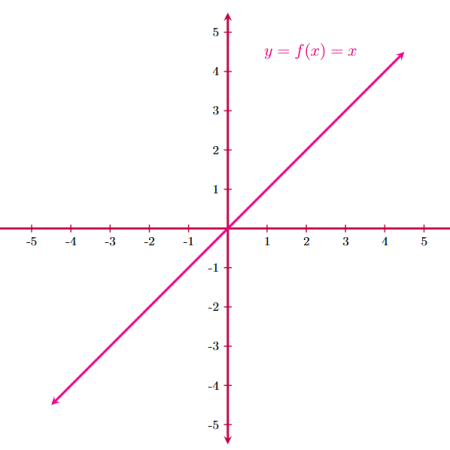
Identity Function
A function is called an identity function if each element of the domain is mapped to itself.
Properties
Domain: \mathbb{R}
Range: \mathbb{R}
One-to-one and onto
Constant Function
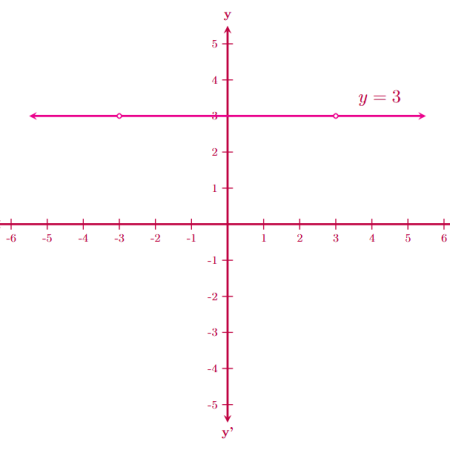
A function is called a constant function if it is of the form: f(x) = c. where c is a real constant.
Properties
Domain: \mathbb{R}
Range: \{c\}
No increase or decrease
The graph of a constant function y = f(x) = 3 is given below.
Polynomial Functions
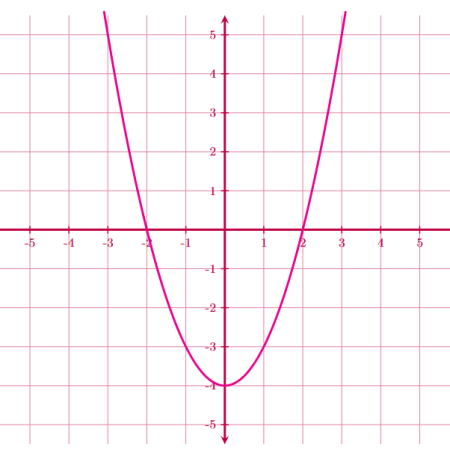
A function f : \mathbb{R} \rightarrow \mathbb{R} is said to be a polynomial function if for each x \in \mathbb{R}, f(x) = a_0 + a_1x + a_2x^2 + \dots + a_nx^n
where:
n is a non-negative integer
a_0, a_1, a_2, \dots, a_n \in \mathbb{R}
a_n \neq 0
Polynomial functions are continuous and smooth for all real values of x.
Rational Functions
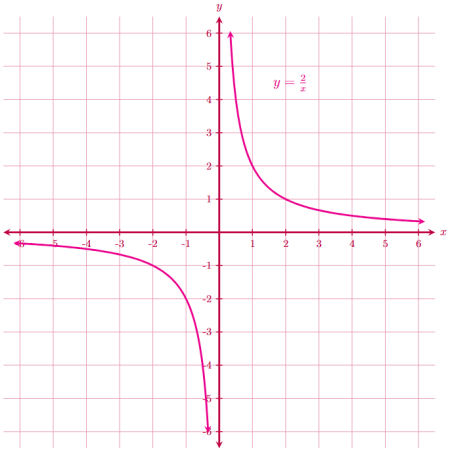
A function is called a rational function if: f(x) = \frac{p(x)}{q(x)}. where p(x) and q(x) are polynomial functions and q(x) \neq 0. The example graph of a rational function is given below:
Absolute Value Function
The absolute value function is defined as: f(x) = |x|
Piecewise Form
The absolute value function is defined as: |x| =
\begin{cases}
x, & x \ge 0 \\
-x, & x < 0
\end{cases}
Properties
Domain: \mathbb{R}
Range: |y \ge 0|
Not differentiable at x = 0
The graph of absolute value function y = |x| is given below.
Exponential Functions
A function of the form: f(x) = a^x, \quad a > 0, \ a \neq 1 is called an exponential function.
Properties
Domain: \mathbb{R}
Range: y > 0
Horizontal asymptote: y = 0
Conclusion
Understanding functions and their graphs is essential for success in AP Calculus AB. A strong foundation in graphical interpretation helps students analyze limits, derivatives, and real-world applications effectively.