L’Hôpital’s Rule Explained: Indeterminate Forms & AP Calculus FRQ
Introduction
In AP Calculus BC, limits play a central role in defining derivatives and understanding continuity. However, sometimes direct substitution into a limit produces expressions such as \frac{0}{0} \quad \text{or} \quad \frac{\infty}{\infty}, which are called indeterminate forms. These expressions do not provide enough information to determine the limit value directly.
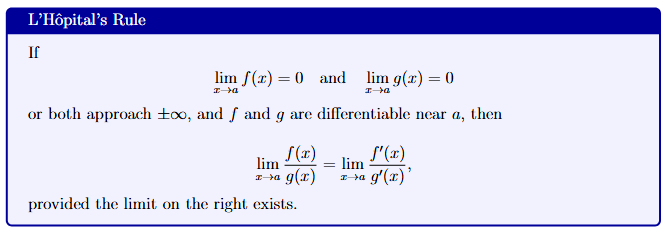
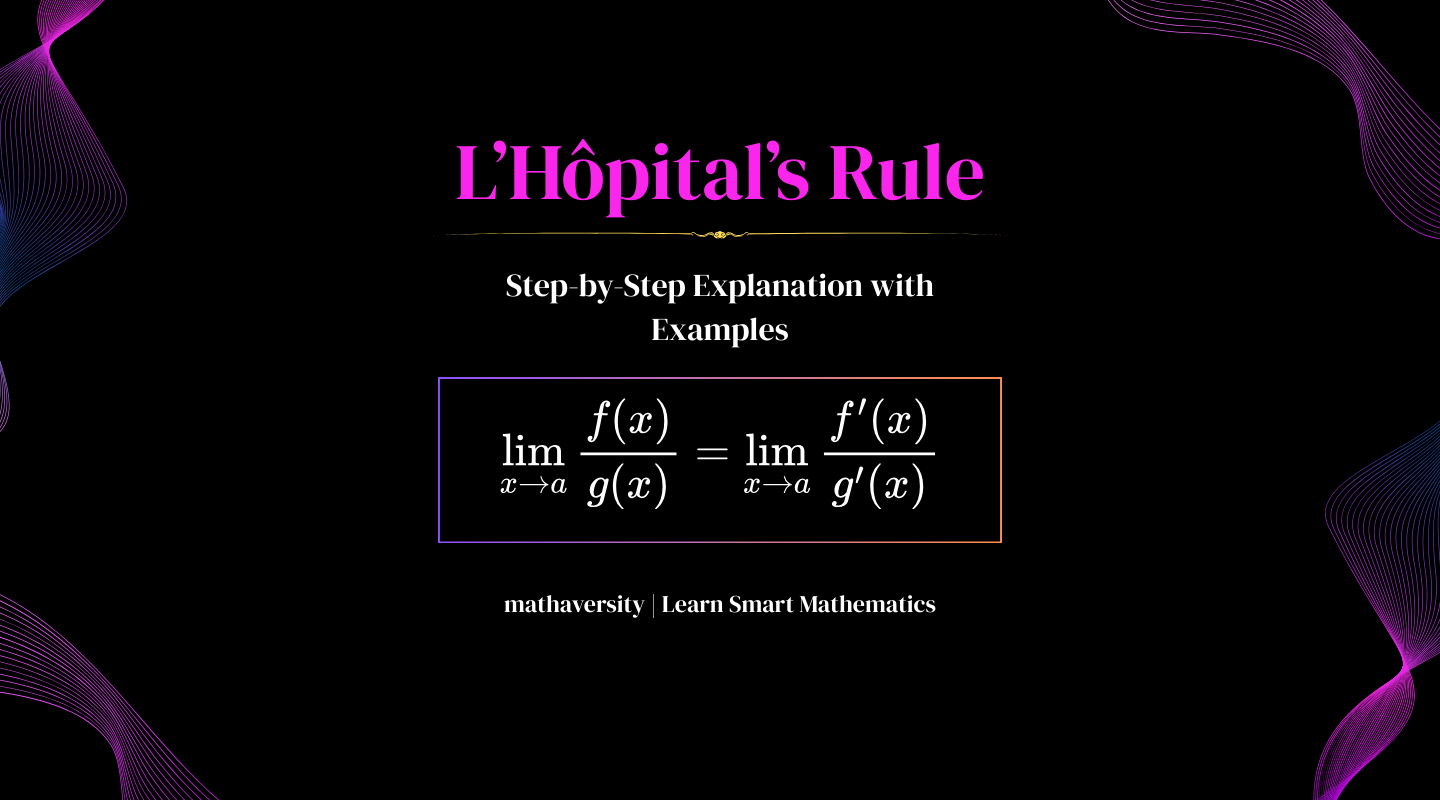
To evaluate such limits, we use one of the most powerful tools in calculus:
Historical Background
The French mathematician Guillaume de L'Hôpital (1661–1704) is the namesake of L'Hôpital's Rule.
However, Johann Bernoulli was the first to discover the rule.
In 1696, L'Hôpital included it in the first calculus textbook.
Theoretical Foundation
L’Hôpital’s Rule is based on the Cauchy Mean Value Theorem.
Near a point a, if both numerator and denominator approach zero,
their ratio behaves like the ratio of their derivatives:
\dfrac{f(x)}{g(x)} \approx \dfrac{f'(x)}{g'(x)}
This reflects how fast each function approaches zero.
Thus, limits are governed by instantaneous rates of change.
Indeterminate Forms
Common indeterminate forms include:
\dfrac{0}{0}, \quad \dfrac{\infty}{\infty}, \quad 0\cdot\infty,
\quad \infty-\infty, \quad 1^\infty, \quad 0^0, \quad \infty^0
L’Hôpital’s Rule applies directly only to:
\frac{0}{0} \quad \text{and} \quad \frac{\infty}{\infty}.
Other forms must first be rewritten as a quotient.
How to Apply L’Hôpital’s Rule
- Substitute the limit value.
- Verify the result is 0/0 or \infty/\infty.
- Differentiate numerator and denominator separately.
- Re-evaluate the limit.
- If still indeterminate, repeat.
Solved Examples
Example
Evaluate:
\lim_{x\to 0} \dfrac{\sin x}{x}
Solution
Substitution gives \dfrac{0}{0}.
Apply L’Hôpital’s Rule:
\dfrac{\cos x}{1}
\lim_{x\to 0} \cos x = 1
Example
Evaluate:
\lim_{x\to 0} \dfrac{1-\cos x}{x^2}
Solution
First derivative:
\dfrac{\sin x}{2x}
Still \dfrac{0}{0}.
Second derivative:
\dfrac{\cos x}{2}
= \dfrac{1}{2}
Example
Evaluate:
\lim_{x\to 0^+} x \ln x
Solution
Rewrite:
\dfrac{\ln x}{1/x}
Differentiate:
\dfrac{1/x}{-1/x^2} = -x
\lim_{x\to 0^+} -x = 0
Example
Evaluate:
\lim_{x\to\infty}\left(1+\dfrac{2}{x}\right)^x
Solution
Let y=\left(1+\dfrac{2}{x}\right)^x.
Take natural log:
\ln y = x\ln\left(1+\frac{2}{x}\right)
Rewrite and apply L’Hôpital:
\ln y = 2=e^2
Growth Rate Comparison
As x \to \infty:
\ln x \ll x^r \ll a^x \ll x!
This means:
- Logarithms grow slowest.
- Polynomials grow faster.
- Exponentials dominate polynomials.
- Factorials grow fastest.
Example:
\lim_{x\to\infty}\dfrac{x^3}{e^{2x}}=0
Exponential growth dominates polynomial growth.
Common Mistakes to Avoid
- Using L’Hôpital without checking indeterminate form.
- Forgetting to differentiate numerator and denominator separately.
- Stopping too early when still in \frac{0}{0}.
- Applying rule to non-differentiable functions.
Frequently Asked Questions (FAQs)
Q1. Is L’Hôpital’s Rule in AP Calculus AB?
Yes, but AP Calculus BC covers more advanced applications.
Q2. Can it be applied multiple times?
Yes, as long as the form remains indeterminate.
Q3. Does it work for every limit?
No. Only for 0/0 or \infty/\infty forms (unless rewritten).
Conclusion
L’Hôpital’s Rule is more than just a mathematical trick.
It demonstrates how instantaneous rates of change govern limits.
On a more complex level, it links:
- Derivatives
- Growth asymptotically
- Extensions of Taylor
- Dominance by exponential
This rule serves as the basis for sophisticated mathematical analysis and is crucial for success in AP Calculus AB and BC.
Mathaversity is ready to help you get the highest grades if you need
professional, targeted help to fill in the last gaps in your knowledge.