Mean Value Theorem
Introduction
In calculus, we frequently contrast a function's behavior at a single point with its behavior over a whole interval. These two concepts are precisely connected by the Mean Value Theorem (MVT). It ensures that there is at least one point where the instantaneous rate of change equals the average rate of change over the interval for a sufficiently smooth function.
This theorem frequently appears in both conceptual and application-based exam questions and is a fundamental idea in AP Calculus AB.
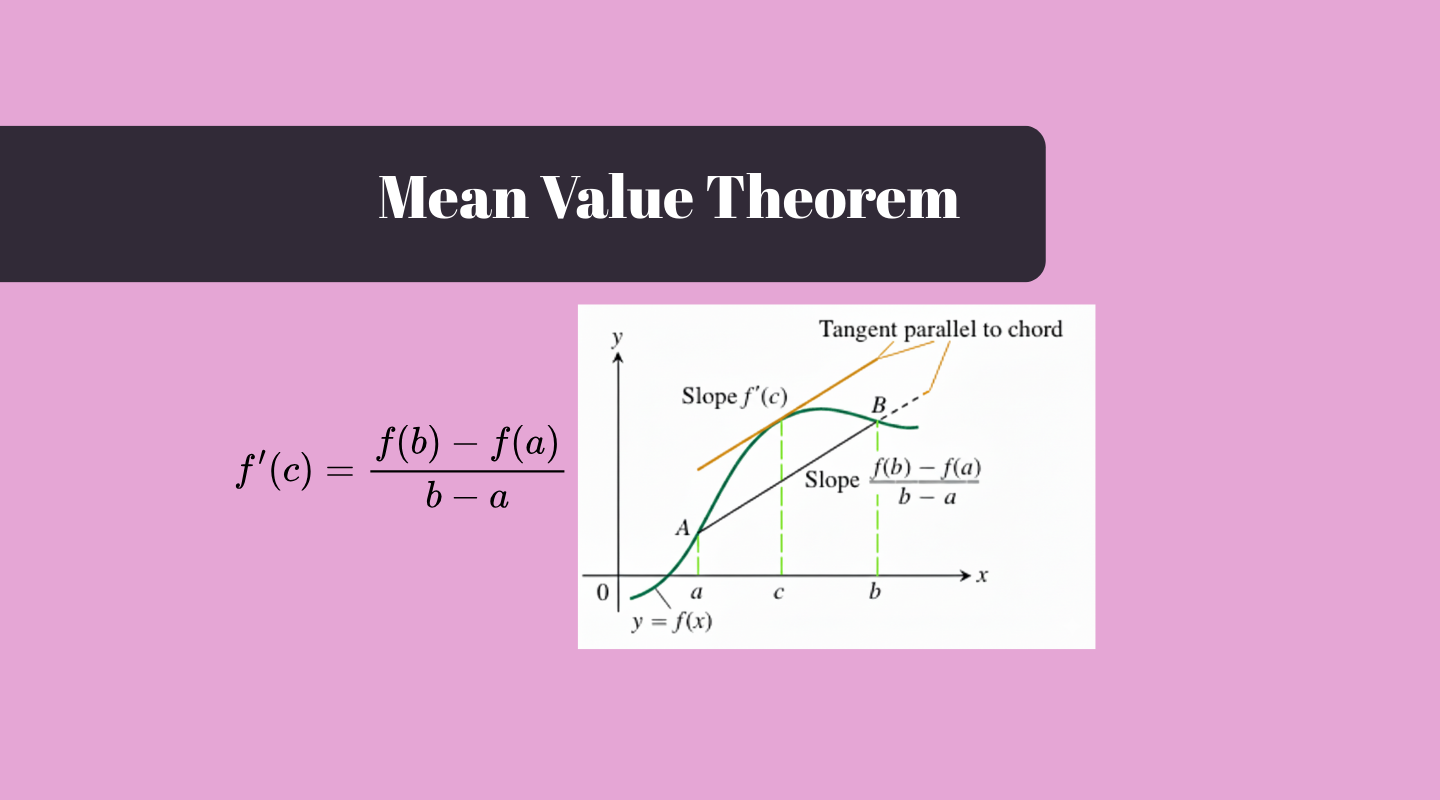
Average Rate of Change vs Instantaneous Rate of Change
The average rate of change of a function over an interval [a,b] is given by
\dfrac{f(b)-f(a)}{b-a}
This represents the slope of the secant line joining the endpoints.
The instantaneous rate of change is the derivative f'(x), which represents the slope of the tangent line at a specific point.
The Mean Value Theorem states that these two quantities must be equal at least once inside the interval.
Statement of the Mean Value Theorem
If a function f(x) satisfies the following conditions:
- f(x) is continuous on [a,b]
- f(x) is differentiable on (a,b)
Then there exists a number c \in (a,b) such that
f'(c) = \dfrac{f(b)-f(a)}{b-a}
Why the Conditions Are Important
Continuity
Continuity ensures the graph has no breaks or jumps. Without continuity, the function may skip values, making the theorem invalid.
Differentiability
Differentiability guarantees smoothness. If a function has sharp corners or cusps, a tangent line may not exist at some points.
Both conditions are essential for the theorem to hold.
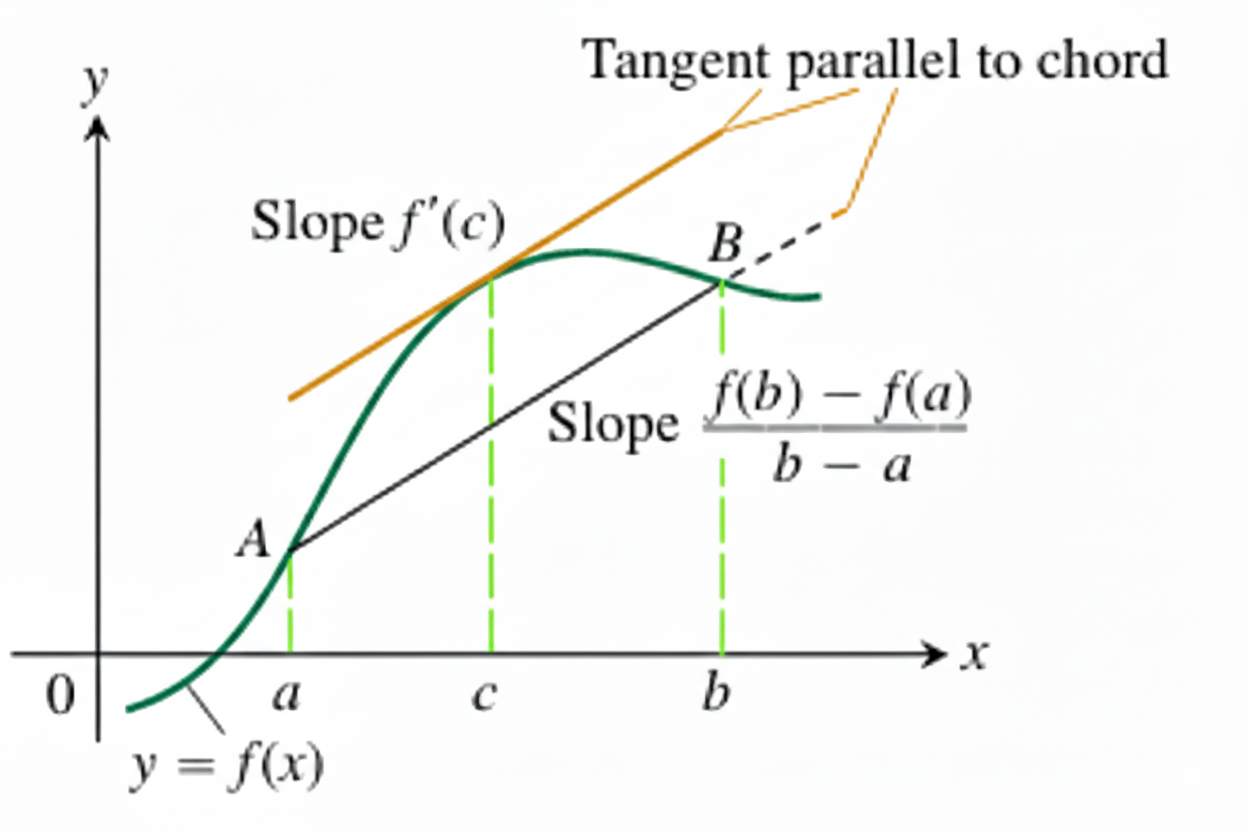
Geometric Interpretation of Mean Value Theorem
The Mean Value Theorem states that for a function continuous on [a,b] and differentiable on (a,b), there exists at least one point c \in (a,b) such that the slope of the tangent at c is equal to the slope of the secant
line joining (a,f(a)) and (b,f(b)).
Steps to Apply the Mean Value Theorem
To correctly apply the Mean Value Theorem in problem-solving, follow these
structured steps:
1. State whether the function is continuous on [a,b].
2. State whether the function is differentiable on (a,b).
3. Compute the average rate of change.
4. Find the derivative f'(x).
5. Solve the equation f'(c)=\frac{f(b)-f(a)}{b-a}
6. Verify that the value of c lies in (a,b).
Skipping any of these steps can lead to incomplete or incorrect solutions.
Relationship with Rolle’s Theorem
Rolle’s Theorem is a special case of the Mean Value Theorem where f(a)=f(b). In that case,
f'(c)=0
for some c in (a,b), meaning the tangent line is horizontal
Solved Problems on Mean Value Theorem
Problem 1
Verify the Mean Value Theorem for the function f(x)=x^2+2x on the interval [1,3] and find the value of c.
Solution:
Step 1: Checking conditions
Since f(x) is a polynomial function, it is continuous on [1,3] and differentiable on (1,3).
Hence, the Mean Value Theorem is applicable.
Step 2: Average rate of change
\dfrac{f(3)-f(1)}{3-1}
= \dfrac{(9+6)-(1+2)}{2}
= \dfrac{12}{2} = 6.
Step 3: Derivative of the function
f'(x)=2x+2
Step 4: Solve f'(c)=6
2c+2=6 \Rightarrow c=2
Since c \in (1,3) , the Mean Value Theorem is verified.
Problem 2
Verify the Mean Value Theorem for the function f(x)=\sqrt{x+1} on the interval [0,3].
Solution:
Step 1: Checking conditions
The function is continuous on [0,3] and differentiable on (0,3).
Therefore, MVT applies.
Step 2: Average rate of change
\dfrac{f(3)-f(0)}{3-0}
= \dfrac{2-1}{3}
= \dfrac{1}{3}
Step 3: Derivative
f'(x)=\dfrac{1}{2\sqrt{x+1}}
Step 4: Solve
\dfrac{1}{2\sqrt{c+1}}=\dfrac{1}{3}
\Rightarrow \sqrt{c+1}=\dfrac{3}{2}
\Rightarrow c=\dfrac{5}{4}
Since c \in (0,3), the theorem is satisfied.
Problem 3
Verify the Mean Value Theorem for f(x)=x^3-6x on the interval [1,3].
Solution:
Step 1: Conditions
The function is a polynomial, hence continuous and differentiable.
Step 2: Average rate of change
\dfrac{f(3)-f(1)}{3-1}
= \dfrac{(27-18)-(1-6)}{2}
= \dfrac{14}{2}=7
Step 3: Derivative
f'(x)=3x^2-6
Step 4: Solve
3c^2-6=7
\Rightarrow 3c^2=13
\Rightarrow c=\sqrt{\frac{13}{3}}
The value of c lies in (1,3), hence MVT is verified.
Problem 4
Verify the Mean Value Theorem for f(x)=\sin x on the interval [0,\pi].
Solution:
Step 1: Conditions
The function \sin x is continuous on [0,\pi] and differentiable on (0,\pi).
Step 2: Average rate of change
\dfrac{\sin\pi-\sin0}{\pi-0}=0.
Step 3: Derivative
f'(x)=\cos x.
Step 4: Solve
\cos c=0
\Rightarrow c=\dfrac{\pi}{2}.
Since c \in (0,\pi), the Mean Value Theorem holds.
Problem 5
A particle moves along a straight line according to s(t)=t^3-3t^2+2t for 0 \le t \le 2.
Show that there exists a time c such that instantaneous velocity equals average velocity.
Solution:
Step 1: Average velocity
\dfrac{s(2)-s(0)}{2}
= \dfrac{(8-12+4)-0}{2}
= 0.
Step 2: Instantaneous velocity
v(t)=s'(t)=3t^2-6t+2.
Step 3: Solve
3c^2-6c+2=0.
c=\dfrac{6\pm\sqrt{36-24}}{6}
=1\pm\dfrac{\sqrt{3}}{3}.
At least one value of c lies in (0,2).
Hence, the Mean Value Theorem is verified.
The Significance of MVT in AP Calculus AB
The Mean Value Theorem is used to:
- Analyze increasing and decreasing behavior
- Justify inequalities
- Solve motion problems
- Build deeper understanding of derivatives
Typical Errors
- Neglecting to verify differentiability or continuity
- Endpoint values are used as c
- Confusing MVT with Rolle’s Theorem
- Applying MVT to functions with corners
Frequently Asked Questions (FAQs)
Q1: Is the value of c unique?
No. A function may have more than one point where the condition of the Mean
Value Theorem is satisfied.
Q2: Can the Mean Value Theorem fail?
Yes. If either continuity or differentiability is violated, the theorem does
not apply.
Q3: How is Rolle’s Theorem related to MVT?
The Mean Value Theorem ensures that there is a point at which the average rate of change and the instantaneous rate of change coincide for any smooth function. This theorem is crucial for success in AP Calculus AB and serves as the basis for many more complex concepts in calculus.
Conclusion
The extreme behavior of functions on an interval is described by maximum and minimum values. Students can methodically ascertain these values by utilizing derivatives, critical points, and the Closed Interval Method. A key component of AP Calculus AB, this subject lays the groundwork for optimization issues and practical applications.