Mathaversity Tutors

Parametric Curves in the Plane (AP Calculus BC) – Derivatives, Arc Length & Cycloids Explained

Introduction

In standard algebra, curves are typically written as y=f(x). However, many important curves in mathematics and physics cannot be expressed this way.

For example, the circle: x^2 + y^2 = r^2

fails the vertical line test and therefore cannot be written as a single function y=f(x).
Parametric Curves in the Plane

Why Parametric Curves Matter

This restriction is overcome by parametric equations, which describe x and y in terms of a third variable, the parameter t:
x = f(t), \quad y = g(t)
As t varies over an interval, the ordered pair (x(t), y(t)) traces a curve in the plane.
In AP Calculus BC, parametric curves are essential because they:

Understanding the Geometry of Parametric Curves

Each value of t corresponds to exactly one point (x,y). If t represents time, then the curve represents the path of a moving particle.
Key ideas:
This makes parametric curves more flexible than rectangular functions.

Graphing Parametric Curves — Deep Explanation

To sketch a parametric curve carefully:
Direction is crucial in AP problems.

Example 1: Eliminating the Parameter and Determining Direction

Given the parametric equations x = 4\cos t, \quad y = 4\sin t,

Solution

Step 1: Eliminate the parameter.
Square both equations:
x^2 = 16\cos^2 t
y^2 = 16\sin^2 t
Add:
x^2 + y^2 = 16(\cos^2 t + \sin^2 t)
Using \cos^2 t + \sin^2 t = 1:
x^2 + y^2 = 16
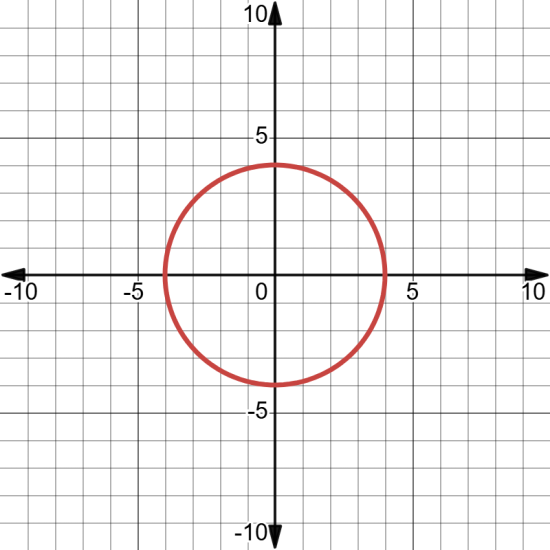
This is a circle of radius 4 centered at the origin.
Step 2: Determine direction of motion.
Evaluate key points:
t=0 \Rightarrow (4,0)
t=\dfrac{\pi}{2} \Rightarrow (0,4)
Since the motion moves from $(4,0)$ to $(0,4)$, the curve is traced counterclockwise
Graph
Eliminating-the-Parameter

Derivatives of Parametric Equations

If x = f(t), \quad y = g(t)
Then the slope of the tangent line is:
\dfrac{dy}{dx} = \dfrac{\dfrac{dy}{dt}}{\dfrac{dx}{dt}}
This formula comes from the Chain Rule:
\dfrac{dy}{dx} = \dfrac{dy}{dt} \cdot \dfrac{dt}{dx}
Vertical tangents occur when:
\dfrac{dx}{dt} = 0
Horizontal tangents occur when:
\dfrac{dy}{dt} = 0

Arc Length of a Parametric Curve

The arc length formula is derived from the Pythagorean theorem.
A small displacement:
ds = \sqrt{(dx)^2 + (dy)^2}
Divide by dt:
ds = \sqrt{\left(\dfrac{dx}{dt}\right)^2 + \left(\dfrac{dy}{dt}\right)^2} \, dt
Thus,
L = \int_a^b \sqrt{ \left(\dfrac{dx}{dt}\right)^2 + \left(\dfrac{dy}{dt}\right)^2 } \, dt

Example 2: Arc Length of a Parametric Curve

Find the total arc length of the curve x = 4\cos t, \quad y = 4\sin t for 0 \le t \le 2\pi.

Solution

Step 1: Compute derivatives.
\dfrac{dx}{dt} = -4\sin t
\dfrac{dy}{dt} = 4\cos t
Step 2: Substitute into arc length formula.
L = \int_0^{2\pi} \sqrt{ (-4\sin t)^2 + (4\cos t)^2 } \, dt
= \int_0^{2\pi} \sqrt{16\sin^2 t + 16\cos^2 t} \, dt
= \int_0^{2\pi} \sqrt{16(\sin^2 t + \cos^2 t)} \, dt
= \int_0^{2\pi} 4 \, dt
Step 3: Evaluate integral.
L = 4(2\pi) = 8\pi
Thus, the total arc length is: 8\pi

Example 3: Length of One Arch of a Cycloid

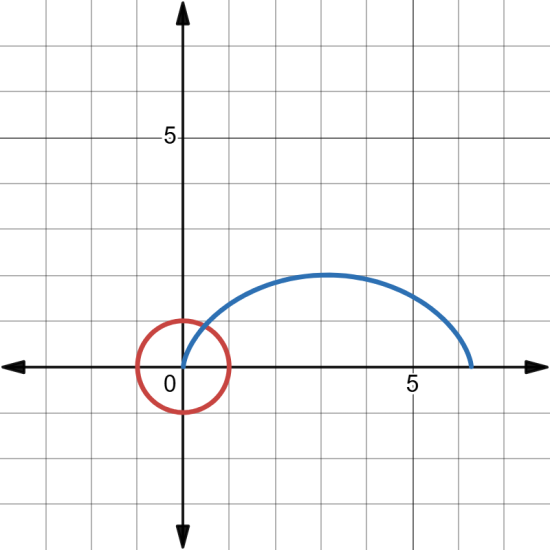
A cycloid is defined by x = r(t - \sin t), \quad y = r(1 - \cos t)

Find the length of one arch of the cycloid for 0 \le t \le 2\pi.

Solution
Step 1: Compute derivatives.
\frac{dx}{dt} = r(1 - \cos t)
\frac{dy}{dt} = r\sin t
Step 2: Apply arc length formula.
L = \int_0^{2\pi} \sqrt{ [r(1 - \cos t)]^2 + [r\sin t]^2 } \, dt
Factor r^2:
= r \int_0^{2\pi} \sqrt{ (1 - \cos t)^2 + \sin^2 t } \, dt
Step 3: Simplify inside square root.
(1 - \cos t)^2 + \sin^2 t = 1 - 2\cos t + \cos^2 t + \sin^2 t
= 2 - 2\cos t
Using identity:
2 - 2\cos t = 4\sin^2\left(\frac{t}{2}\right)
Step 4: Simplify integral.
L = r \int_0^{2\pi} 2\sin\left(\frac{t}{2}\right) \, dt
L = 8r
Length of One Arch of a Cycloid

Frequently Asked Questions (FAQs)

Parametric equations are used when a curve cannot be written as a single-valued function of x[/katex. For example, a circle fails the vertical line test and cannot be expressed as [katex]y=f(x) without splitting it into two functions.

Parametric form: x = f(t), \quad y = g(t)

allows us to describe more general curves and also model motion where $t$ represents time.

If x = f(t), \quad y = g(t), then by the Chain Rule, \frac{dy}{dx} = \frac{\frac{dy}{dt}}{\frac{dx}{dt}}

provided that \frac{dx}{dt} \neq 0.

This formula allows us to compute the slope of the tangent line even when y is not written directly as a function of x.

The arc length of a parametric curve from t=a to t=b is:

L = \int_a^b \sqrt{ \left(\frac{dx}{dt}\right)^2 + \left(\frac{dy}{dt}\right)^2 } \, dt

This formula is derived from the Pythagorean Theorem and measures the total distance traveled along the curve.

Conclusion

The modeling of motion, geometry, and complex curves like cycloids is made possible by parametric curves, which also extend classical function theory.
Gaining mastery of this subject improves comprehension of integrals, derivatives, and geometric intuition—all of which are essential for success in AP Calculus BC.
Mathaversity is ready to help you get the highest grades if you need professional, targeted help to fill in the last gaps in your knowledge.