- Call now to book a trial session!
- +18787865635

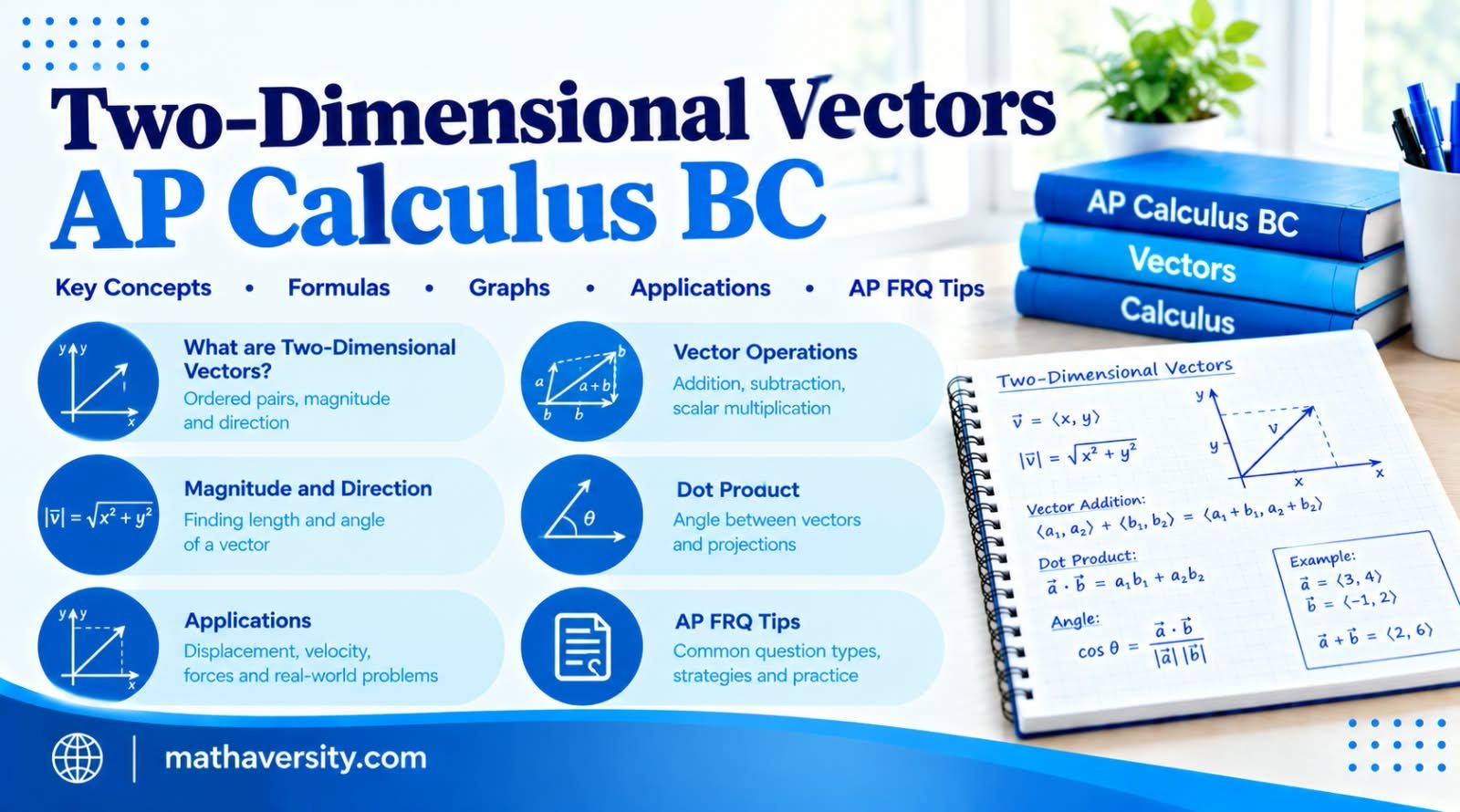
Two-Dimensional Vectors AP Calculus BC
Introduction
A conceptual grasp of motion is necessary to navigate the world of AP Calculus BC. Today, we investigate 2D vectors, which serve as a link between dynamic motion and algebra.
Understanding vectors is more than just a requirement for the exam; it is the foundation for physics, engineering, and computer graphics. In this guide, we will move beyond basic "arrows" and dive deep into Vector-Valued Functions, exploring how the fundamental theorems of calculus allow us to track a particle's position, determine its instantaneous speed, and calculate the total distance it travels across a two-dimensional landscape.
The Anatomy of a 2D Vector
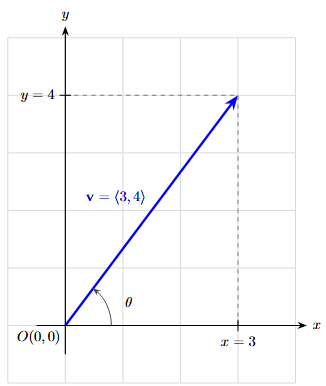
Magnitude (Length)
Vector Operations: The Essentials
Vector Addition
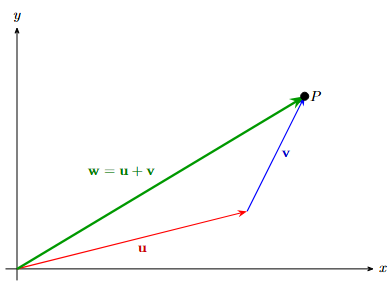
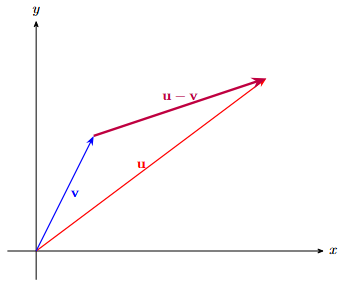
Vector Subtraction
Scalar Multiplication
The Dot Product
Fundamentals of Vector Algebra: Step-by-Step Examples
Example 1: Vector Addition and Subtraction
- (a) \mathbf{u} + \mathbf{v}
- (b) \mathbf{u} - \mathbf{v}
Solution
Example 2: Scalar Multiplication
Solution
Example 3: The Dot Product (Scalar Product)
Solution
Example 4: Application - Angle Between Vectors
Solution
Calculus Applications: Position, Velocity, and Acceleration
- Position: \mathbf{r}(t) = \langle x(t), y(t) \rangle
- Velocity: \mathbf{v}(t) = \mathbf{r}'(t) = \langle x'(t), y'(t) \rangle
- Acceleration: \mathbf{a}(t) = \mathbf{v}'(t) = \langle x''(t), y''(t) \rangle
- Speed:This is the magnitude of the velocity vector: \text{Speed} = \|\mathbf{v}(t)\| = \sqrt{(x'(t))^2 + (y'(t))^2}
Example: Particle Motion
Solution:
Integration and Total Distance
Challenge Problems
Problem 1: The Spiral Path
- 1. Find the velocity vector \mathbf{v}(t).
- 2. Find the speed of the particle at t = \pi.
- 3. Set up, but do not evaluate, an integral expression for the total distance traveled by the particle from t=0 to t=2\pi.
Solution
Problem 2: Finding Initial Position
Solution
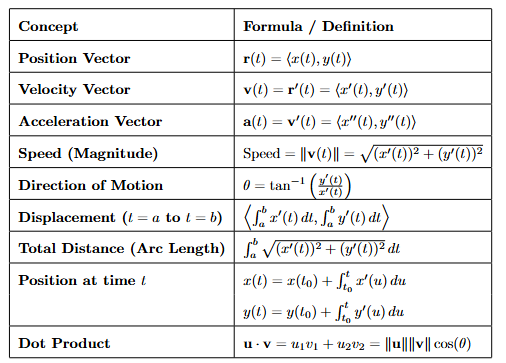
AP Calculus BC: 2D Vector Formula Cheat Sheet
Frequently Asked Questions (FAQs)
Q1. What is the difference between velocity and speed in 2D?
Q2. When is a particle at rest in a 2D plane?
provided that \frac{dx}{dt} \neq 0.
If only one component is zero, the particle is still moving (e.g., if y is not written directly as a function of x'(t) = 0, it is moving vertically).