In precalculus, the concept of absolute value plays a central role in understanding distance on the real number line. Absolute value describes how far a number is from zero, regardless of direction. Since distance is always non-negative, absolute values are never negative. This idea becomes particularly useful when solving equations, inequalities, and modeling situations involving distance.
Definition of Absolute Value
The absolute value of a real number x is defined mathematically as
|x|=
\begin{cases}
x, & x \ge 0 \\
-x, & x < 0
\end{cases}
This definition shows that absolute value removes the negative sign from negative numbers while leaving positive numbers unchanged. Because of this, absolute value always produces a non-negative result.
Consider the following examples:
|5|=5, \qquad |-5|=5, \qquad |0|=0
These examples confirm that absolute value measures magnitude only, not direction.
Absolute Value Symbol
The absolute value of a number is represented using two vertical bars placed on either side of the expression. These vertical bars are called the absolute value symbol. The symbol indicates that we are considering only the magnitude of the number, without regard to its sign.
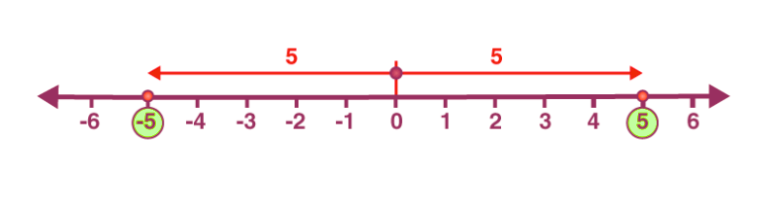
For a real number x, the absolute value is written as |x|. This notation means the distance of x from zero on the real number line. Since distance cannot be negative, the value of |x| is always non-negative.
Thus, the absolute value symbol is used to measure distance, magnitude, and size without considering direction.
Absolute Value and the Number Line
Absolute value can be visualized easily on the real number line. The distance of any point from zero corresponds to its absolute value.
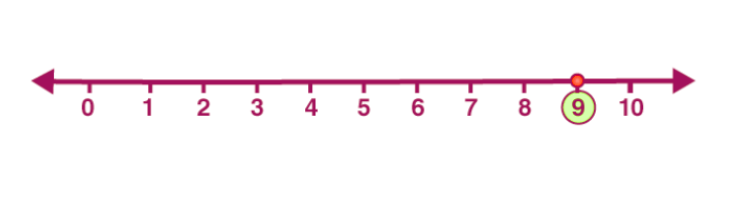
Example: Graph the absolute value of the number -9.
Solution: Absolute value of |-9| is +9.
So the graph for the absolute value of -9 will look like following
Absolute Value as Distance Between Two Numbers
Absolute value can also be used to find the distance between any two real numbers. If a and b are two numbers on the number line, the distance between them is given by
\text{Distance} = |a-b|
This formula works because subtraction gives directional distance, and absolute value removes the sign, leaving only magnitude.
Example
Find the distance between 4 and -2.
|4-(-2)| = |6| = 6
Thus, the two numbers are six units apart.
Distance from a Fixed Point
Absolute value expressions of the form |x-a| represent the distance between a variable point x and a fixed number a. This interpretation is important in solving inequalities.
For instance, the expression |x-3| represents the distance between x and 3 on the number line.
Absolute Value Inequalities
Absolute value inequalities describe distances within a range. Consider the inequality |x-2|<3
This means the distance between x and 2 is less than 3. Converting this into compound inequality gives -3<x-2<3
Adding 2 to each part results in -1<x<5
Hence, the solution includes all numbers within three units of 2.
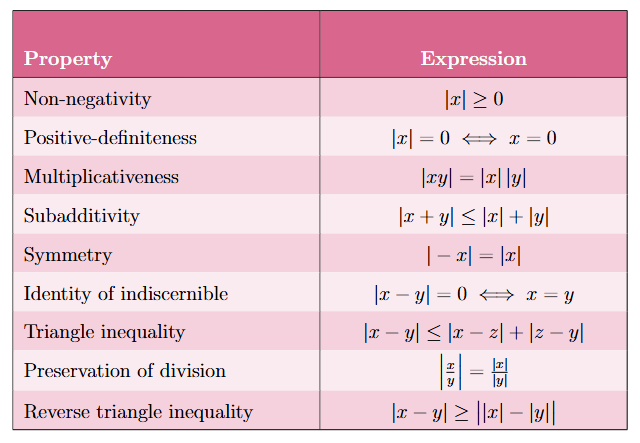
Absolute Value Properties
If x and y are real numbers, then the absolute values satisfy the following properties:
Problems and Solutions
Let us understand absolute value and distance with the help of the following examples.
Question 1
Find the absolute value for the following numbers:
(a) \left|-\dfrac{5}{8}\right|
(b) |-64|
(c) \left| \dfrac{9}{10} \right|
Solution
(a) Absolute value converts a negative number into a positive number. Apply the rule
\left| -\dfrac{5}{8} \right| = \dfrac{5}{8}
(b) The number is negative. Remove the negative sign
|-64| = 64
(c) The number is already positive. Absolute value does not change it
\left| \dfrac{9}{10} \right| = \dfrac{9}{10}
Question 2
Find the distance between -4 and 6.
Solution
Step 1: Distance between two numbers is given by absolute value:
\text{Distance} = |a - b|
Step 2: Substitute values
= |-4 - 6|
Step 3: Simplify inside
= |-10|
Step 4: Take absolute value
= 10
\textbf{Final Answer:} Distance = 10
Question 3
Solve |x - 5| = 2.
Solution
Step 1: Use the rule
|A| = B \Rightarrow A = B \quad \text{or} \quad A = -B
Step 2: Apply the rule
x - 5 = 2 \quad \text{or} \quad x - 5 = -2
Step 3: Solve each case
\textbf{Case 1:} x - 5 = 2
x = 2 + 5 = 7
\textbf{Case 2:} x - 5 = -2
x = -2 + 5 = 3
\textbf{Final Answer:} x = 7 \quad \text{or} \quad x = 3
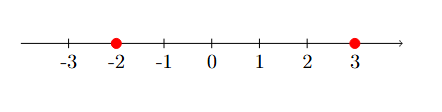
Question 4
Find the distance between the given numbers.
Solution
Step 1: Identify the points
a = -2, \quad b = 3
Step 2: Use distance formula
\text{Distance} = |a - b|
Step 3: Substitute values
= |-2 - 3|
Step 4: Simplify
= |-5| = 5
\textbf{Answer:} 5
Practice Questions
1) Evaluate each expression
(a) |85|
(b) |\sqrt{7}-3|
(c) |3-|-10||
(d) \left|\frac{-8}{16}\right|
2) Find the distance between the given numbers
(a) -4 and 6
(b) \frac{3}{4} and -\frac{5}{4}
Applications of Absolute Value
Absolute value appears in many real-life contexts. It is used to measure distance between locations, calculate error in measurements, describe temperature changes, and determine tolerances in engineering. In finance, absolute value represents magnitude of profit or loss without considering direction.
Frequently Asked Questions (FAQs)
Q1. What does absolute value represent?
Absolute value represents the distance of a number from zero.
Q2. Can absolute value be negative?
No, absolute value is always non-negative.
Q3. What does |x-a| mean?
It represents the distance between xand a.
Conclusion
Absolute value is an essential concept in precalculus that represents distance and magnitude without considering direction. It helps us understand how far a number lies from zero on the real number line and provides a convenient way to describe distances between numbers.
To further strengthen your understanding, you can also practice using our dedicated worksheet available at: