- Call now to book a trial session!
- +18787865635

AP Calculus AB Study Guide: Complete Guide for Students
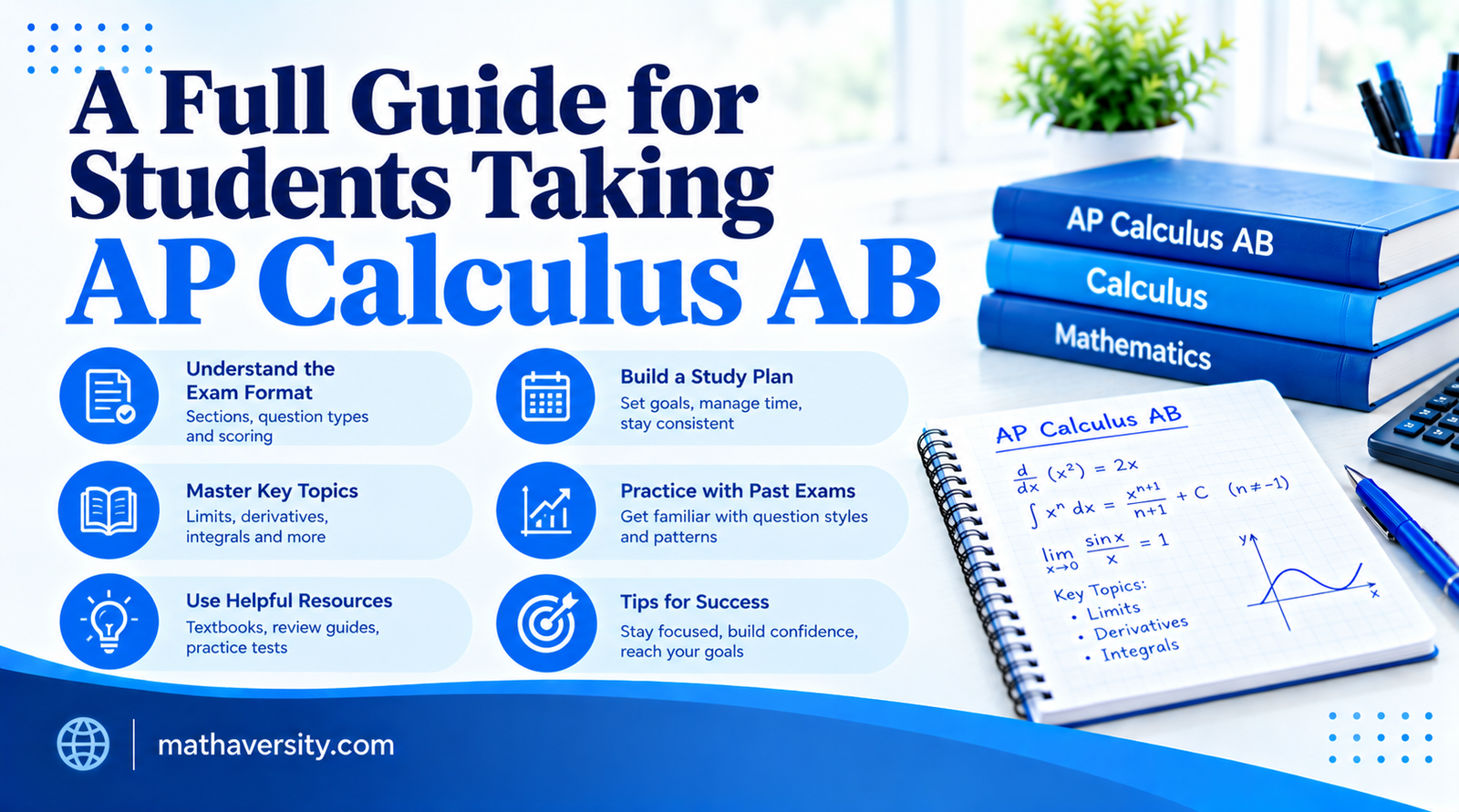
A Full Guide for Students Taking AP Calculus AB
The AP Calculus AB study guide is designed to help students understand essential calculus concepts, strengthen problem-solving skills, and prepare effectively for the AP Calculus AB exam. From limits and derivatives to integrals and their applications, this guide covers the key topics students need to develop a strong foundation in calculus.
This guide will tell students everything they need to know about AP Calculus AB, such as the syllabus, the format of the test, how to study, common mistakes, the best resources, and frequently asked questions.
What is the AP Calculus AB test?
Why AP Calculus AB is Important:
- Colleges and universities really like it, especially for STEM (Science, Technology, Engineering, and Mathematics) majors.
- Getting a good score can get you college credit, which saves you time and money.
- It helps students get ready for more advanced math classes like Calculus BC, Multivariable Calculus, or Differential Equations by making them more mature in math.
AP Calculus AB Course Outline
- Limits and continuity
- Comprehending limits at finite values and infinity
- Continuity and breaks
- Derivatives
- What a derivative is
- Rules for differentiation (power rule, product rule, quotient rule, chain rule)
- Uses: speed, acceleration, optimisation, and related rates
- The Fundamental Theorem of Calculus and Integrals
- Antiderivatives and definite integrals
- Riemann sums and the area beneath a curve
- The Basic Theorem of Calculus
- Uses of Integration
- The volumes of solids that revolve
- Space between curves
- Problems with motion that have to do with distance and displacement
- Differential Equations
- Slope fields
- Differential equations that can be separated
- Growth and decay that happens quickly
- Review and practise for the exam
- Answering questions from past tests
- Using ideas in real-life situations
Why should you take AP Calculus AB?
-
Get college credit and save money
- If you get a qualifying score (usually a 4 or 5), you might not have to take introductory calculus in college. This will save you money on tuition and give you more room for electives.
-
Make College Applications Better
- Admissions officers like it when students push themselves. AP Calculus AB shows that you are academically strong and ready for college-level work.
-
A strong base for STEM fields
- Calculus is a must if you want to study biology, physics, economics, computer science, or engineering.
-
Learn how to solve problems in the real world
- Calculus is used all over the place, from figuring out how fast businesses are growing to modelling how fast populations are growing in biology.
How the AP Calculus AB Exam Works
-
Part I: Multiple Choice
- Part A: 30 questions, 60 minutes, no calculator
- Part B: 15 questions in 45 minutes, with a calculator allowed
-
Part II: Questions with no answers (FRQs)
- Part A: 2 questions, 30 minutes, you can use a calculator
- Part B: 60 minutes, 4 questions, no calculator
-
The test checks:
- Understanding of concepts
- Fluency in procedures
- Putting ideas into practice in the real world
- Each part of the test counts for 50% of the total score.
How to Get Ready for AP Calculus AB
- About 58% of students who took AP Calculus AB got a 3 or higher.
- About 81% of people who took AP Calculus BC got a 3 or higher.
- It's surprising that BC has a higher pass rate because the students who take it are usually very well prepared.
How to Get Ready for AP Calculus AB
Get a handle on the main ideas
Keep practicing
Get good at algebra and pre-calculus
Get better at managing your time
- Don't spend too much time on one multiple-choice question.
- In FRQs, you should always show your work and explain why.
Study and tutoring in groups
- Studying with friends or hiring an online AP Calculus AB tutor can help you quickly understand hard ideas.
- Mistakes Students Often Make
Forgetting Why You Did Something in FRQs
Too Much Dependence on Calculators
Not good at algebra
Not doing word problems
Final Thoughts
- AP Calculus AB can be hard, but it's also one of the best things you can do in high school. Students can not only do well on the test, but also get ready for future STEM studies by practicing regularly, having a good grasp of the concepts, and using the right study methods.
- This complete guide to AP Calculus AB will help you get ready for the test, avoid common mistakes, and use the best resources. If you want to get college credit, raise your GPA, or just push yourself, AP Calculus AB will give you access to exciting academic opportunities.
- Do you need help making a decision or getting ready? Schedule a session with https://mathaversity.com today to get expert help with your AP Calculus work.
- Quick Links:
- What is the AP Calculus AB test?
- Why AP Calculus AB is Important:
- AP Calculus AB Course Outline
- Why should you take AP Calculus AB?
- How the AP Calculus AB Exam Works
- How to Get Ready for AP Calculus AB
- Forgetting Why You Did Something in FRQs
- Too Much Dependence on Calculators
- Not good at algebra
- Not doing word problems
- Final Thoughts