- Call now to book a trial session!
- +18787865635

Implicit Differentiation in AP Calculus AB: Complete Guide
Introduction
Implicit differentiation is a method for finding dy/dx when y is not written directly as a function of x. In AP Calculus AB, you differentiate both sides with respect to x, apply the chain rule to every y-term, and then solve for dy/dx. This guide explains the steps, formulas and solved examples of implicit differentiation.
In AP Calculus AB, not all equations are given in the form y=f(x). When x and y appear together in the same equation and it is difficult or impossible to solve explicitly for y, we use a technique called implicit differentiation.
This method allows us to find \dfrac{dy}{dx} directly by differentiating both sides of the equation with respect to x.
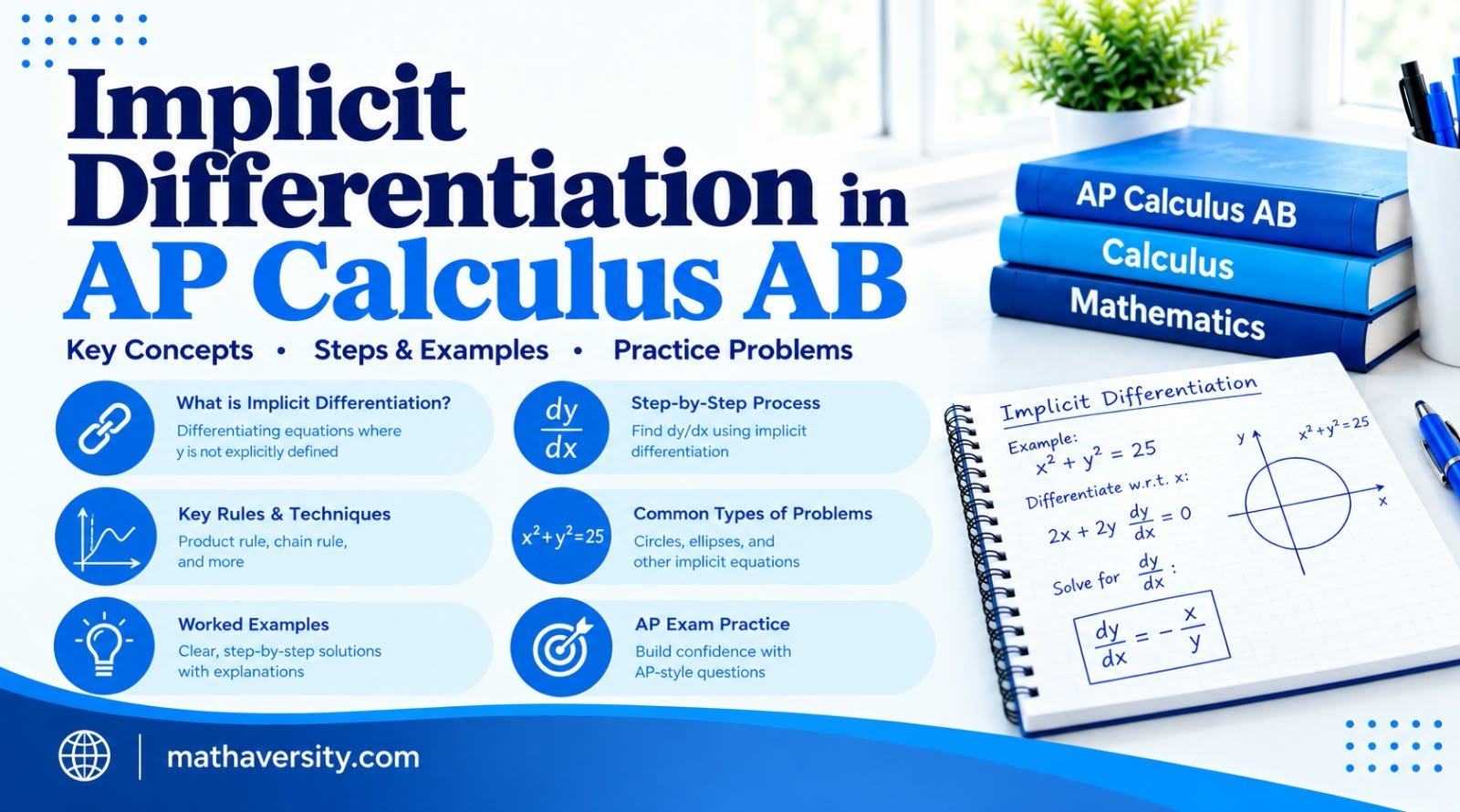
What Is Implicit Differentiation?
- y is not isolated on one side of the equation
- Both x and y appear together
Steps for Implicit Differentiation
- Differentiate both sides of the equation with respect to x.
- Every time you differentiate a y-term, multiply by dy/dx (chain rule).
- Use the product rule when x and y are multiplied.
- Collect all dy/dx terms on one side.
- Factor out dy/dx and solve for it.
Key Idea
Solved Examples
Finding the Slope at a Point
Common Mistakes
- Forgetting to include \frac{dy}{dx} when differentiating y terms
- Forgetting the product rule for terms like xy.
- Algebraic mistakes while solving for \frac{dy}{dx}
- Treating y as a constant.
- Not substituting the given point at the end.
Practice Questions
Free Practice Worksheets by Mathaversity
AP Calculus AB Exam Tips
- Write \frac{dy}{dx} in every step, because graders look for it.
- Implicit differentiation often appears in tangent line and related rates questions.
- Leave your answer in terms of x and y unless asked for a number.
- Check the slope by plugging in the point.
Online AP Calculus AB Tutoring
Frequently Asked Questions on Implicit Functions
Q1: What is an implicit function in calculus?
x^2 + y^2 = 25
Q2: When should we use implicit differentiation?
y cannot be easily isolated
Both x and y appear together in an equation
The equation represents curves like circles or ellipses
Q3: Is the chain rule always used in implicit differentiation?
Implicit differentiation automatically involves the chain rule whenever a term containing y is differentiated, even if it is not written explicitly.