Polar Coordinates in AP Calculus BC: Graphs, Area & Arc Length
Introduction
By describing points using a radius and an angle rather than horizontal and vertical distances, polar coordinates expand on the Cartesian coordinate system.
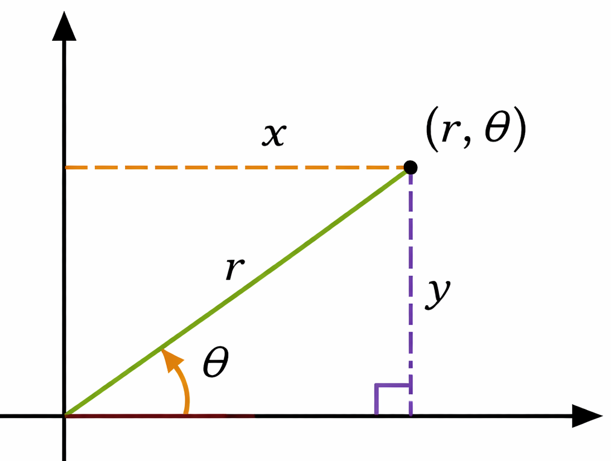
A point in polar form is written as: (r, \theta)
where:
r = distance from the origin
\theta = angle measured from the positive x-axis
Polar coordinates are utilized in AP Calculus BC for arc length, area calculations, and derivatives.
Polar coordinate
A two-dimensional coordinate system is referred to as the polar coordinate system when each point on a plane is determined by a distance from a reference point and an angle is taken from a reference direction.
Pole: The point of reference
The line segment ray from the pole in the reference direction is known as the polar axis.
The origin is referred to as a pole in the polar coordinate system.
Polar CoordinatesPolar Coordinates
Polar to Cartesian
x = r\cos\theta
y = r\sin\theta
Cartesian to Polar
r = \sqrt{x^2 + y^2}
\tan\theta = \frac{y}{x}
Quadrant analysis is essential when determining \theta
Graphing Polar Equations
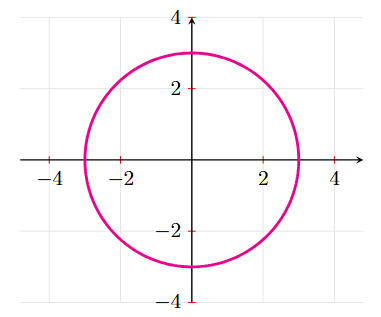
Example 1: Circle r = 3
This represents a circle centered at the origin with radius 3.
L = \int_0^\pi \sqrt{(2\theta)^2 + 2^2} \, d\theta
L = \int_0^\pi \sqrt{4\theta^2 + 4} \, d\theta
Factor:
= 2 \int_0^\pi \sqrt{\theta^2 + 1} \, d\theta
This requires substitution or hyperbolic methods.
Common AP Mistakes
Forgetting the \frac{1}{2} in area formula
Incorrect \theta interval for one petal
Ignoring symmetry
Not checking denominator when finding vertical tangents
Conceptual Depth: Why Polar Is Powerful
Polar coordinates simplify:
Circular motion
Spiral growth
Rotational symmetry
Oscillatory radial behavior
Many complex Cartesian equations become simple trigonometric forms in polar representation.
AP Exam Strategy Tips
Always sketch the curve before integrating.
Check symmetry to reduce computation.
Carefully determine correct \theta intervals.
Watch for negative r values.
Formula Summary
Conclusion
By using radial distance and angular displacement to represent curves, polar coordinates offer a potent substitute for the Cartesian coordinate system. This framework enables students to precisely evaluate arc length, calculate enclosed areas, identify tangent slopes, and analyze rotational symmetry in AP Calculus BC.
Students gain greater computational fluency and a deeper understanding of geometry by mastering conversion formulas, symmetry analysis, derivative techniques, and integral applications. One of the most elegant and conceptually rich topics in advanced calculus is polar coordinates, which combine trigonometry and calculus into a single analytical structure.
Confidence on the multiple-choice and free-response portions of the AP Calculus BC exam is ensured by regular practice with graph sketching, integration limits, and derivative interpretation.
Mathaversity is ready to help you get the highest grades if you need
professional, targeted help to fill in the last gaps in your knowledge.