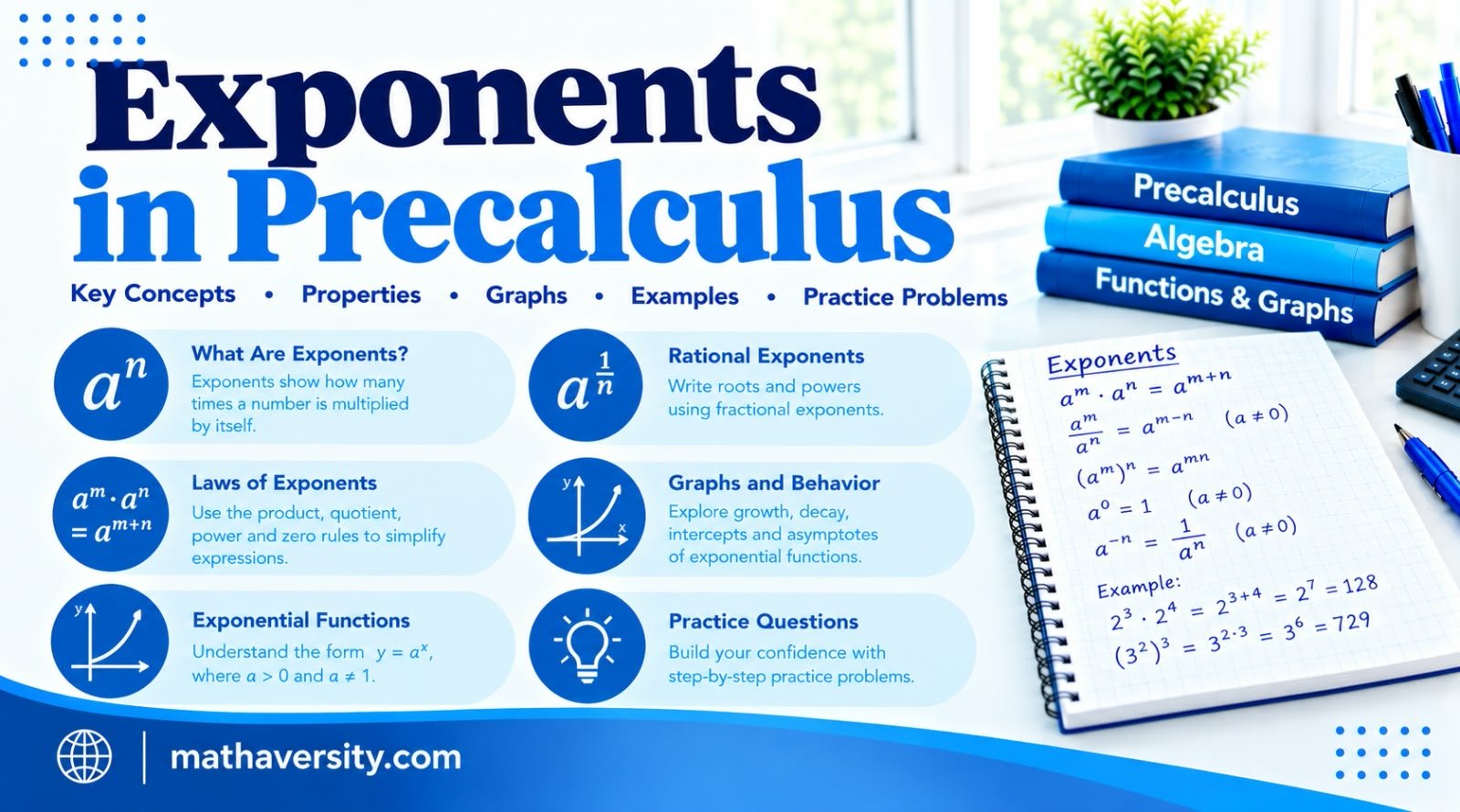
Exponents are used to represent repeated multiplication in a compact form. Instead of writing a number multiplied by itself many times, exponent notation provides a shorter and more convenient way. This concept is widely used in algebra, scientific notation, exponential growth, and higher-level mathematics.
What are Exponents and Powers?
The terms exponent and power are often used interchangeably, but they represent specific parts of a mathematical expression. When a number is multiplied by itself multiple times, we use exponential notation to represent it.
a^n = \underbrace{a \times a \times a \times \cdots \times a}_{n\text{ times}}
Here a is any number and n is a natural number.
a^n is also called the nth power of a.
a is the base and n is the exponent or index or power.
Example:
3^5 = 3 \times 3 \times 3 \times 3 \times 3 = 243
Laws of Exponents
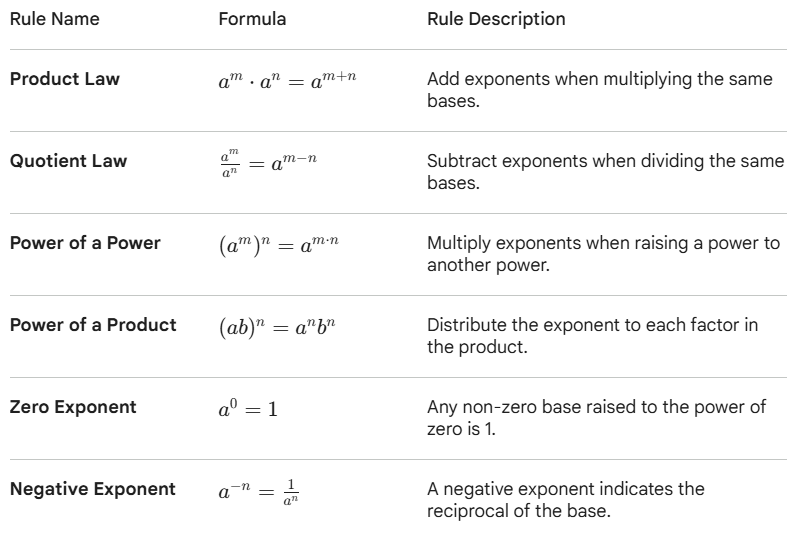
To simplify mathematical operations involving exponents, we follow a set of established rules known as the Laws of Exponents.
Important Properties to Remember
Identity Exponent: Any number raised to the power of 1 is the number itself: a^1 = a
Power of One: The number 1 raised to any power remains 1: 1^n = 1
Negative Base (Even Power): If the exponent is even, the result is positive: (-a)^n = a^n \quad \text{(where n is even)}
Negative Base (Odd Power): If the exponent is odd, the result is negative: (-a)^n = -a^n \quad \text{(where n is odd)}
Solved Examples
Let us understand exponents with the help of the following examples.
An exponent represents repeated multiplication of a number by itself.
For example, 5^3 = 5 \times 5 \times 5.
Q2. What does a zero exponent mean?
Any non-zero number raised to the power zero equals 1.
a^0 = 1 \quad (a \neq 0)
Q3. What is a negative exponent?
A negative exponent represents the reciprocal of the base.
a^{-n} = \frac{1}{a^n}
Conclusion
Exponents provide a concise way to represent repeated multiplication. By applying the laws of exponents, complex expressions can be simplified easily. Understanding these rules is essential for solving algebraic problems and learning advanced topics in precalculus.
To further strengthen your understanding, you can also practice using our dedicated worksheet available at: