- Call now to book a trial session!
- +18787865635

Radicals in Precalculus
Introduction
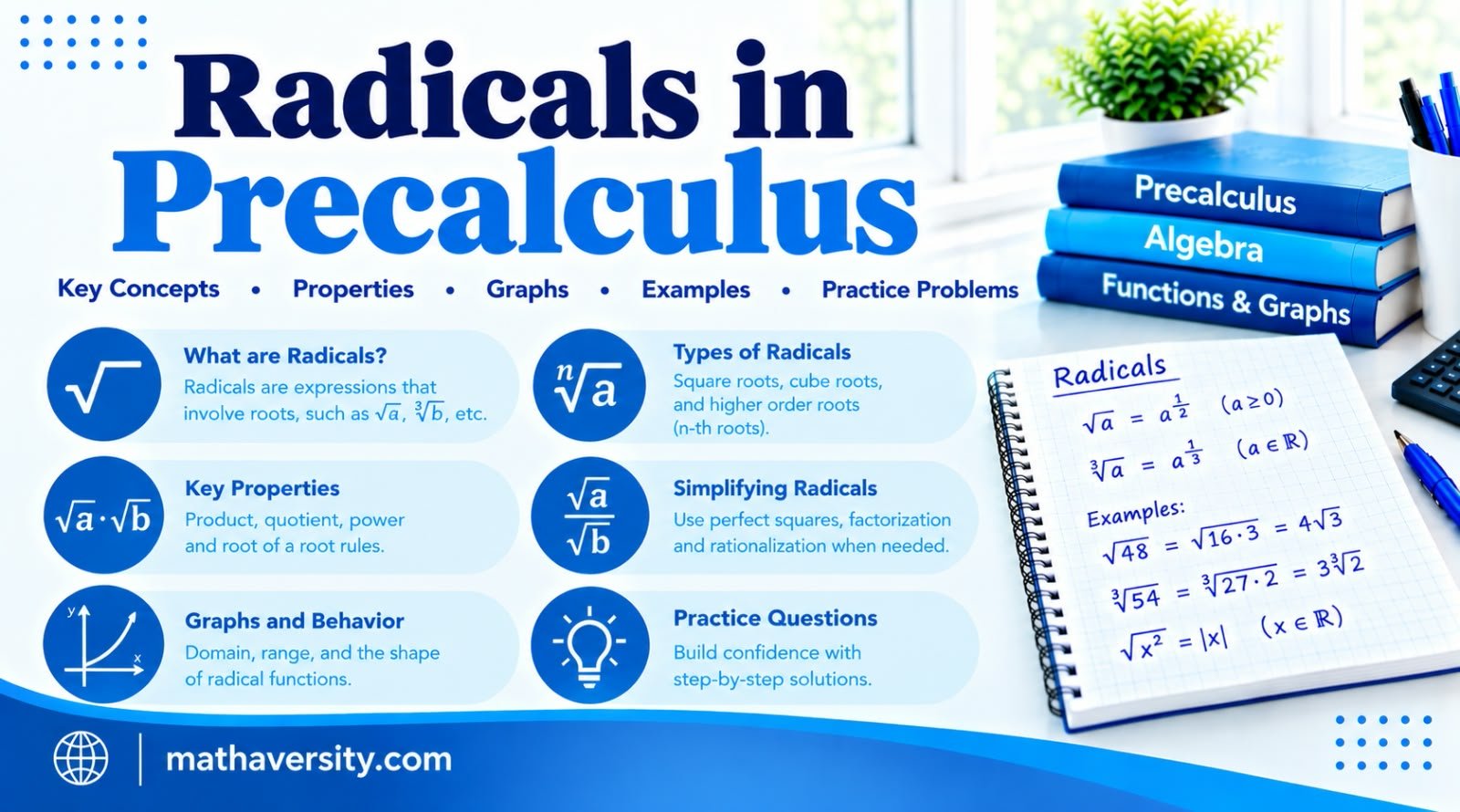
In the world of Precalculus, understanding Radicals is a fundamental skill that acts as a bridge between basic algebra and advanced calculus. Whether you are solving quadratic equations or analyzing complex functions, radicals appear everywhere.
In this guide, we will break down everything you need to know about radicals—from basic definitions to rationalizing denominators—with step-by-step examples designed for maximum clarity.
What is a Radical?
A radical is a mathematical symbol used to represent the root of a number. While the square root is the most common, radicals can represent any n^{th} root.
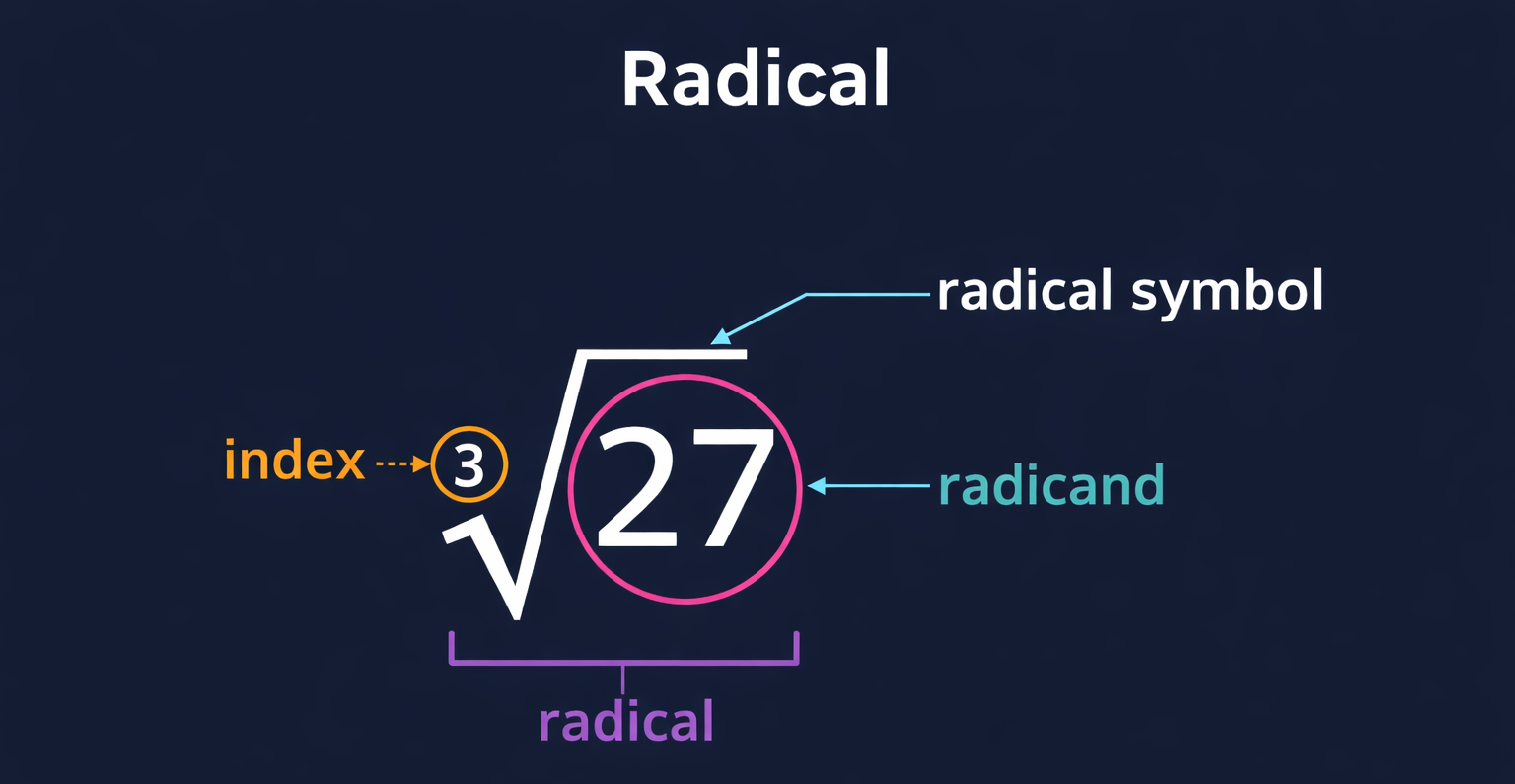
Components of a Radical:
- Radical Symbol (\sqrt{\quad}): The symbol itself.
- Radicand: The value inside the symbol.
- Index (n):The small number outside the radical that indicates which root is being taken. (If no number is shown, it is a square root, where n=2).
Definition of n^{th} Root
If a is a real number and n is a positive integer, then
\sqrt[n]{a}=b \quad \text{if and only if} \quad b^n=a
Examples: \sqrt{16}=4, \quad\sqrt[3]{27}=3
Relationship Between Radicals and Exponents
In precalculus, understanding the relationship between radicals and exponents is essential because it helps simplify expressions, solve equations, and work with functions efficiently.
Radicals can be written as fractional exponents: \sqrt[n]{a}=a^{1/n}
Examples: \sqrt{x}=x^{1/2}, \quad\sqrt[3]{x}=x^{1/3}
Properties of n^{th} Roots
To simplify radicals efficiently, you must master these properties:
1. Product Property: \sqrt[n]{a \cdot b} = \sqrt[n]{a} \cdot \sqrt[n]{b}
2. Quotient Property: \sqrt[n]{\dfrac{a}{b}} = \dfrac{\sqrt[n]{a}}{\sqrt[n]{b}}
3. Root of a Root Property: \sqrt[m]{\sqrt[n]{a}}=\sqrt[mn]{a}
4. Even Root Property: \sqrt[n]{a^n}=|a| \quad \text{if n is even}
5. Odd Root Property: \sqrt[n]{a^n}=a \quad \text{if n is odd}
How to Simplify Radicals (Step-by-Step)
A radical is in its simplest form when the radicand has no factors that can be moved outside the radical sign.
Example 1:
Simplify \sqrt{72}
Solution:
Step 1: Find the largest perfect square factor of 72.
72 = 36 \times 2
Step 2: Apply the Product Property.
\sqrt{36 \cdot 2} = \sqrt{36} \cdot \sqrt{2}
Step 3: Calculate the root of the perfect square.
\mathbf{6\sqrt{2}}
Example 2:
Simplify \sqrt[3]{40x^4}
Solution:
Step 1: Factor the number into a perfect cube:
40 = 8 \times 5
Step 2: Factor the variable into a perfect cube:
x^4 = x^3 \times x^1
Step 3: Group the cubes:
\sqrt[3]{(8 \cdot x^3) \cdot (5 \cdot x)}
Step 4: Extract the roots:
\mathbf{2x\sqrt[3]{5x}}
Adding and Subtracting Radicals
You can only combine radicals if they are "Like Radicals" (same index and same radicand).
Example 1:
Simplify 3\sqrt{20} + \sqrt{45}
Solution:
Step 1: Simplify
3\sqrt{20}: 3\sqrt{4 \cdot 5} = 3 \cdot 2\sqrt{5} = 6\sqrt{5}
Step 2: Simplify
\sqrt{45}: \sqrt{9 \cdot 5} = 3\sqrt{5}
Step 3: Combine:
6\sqrt{5} + 3\sqrt{5} = \mathbf{9\sqrt{5}}
Example 2:
Simplify \sqrt{50} - \sqrt{8}
Solution:
Step 1: Simplify each radical
\sqrt{50} = \sqrt{25 \times 2} = 5\sqrt{2}
\sqrt{8} = \sqrt{4 \times 2} = 2\sqrt{2}
Step 2: Substitute the simplified forms
\sqrt{50} - \sqrt{8} = 5\sqrt{2} - 2\sqrt{2}
Step 3: Combine like terms
= (5 - 2)\sqrt{2}
= 3\sqrt{2}
Rationalizing the Denominator
In mathematics, it is standard practice not to leave a radical in the denominator of a fraction.
Case 1: Monomial Denominator
If you have \dfrac{1}{\sqrt{a}}, multiply the numerator and denominator by \sqrt{a}.
Example: \dfrac{5}{\sqrt{3}}
Solution:
\dfrac{5}{\sqrt{3}} \times \dfrac{\sqrt{3}}{\sqrt{3}}
= \dfrac{5\sqrt{3}}{3}
Case 2: Binomial Denominator (Using the Conjugate)
If the denominator is (a + \sqrt{b}) multiply by its conjugate (a - \sqrt{b}).
Example: Rationalize
\dfrac{2}{3 - \sqrt{5}}
Solution:
Step 1: Identify the conjugate
The conjugate of 3 - \sqrt{5} is 3 + \sqrt{5}.
Step 2: Multiply numerator and denominator
\dfrac{2}{3 - \sqrt{5}} \times \dfrac{3 + \sqrt{5}}{3 + \sqrt{5}}
= \dfrac{2(3 + \sqrt{5})}{(3 - \sqrt{5})(3 + \sqrt{5})}
Step 3: Simplify the denominator (Difference of Squares)
(3 - \sqrt{5})(3 + \sqrt{5}) = 3^2 - (\sqrt{5})^2 = 9 - 5 = 4
Step 4: Final Result
\dfrac{2(3 + \sqrt{5})}{4} = \dfrac{3 + \sqrt{5}}{2}
Practice Questions
Simplify
(1) \sqrt{48}
(2) \sqrt{32}+\sqrt{18}
(3) \sqrt[3]{16x^4}
(4) \sqrt{12}+\sqrt{27}
(5) \sqrt{6}\cdot\sqrt{24}
(6) \frac{\sqrt{45}}{\sqrt{5}}
(7) \sqrt{2x-3}=3
Frequently Asked Questions (FAQs)
Q1. What is a radical?
A radical represents a root of a number.
Q2. What is an n^{th} root?
A number that when raised to power n gives the radicand.
Q3. Can radicals be added?
Only like radicals can be added.
Q4. Why rationalize denominator?
To remove radicals from the denominator.
Conclusion
Mastering radicals is all about recognizing patterns and applying properties consistently. Whether you are prepping for the SAT or moving toward Calculus, these rules will be your foundation.
To further strengthen your understanding, you can also practice using our dedicated worksheet available at:
Regular practice with structured worksheets can significantly improve problem-solving skills and conceptual clarity.
Mathaversity is ready to help you get the highest grades if you need
professional, targeted help to fill in the last gaps in your knowledge.