In precalculus, the concept of the real line is a visual way of understanding real numbers. Instead of thinking of numbers as abstract values, the real line allows us to represent each number as a specific point in space.
This concept makes it easier for students to visualize mathematical relationships, compare numbers, and comprehend distance.
What is the Real Line?
The real line is a straight horizontal line where every point corresponds to exactly one real number, and every real number corresponds to a unique point.
Key Idea:
Real numbers and points on a line are in one-to-one correspondence.
A number line extends infinitely in both directions and includes:
Positive numbers (right side)
Negative numbers (left side)
Zero at the center (origin)
This concept forms the foundation of graphing and coordinate geometry.
Structure of the Real Line
Explanation:
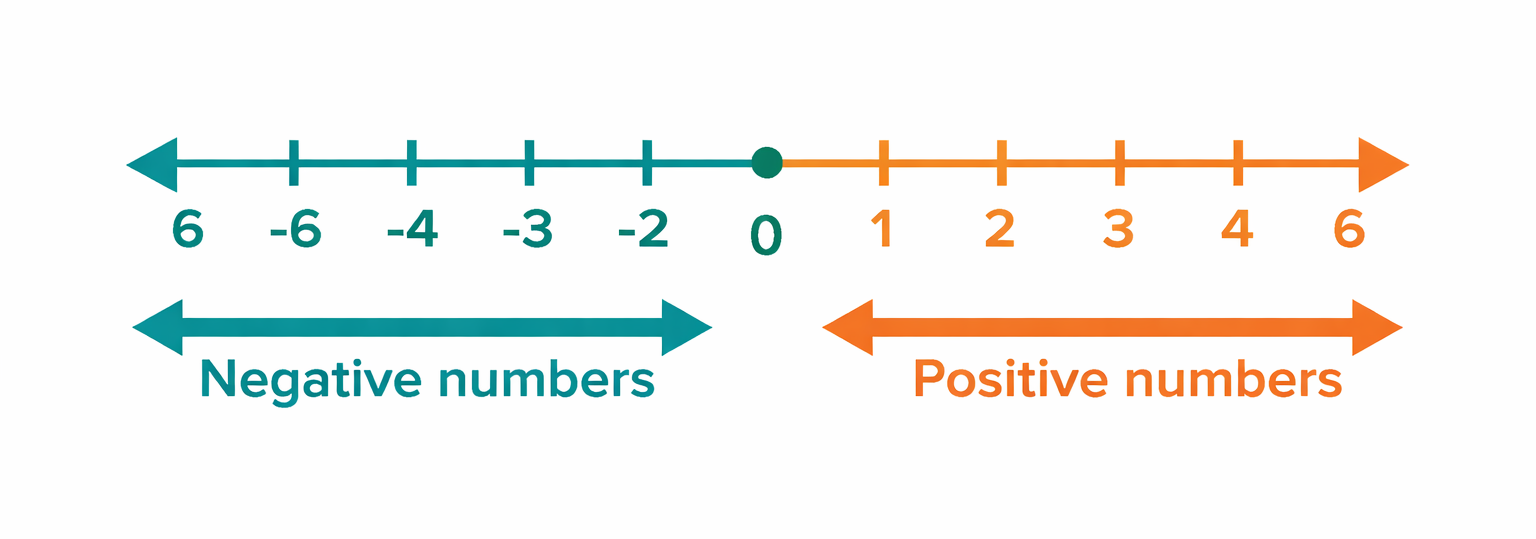
The point labeled 0 is called the origin
Numbers increase as we move to the right
Numbers decrease as we move to the left
The line continues infinitely in both directionsThe line continues infinitely in both directions
Every point on this line represents a real number, including integers, fractions, and irrational numbers.
How to Represent Real Numbers on the Real Line
To represent real numbers on the real line, follow these steps:
Step 1: Draw a straight horizontal line with arrows at both ends.
Step 2: Mark a point as 0 (origin).
Step 3: Choose a scale and mark equal intervals (1, 2, 3, etc.).
Step 4: Plot the number:
Positive numbers → right side
Negative numbers → left side
Step 5: For fractions or decimals, divide the intervals accordingly.
Representation of Different Types of Numbers on the Real Line
Depending on their values and locations, various real numbers can be represented on the real line. Every kind of number has a designated spot on the line.
1. Integers on the Real Line
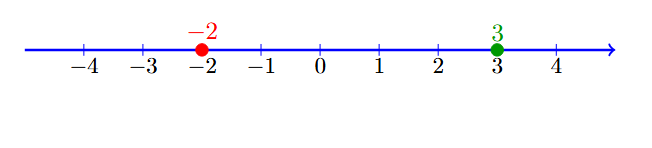
Integers are placed at equal distances on both sides of zero.
Example: Represent -2 and 3
2. Rational Numbers on the Real Line
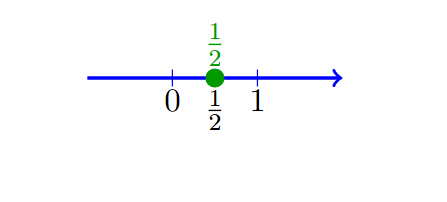
Rational numbers (fractions) are represented by dividing intervals into equal parts.
Example: Represent \dfrac{1}{2}
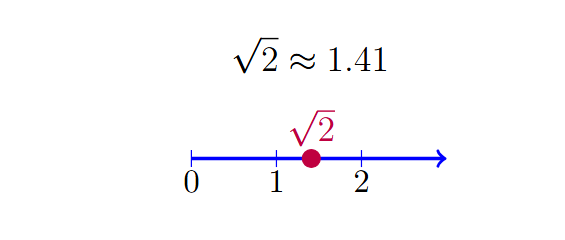
3. Irrational Numbers on the Real Line
Irrational numbers are represented using approximations since their decimal values are non-terminating and non-repeating.
Example: Represent \sqrt{2}
Important Concepts of the Real Line
Irrational numbers are represented using approximations since their decimal values are non-terminating and non-repeating.
1. Ordering of Real Numbers
Numbers on the right are always greater than numbers on the left.
Example:
3 > 1, \quad -2 > -5
2. Distance on the Real Line
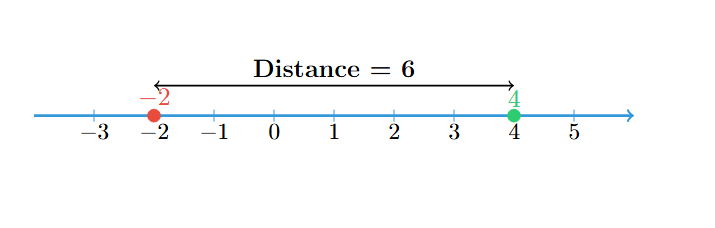
The distance between two numbers is given by: |a - b|
This distance is always positive.
3. Absolute Value
The absolute value represents the distance from zero.
|x| = \text{distance from } 0
Example:
|-4| = 4
Solved Examples with Number Lines
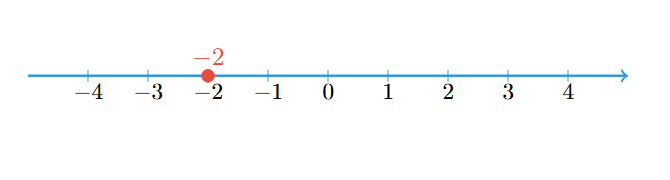
Example 1: Represent -2 on the Real Line
Solution:
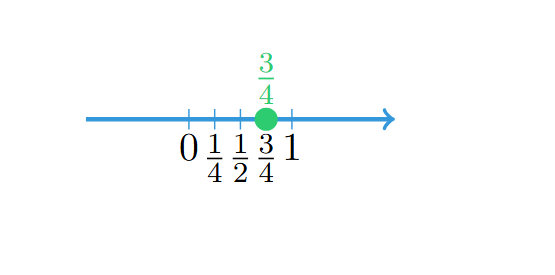
Example 2: Represent \dfrac{3}{4} on the Real Line
Solution:
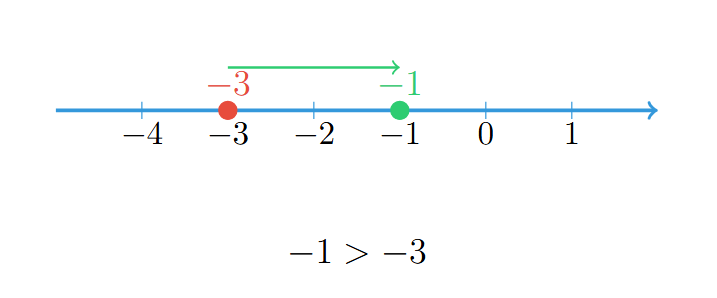
Example 3: Compare -1 and -3
Solution:
Example 4: Distance Between 4 and -2
Solution:
Applications of the Real Line
The real line is widely used in:
Graphing functions
Solving inequalities
Measuring distance
Understanding intervals in calculus
Practice Questions
1. Plot 2 and -3 on the real line
2. Represent \frac{1}{3}
3. Find the distance between 4 and -2
4. Which is greater: 0.5 or \frac{1}{2}?
Frequently Asked Questions (FAQs)
Q1. What is a real number line?
The real number line is a straight horizontal line where every point represents a real number. It extends infinitely in both directions and includes an origin marked as 0.
All positive numbers are located on the right side of the origin, while negative numbers are placed on the left. Each point on the line corresponds to a unique real number, making it a complete representation of the real number system.
Q2. Can complex numbers be represented on the real line?
No, complex numbers cannot be represented on the real line.
A complex number contains an imaginary part (involving i = \sqrt{-1}), whereas the real line only represents real values. To represent complex numbers, a two-dimensional plane called the complex plane is used.
Q3. How are rational and irrational numbers located on the real line?
Rational numbers are located by dividing intervals into equal parts based on fractions or decimals.
Irrational numbers are placed using approximations or geometric constructions. Their exact positions are determined by extending the number line using more precise measurements.
Conclusion
The real line provides a powerful way to visualize real numbers and understand their relationships. It helps in comparing values, measuring distances, and building the foundation for advanced topics such as functions and calculus.
To further strengthen your understanding, you can also practice using our dedicated worksheet available at: