Mathaversity Tutors

Real Numbers

Introduction

In mathematics, numbers are used to represent quantities, measurements, and values in real life. One of the most important number systems studied in precalculus is the system of real numbers.

Real numbers include almost every number we commonly use, such as integers, fractions, decimals, and even special numbers like \pi and \sqrt{2}. These numbers help us perform calculations, represent data, and solve mathematical problems.
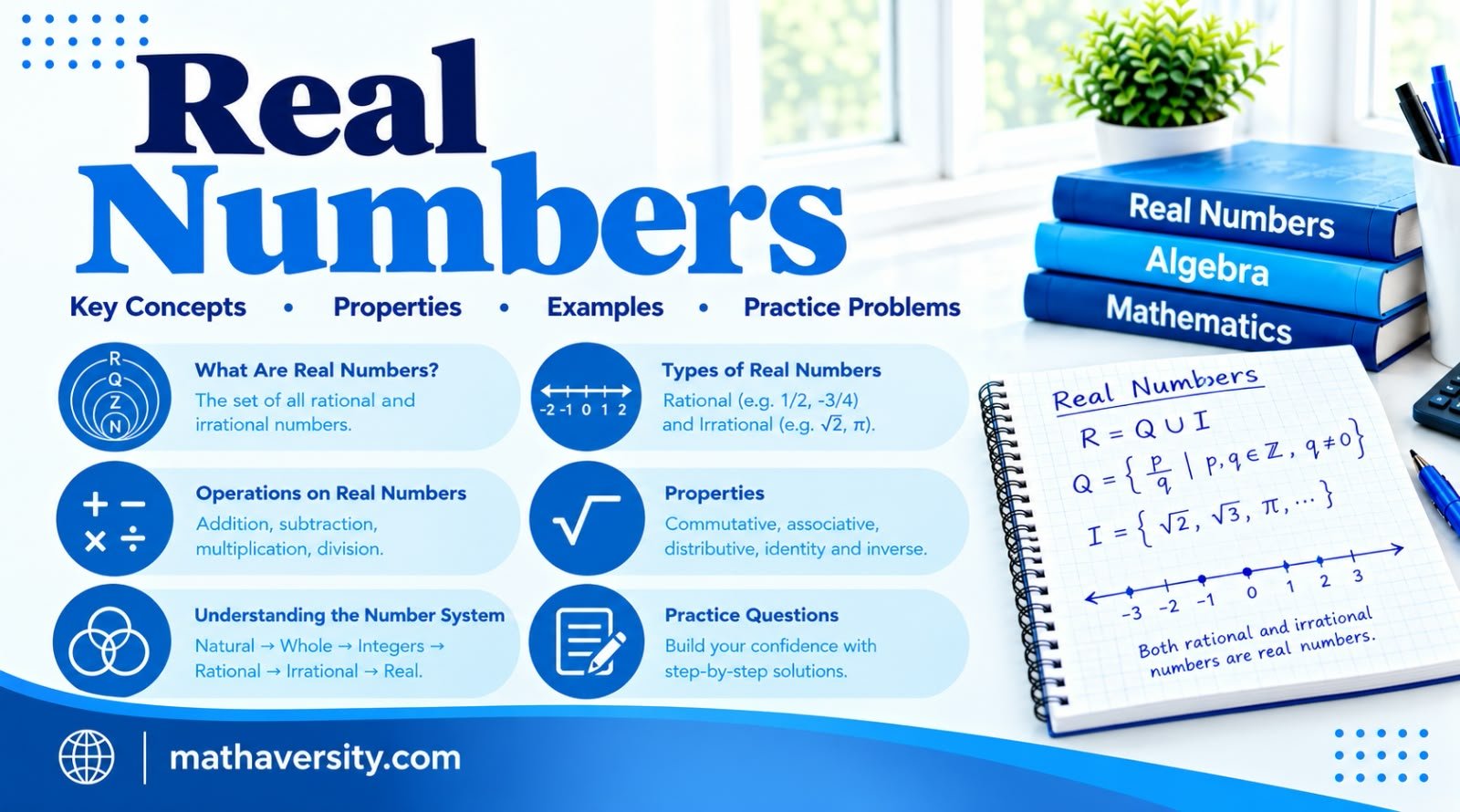
Real Numbers

What Are Real Numbers?

Real numbers are defined as the set of all numbers that can be represented on a number line.
In other words, real numbers include both rational and irrational numbers.
Examples of real numbers: -10, \quad 0, \quad 5, \quad \frac{3}{4}, \quad 2.75, \quad \sqrt{2}, \quad \pi
Key Idea: Every point on the number line corresponds to a real number.

Set of Real Numbers

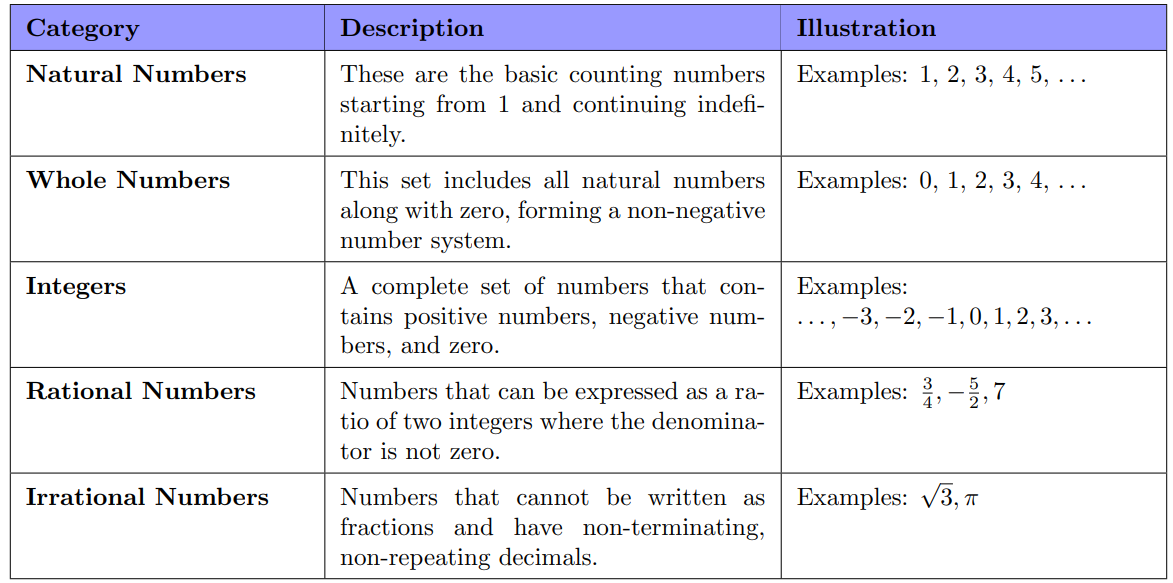
The set of real numbers is denoted by: \mathbb{R}. Real numbers are made up of different subsets. Each subset represents a specific type of number.
All of the real number formulas—that is, the representation of the real number classification—are defined with examples in the table that follows.
Set of Real Numbers

Real Numbers Chart (Hierarchy)
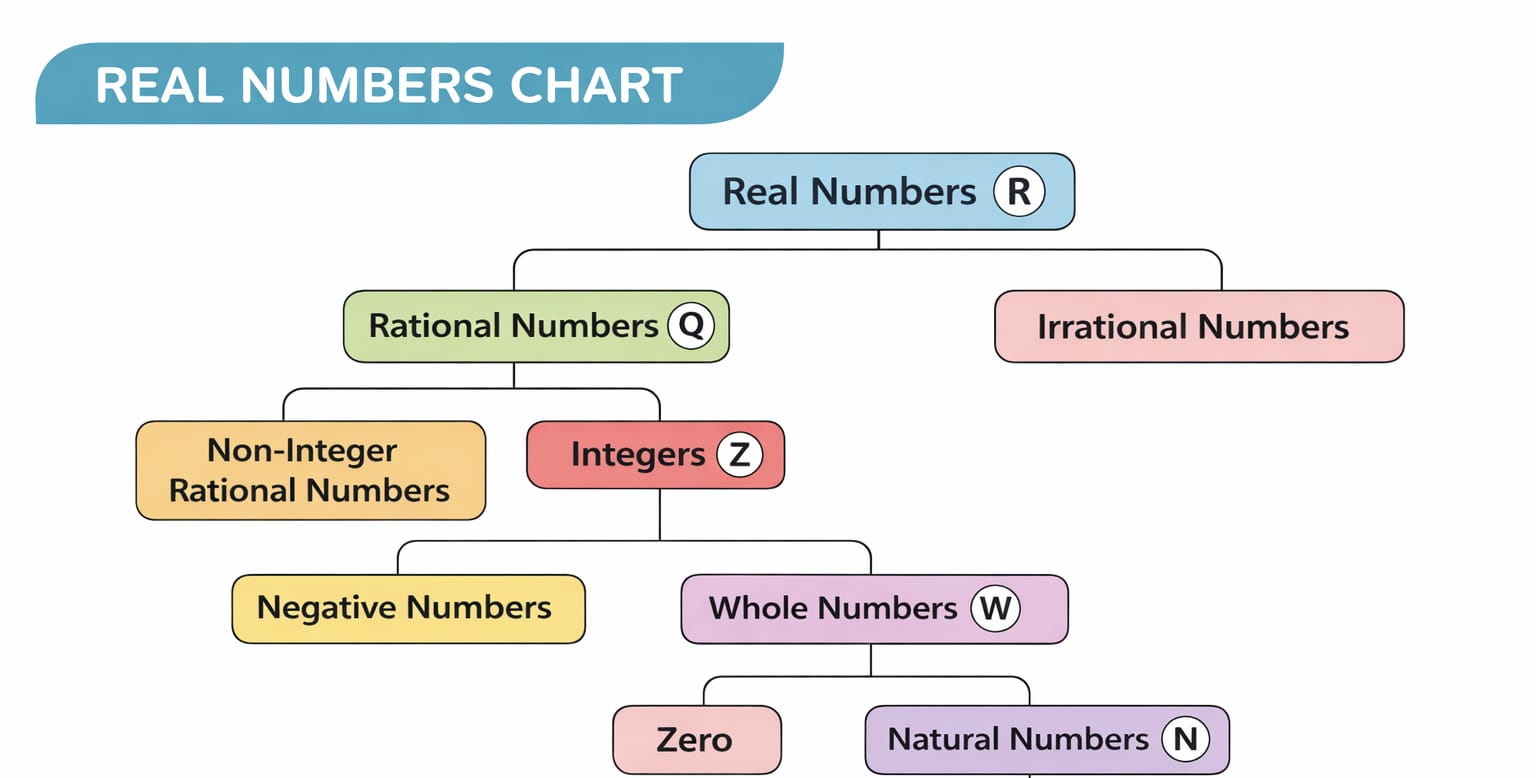
Below is the chart for the set of real numerals that includes every type:
Real Numbers Chart

Properties of Real Numbers

Real numbers follow certain standard properties that make mathematical operations reliable and consistent. These properties are widely used in algebra to simplify expressions and solve equations efficiently.
Let a, b, and c be any real numbers. The main properties of real numbers are explained below.

1. Commutative Property

The commutative property tells us that changing the order of numbers does not affect the result of addition or multiplication.
General Form:
a + b = b + a
a \times b = b \times a
Explanation:
If two real numbers are added or multiplied, their positions can be swapped without changing the final answer.
Examples:
Addition: 6 + 2 = 2 + 6 = 8
Multiplication: 6 \times 2 = 2 \times 6 = 12

2. Associative Property

The associative property states that the grouping of numbers does not change the result when adding or multiplying.
General Form:
a + (b + c) = (a + b) + c
(a \times b) \times c = a \times (b \times c)
Explanation:
When working with three or more numbers, we can group them in different ways, and the result will remain the same.
Examples:
Addition: 8 + (4 + 1) = (8 + 4) + 1 = 13
Multiplication: (3 \times 2) \times 5 = 3 \times (2 \times 5) = 30

3. Distributive Property

The distributive property connects multiplication with addition and allows expansion of expressions.
General Form:
a(b + c) = ab + ac
(a + b)c = ac + bc
Explanation:
A number outside the bracket is multiplied with each term inside the bracket separately.
Example:
4(3 + 5) = 4 \times 3 + 4 \times 5
= 12 + 20 = 32

4. Identity Property

Identity properties involve special numbers that do not change the value of a real number.
(a) Additive Identity
a + 0 = a
Explanation:
Adding zero to any real number leaves it unchanged.
Example:
11 + 0 = 11
(b) Multiplicative Identity
a \times 1 = 1 \times a = a
Explanation:
Multiplying any real number by 1 does not change its value.
Example:
9 \times 1 = 9

Final Understanding

Solved Examples

Example 1

Find five rational numbers between \dfrac{1}{2} and \dfrac{3}{5}.
Solution:
\dfrac{1}{2} = \dfrac{5}{10}, \quad \dfrac{3}{5} = \dfrac{6}{10}
Multiply by 6:
\dfrac{30}{60}, \quad \dfrac{36}{60}
Numbers between them:
\dfrac{31}{60}, \dfrac{32}{60}, \dfrac{33}{60}, \dfrac{34}{60}, \dfrac{35}{60}

Example 2

\textbf{(a) Convert } \dfrac{5}{8} \textbf{ into decimal.}
Solution:
5 \div 8 = 0.625
\textbf{Answer:} 0.625
\textbf{(b) Convert } \dfrac{7}{4} \textbf{ into decimal.}
Solution:
7 \div 4 = 1.75
\textbf{Answer:} 1.75
\textbf{(c) Convert } \dfrac{2}{3} \textbf{ into decimal.}
Solution:
2 \div 3 = 0.666\ldots
\textbf{Answer:} 0.666\ldots

Example 3

Find multiplicative inverse of 1.25
Solution:
1.25 = \dfrac{125}{100}
Inverse:
\dfrac{100}{125}

Practice Questions

1. Classify the number -3.
2. Is \sqrt{5} rational?
3. Find decimal form of \dfrac{3}{4}
4. Simplify: 2 + 3 \times 6 - 5

Applications of Real Numbers

Frequently Asked Questions (FAQs)

Natural numbers are the counting numbers that start from 1 and continue infinitely, such as: 1, 2, 3, 4, \dots

Real numbers, on the other hand, include all types of numbers that can be placed on a number line. This includes natural numbers, whole numbers, integers, rational numbers, and irrational numbers.

Conclusion: Every natural number is a real number, but real numbers include much more than just counting numbers.

Yes, zero is a real number. It belongs to multiple categories:

• Whole number

• Integer

• Rational number

Because it can be represented on a number line, it is part of the real number system.

No, this is not possible. Every real number must fall into one of the two categories:

• Rational numbers

• Irrational numbers

These two groups together form the complete set of real numbers.

Yes, \sqrt{3} is a real number.

Although it cannot be written as a fraction, it is an irrational number. Since irrational numbers are included in real numbers, \sqrt{3} is also a real number.

Real numbers are divided into several subsets:

• Commutative Property

• Associative Property

• Distributive Property

• Identity Property

Each subset represents a different type of number within the real number system.

Conclusion

Real numbers form a complete number system that includes all rational and irrational numbers. They play a fundamental role in mathematics and are essential for understanding algebra, functions, and precalculus concepts.
To further strengthen your understanding, you can also practice using our dedicated worksheet available at:
Regular practice with structured worksheets can significantly improve problem-solving skills and conceptual clarity.
Mathaversity is ready to help you get the highest grades if you need professional, targeted help to fill in the last gaps in your knowledge.