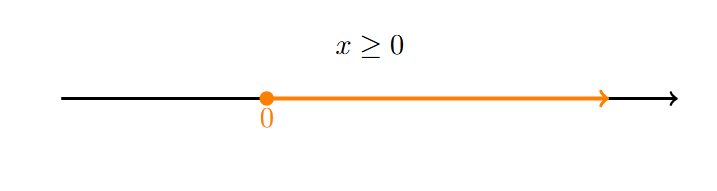
The fundamental tools used in precalculus to describe collections of numbers, particularly subsets of real numbers, are sets and intervals. Graphs, functions, domains, and inequalities all make extensive use of these ideas. Students can more effectively and clearly represent mathematical solutions when they comprehend the relationship between sets and intervals.
A set is just a grouping of elements, like objects or numbers. All real numbers that fall between specified endpoints are included in intervals, which are unique kinds of sets.
What is a Set?
A set is defined as a well-defined collection of distinct objects called elements.
Examples:
A number line extends infinitely in both directions and includes:
A = \{1, 2, 3, 4\}, \quad B = \{x \mid x > 2\}
Sets can be written in three forms.
Roster Form
List all elements inside curly braces.
A = \{2, 4, 6, 8\}
Set Builder Form
B = \{x \mid x > 0\}
Interval Form
(0,5)
What is an Interval?
An interval is a set of real numbers that contains all numbers between two given endpoints. The endpoints may be included or excluded depending on notation.
Types of Intervals
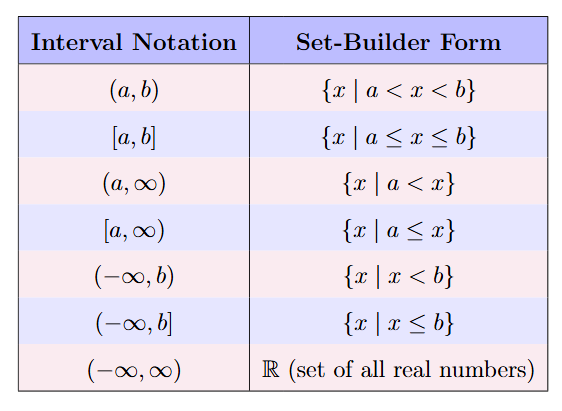
Intervals are classified according to whether their endpoints are included or excluded. These intervals represent subsets of real numbers lying between two given values. Parentheses ( ) indicate exclusion of endpoints, while brackets [ ] indicate inclusion.
Open Interval
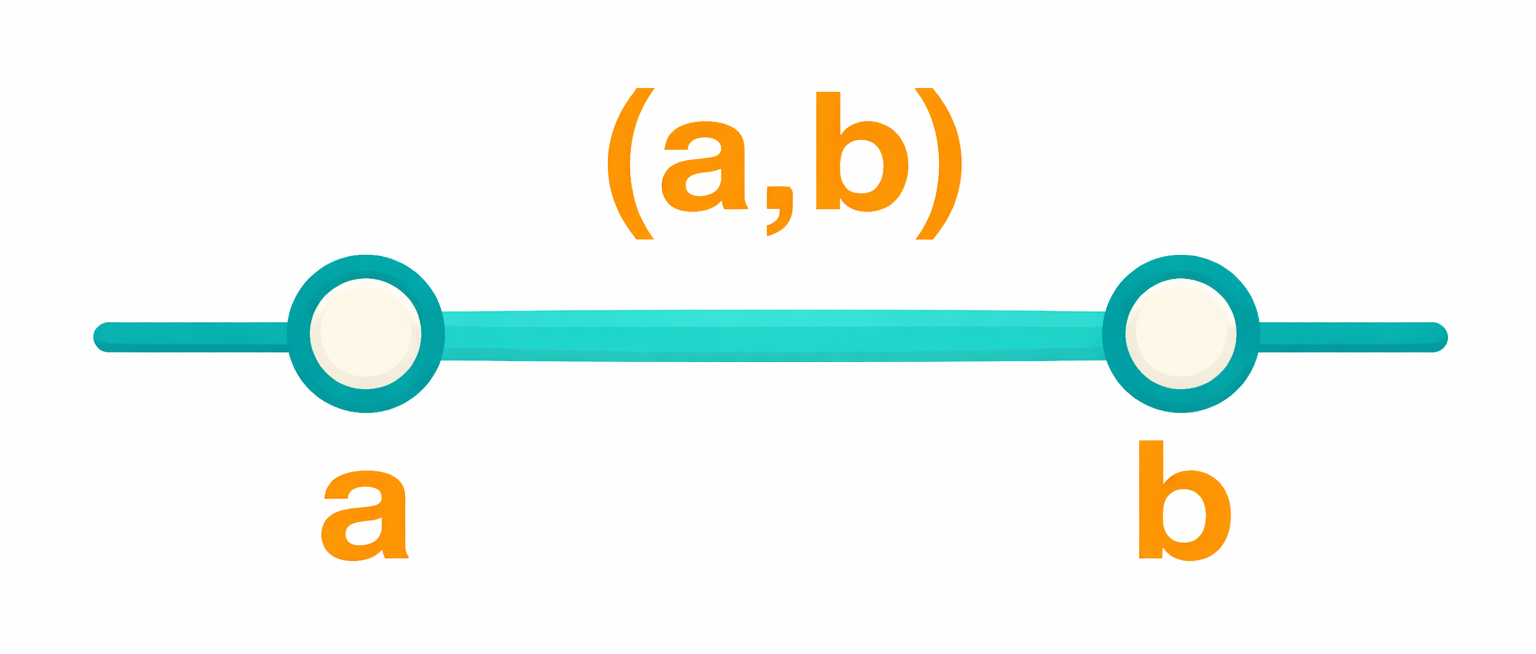
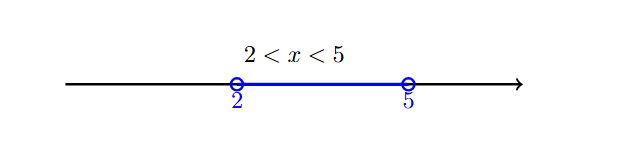
The set of real numbers satisfying a < x < b is called an open interval and is written as (a,b).
An open interval contains every real number strictly between a and b, but the endpoints themselves are not part of the interval. This means that neither a nor b belongs to the set.
Graphical interpretation:
Open circles are used at both endpoints on the number line to indicate exclusion.
This can be represented on the real number line as:
Closed Interval
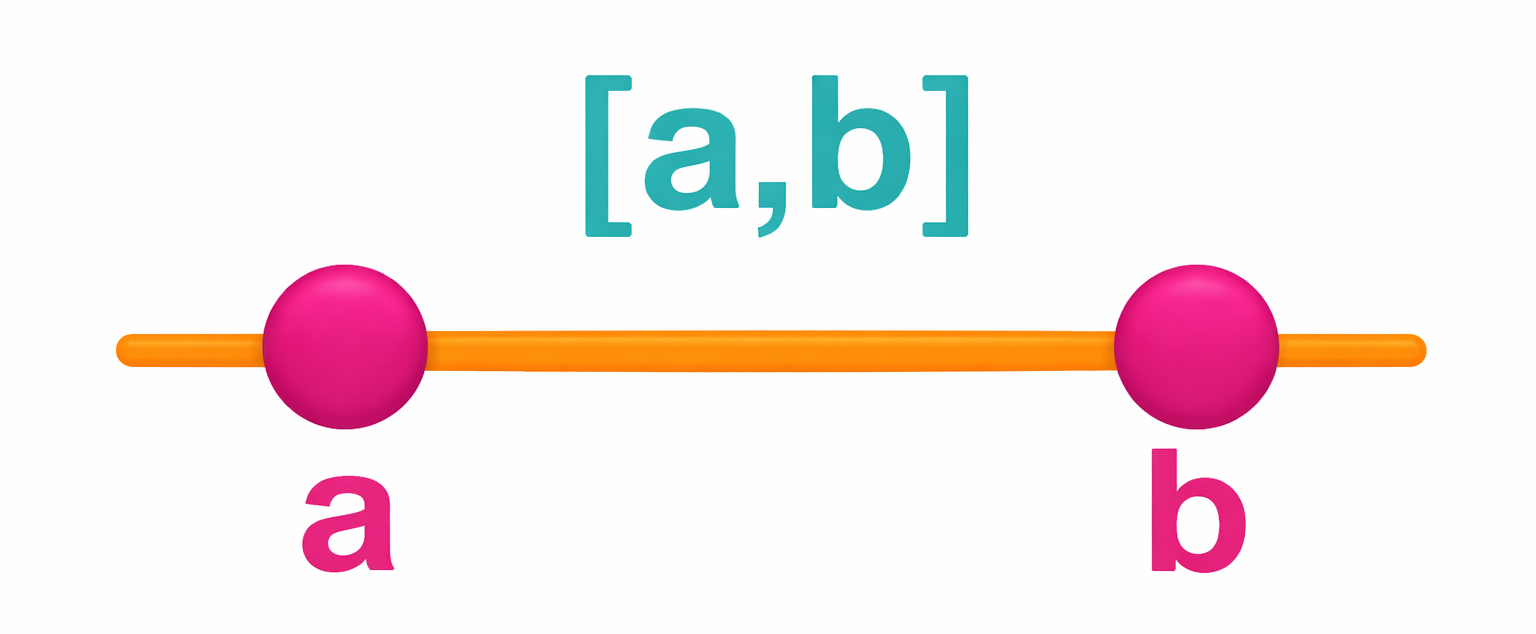
The set of real numbers satisfying a \le x \le b is called a closed interval and is written as [a,b].
In a closed interval, both endpoints are included in the set. Therefore, a and b are part of the interval along with all numbers between them.
Graphical interpretation:
Closed circles are placed at both endpoints to indicate inclusion.
Closed interval [a, b] can be described on a real number line as:
Half-Open (Half-Closed) Intervals
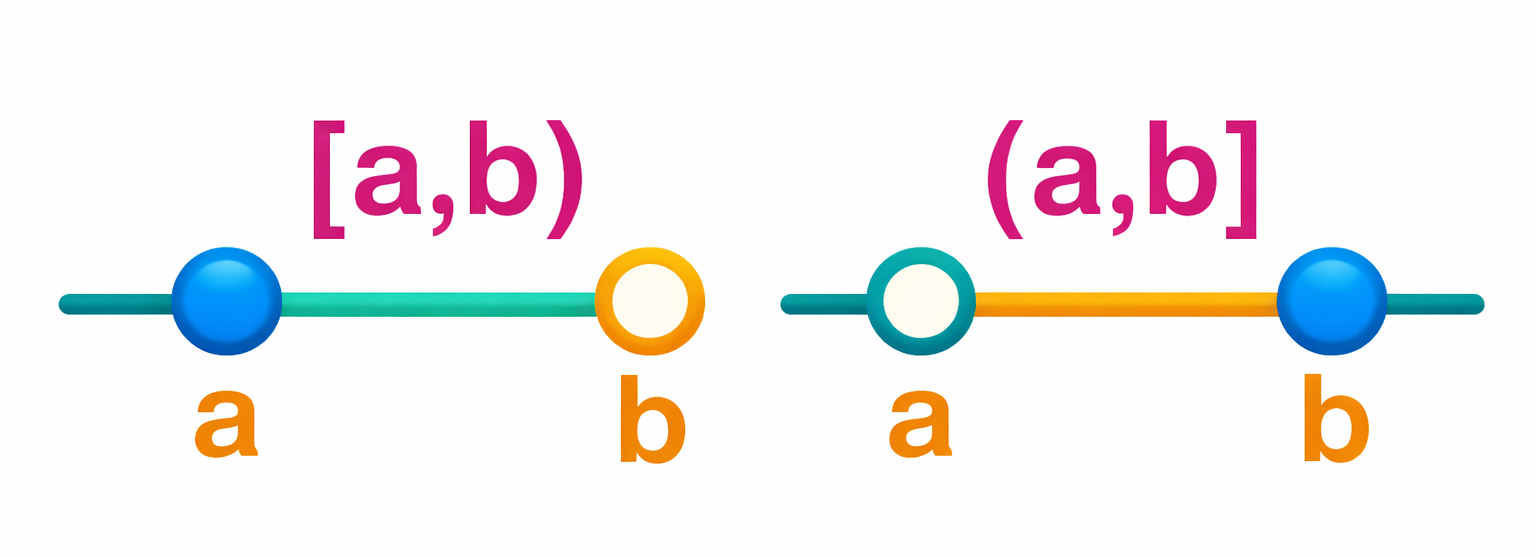
Half-open intervals mean the intervals that are closed at one end and open at the other. These can be represented as:
(a,b]=a < x \le b
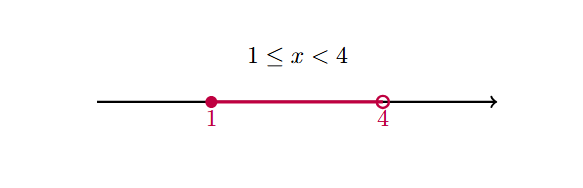
[a,b)=a \le x < b
These intervals can be represented on the real number line as shown in the below figure:
Infinite Intervals
Some intervals extend indefinitely in one or both directions. Since infinity is not a real number, it is never included, and parentheses are always used.
Example 1:
(a,\infty)
represents all real numbers greater than a.
Example 2:
(-\infty,b]
represents all real numbers less than or equal to b.
Interval Notation and Set-Builder Form
Express each interval in terms of inequalities, and then graph the interval
Example 1 Interval: (2,5)
Solution:
Example 2 Interval: [1,4)
Solution:
Example 3 Interval: (-\infty,3]
Solution:
Example 4: Interval: [0,\infty)
Solution:
Why Sets and Intervals are Important
Sets and intervals are used in:
Domain and range
Graphing functions
Solving inequalities
Limits and continuity
Piecewise functions
Frequently Asked Questions (FAQs)
Q1. What is the difference between open and closed interval?
An open interval does not include its endpoints, whereas a closed interval includes both endpoints.
Q2. Can infinity be included in an interval?
Infinity cannot be included in an interval because it is not a real number. Therefore, parentheses are always used with infinity.
Q3. What is a half-open interval?
A half-open interval includes one endpoint and excludes the other.
Conclusion
Sets and intervals are fundamental concepts in precalculus used to represent subsets of real numbers. Interval notation provides a concise way to express inequalities and describe solution sets. Understanding open, closed, and infinite intervals makes it easier to analyze domains, ranges, and graphs of functions.
To further strengthen your understanding, you can also practice using our dedicated worksheet available at:

![Interval: (−∞, 3]](https://mathaversity.com/wp-content/uploads/2026/03/Interval-−∞-3.png "Sets and Intervals 8")