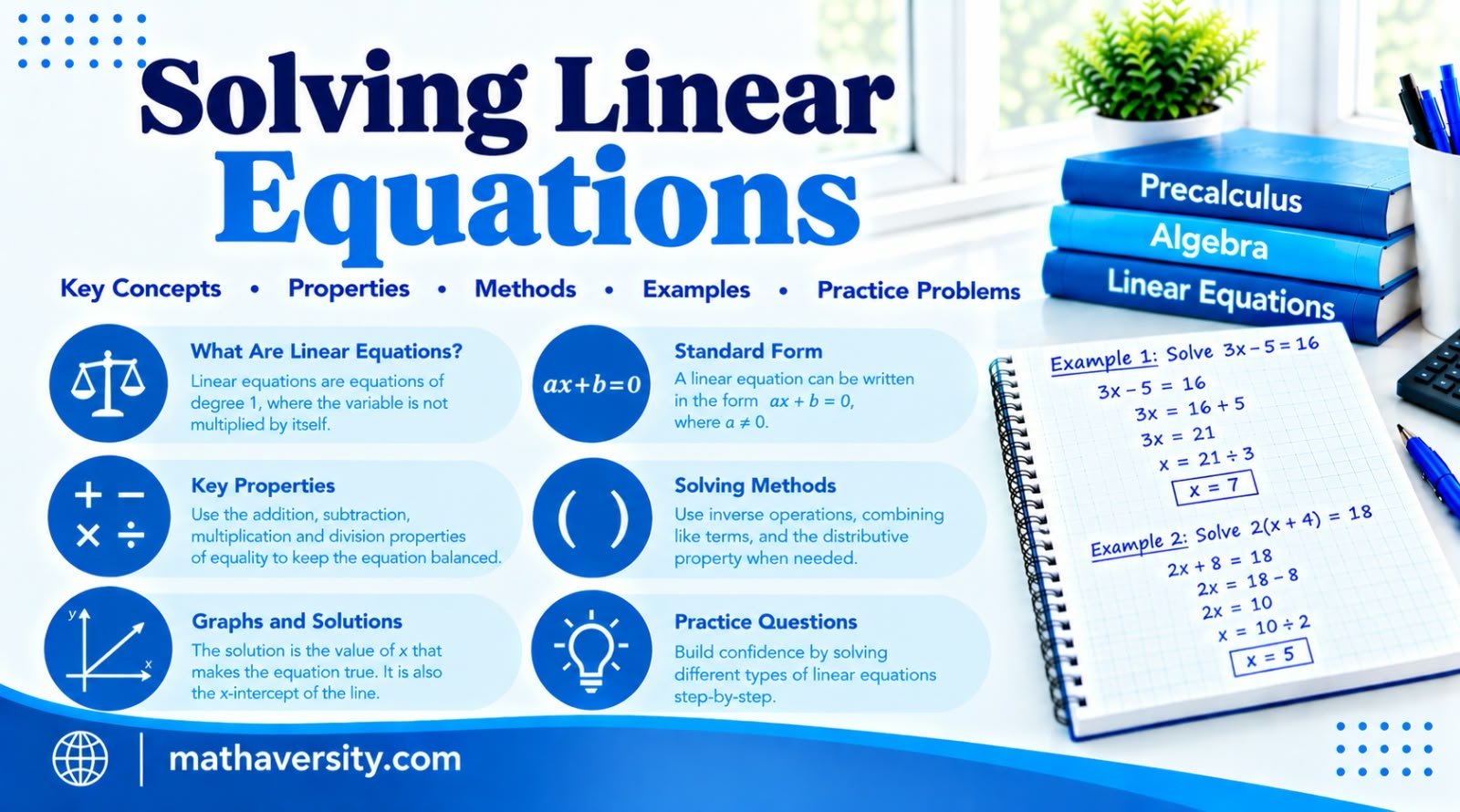
Solving linear equations is one of the most essential skills in precalculus. Linear equations appear in algebra, coordinate geometry, functions, and real-world applications. Students use linear equations to find unknown values, solve word problems, and analyze relationships between variables. A strong understanding of this topic prepares students for more advanced algebraic techniques.
What is an Equation?
An equation is a mathematical statement that shows two expressions are equal. It contains an equals sign and may include numbers, variables, or both. The goal when solving an equation is to find the value of the variable that makes both sides equal.
Examples of equations: x+3=7,\quad 2x=10 ,\quad x-5=1
Definition of Linear Equation
A linear equation is an equation in which the highest power of the variable is one. These equations form straight lines when graphed and can be solved using inverse operations.
General form: ax+b=c
where a, b, and c are constants and a\neq0.
Steps for Solving Linear Equations
To solve linear equations:
Simplify both sides of the equation
Use inverse operations to isolate the variable
Move variable terms to one side
Move constants to the other side
Divide by the coefficient of the variable
Check the solution
Example 1: Basic Linear Equation
Solve the equation 3x+7=22.
Solution:
Step 1: Subtract 7 from both sides.
3x+7-7=22-7
Step 2: Simplify.
3x=15
Step 3: Divide by 3.
x=5
Example 2: Variables on Both Sides
Solve the equation 6x-4=2x+12.
Solution:
Step 1: Subtract 2x from both sides.
6x-2x-4=12
Step 2: Simplify.
4x-4=12
Step 3: Add 4 to both sides.
4x=16
Step 4: Divide by 4.
x=4
Example 3: Distribution Required
Solve the equation 4(x-3)+2=3x+10.
Solution:
Step 1: Distribute 4.
4x-12+2=3x+10
Step 2: Combine like terms.
4x-10=3x+10
Step 3: Subtract 3x.
x-10=10
Step 4: Add 10.
x=20
Example 4: Fractions in Linear Equation
Solve the equation \dfrac{x}{3}+\dfrac{x}{2}=5.
Solution:
Step 1: Find LCD = 6.
Step 2: Multiply entire equation by 6.
2x+3x=30
Step 3: Combine like terms.
5x=30
Step 4: Divide by 5.
x=6
Example 5: Decimals in Linear Equation
Solve the equation 0.5x+1.2=2.7.
Solution:
Step 1: Subtract 1.2.
0.5x=1.5
Step 2: Divide by 0.5.
x=3
No Solution Case
Sometimes when solving a linear equation, the variable terms cancel out and we are left with a false statement such as 5=9. This means there is no value of the variable that makes the equation true. In such cases, the equation has no solution. This usually happens when both sides have the same variable coefficient but different constants.
Example 6: No Solution Case
Solve the equation 3(2x-1)-2x=4x+5.
Solution:
Step 1: Distribute.
6x-3-2x=4x+5
Step 2: Combine like terms.
4x-3=4x+5
Step 3: Subtract 4x.
-3=5
This is false, so no solution.
Infinite Solutions
In some linear equations, the variable terms cancel out and the remaining statement is always true, such as 6=6. This means every value of the variable satisfies the equation. In this case, the equation has infinitely many solutions. This usually happens when both sides of the equation are equivalent.
Example 7: Infinite Solutions
Solve the equation 2(x+3)=2x+6.
Solution:
Step 1: Distribute.
2x+6=2x+6
Step 2: Subtract 2x.
6=6
This is true for all values, so infinite solutions.
Example 8
Solve the equation \dfrac{2x-3}{4}-\dfrac{x+1}{2}=3.
Solution:
Step 1: LCD = 4.
Step 2: Multiply entire equation by 4.
2x-3-2(x+1)=12
Step 3: Distribute.
2x-3-2x-2=12
Step 4: Combine like terms.
-5=12
No solution.
Common Mistakes
Forgetting to distribute
Not multiplying every term
Sign errors
Incorrect fraction clearing
Skipping simplification
Check the solution
Practice Questions
Solve the following equations:
(1) 5x-7=3x+11
(2) \frac{3x-1}{2}+\frac{x+5}{4}=6
(3) 5(2x-3)-3(x+1)=4x+2
(4) \frac{2x-5}{3}-\frac{x-1}{6}=4
(5) 0.2x+3=5
Frequently Asked Questions (FAQs)
Q1. What is a linear equation?
An equation where highest power of variable is one.
Q2. How do you solve linear equations?
Use inverse operations to isolate the variable.
Q3. What does no solution mean?
Equation gives false statement.
Q4. What are infinite solutions?
Equation true for all values.
Conclusion
Solving linear equations is a fundamental precalculus skill. By mastering simplification, distribution, and inverse operations, students can confidently solve more advanced algebraic problems.
To further strengthen your understanding, you can also practice using our dedicated worksheet available at: