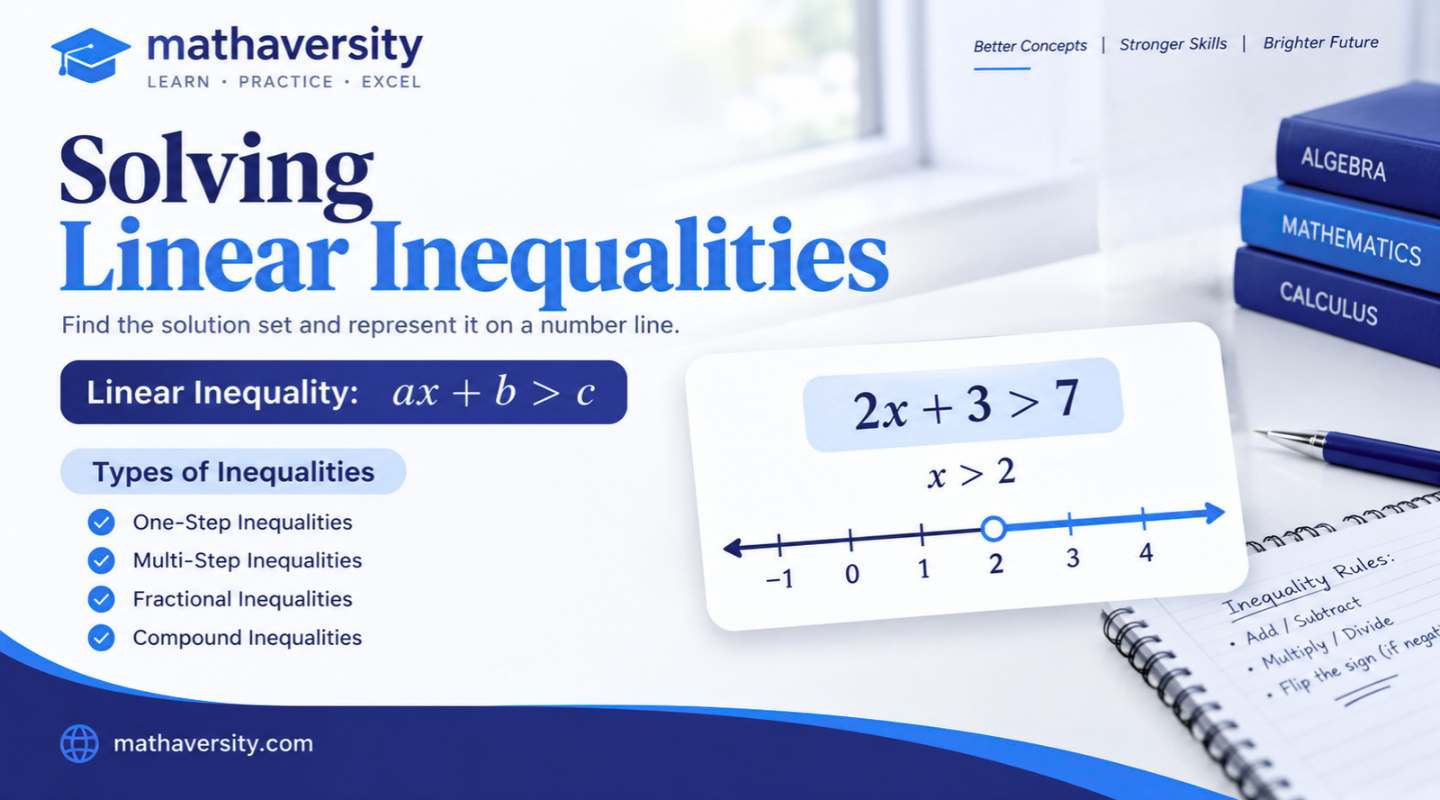
Linear inequalities are similar to linear equations, but instead of using an equals sign, they use inequality symbols. These inequalities represent a range of values rather than a single solution. Solving linear inequalities is important for graphing solution sets, working with interval notation, and understanding compound inequalities.
What is an Inequality?
An inequality compares two expressions using the symbols:
<,\quad >,\quad \le,\quad \ge.
Example: x+3>7
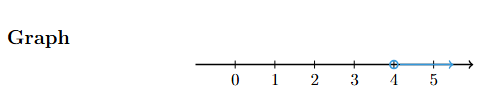
This inequality means all values of x greater than 4 satisfy the statement.
Linear Inequalities
A linear inequality is an inequality that contains a linear expression. The highest power of the variable is 1.
General form: ax+b>c (or <,\quad \le,\quad \ge)
Linear inequalities usually have infinitely many solutions.
Important Rule
When solving inequalities, follow the same steps as equations, except:
If you multiply or divide both sides by a negative number, reverse the inequality sign.
Methodology for Solving Different Types of Inequalities
Students should identify the type of inequality first, then apply the correct method.
1. One-Step Inequalities
Example: x+5>9
Method:
Use inverse operation.
Add, subtract, multiply, or divide both sides.
Write final answer clearly.
2. Inequalities with Negative Coefficients
Example: -3x\le12
Method:
Divide both sides by -3.
Reverse the inequality sign.
Final answer: x\ge-4
3. Multi-Step Inequalities
Example: 2x+5>11
Method:
Move constants first.
Simplify both sides.
Isolate the variable.
4. Inequalities with Parentheses
Example: 3(x-2)\ge9
Method:
Apply distributive property.
Combine like terms.
Solve normally.
5. Fractional Inequalities
Example: \dfrac{x+1}{2}>4
Method:
Multiply both sides by the LCM.
Remove fractions carefully.
Solve the remaining inequality.
6. Compound Inequalities
Example: -2<3x+1\le7
Method:
Perform same operation on all three parts.
Keep inequality order correct.
Write answer in interval notation if needed.
7. Variable on Both Sides
Example: 5x-2>2x+7
Method:
Move variable terms to one side.
Move constants to the other side.
Solve as usual.
Example 1: Basic Linear Inequality
Solve: x+5>9
Solution:
Step 1: Subtract 5 from both sides
x>4
Example 2: Negative Coefficient
Solve: -2x<8
Solution:
Step 1: Divide by -2 and reverse sign
x>-4
Example 3:
Solve: 5(2x-3)-3( x+4)\le7
Solution:
Step 1: Distribute
10x-15-3x-12\le7
Step 2: Combine like terms
7x-27\le7
Step 3: Add 27
7x\le34
Step 4: Divide by 7
x\le\dfrac{34}{7}
Example 4:
Solve: \dfrac{2x-1}{3}+\dfrac{x+4}{2}>5
Solution:
Step 1: Multiply both sides by 6
2(2x-1)+3(x+4)>30
Step 2: Expand
4x-2+3x+12>30
Step 3: Combine like terms
7x+10>30
Step 4: Subtract 10
7x>20
Step 5: Divide by 7
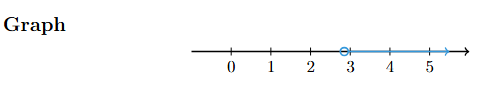
x>\dfrac{20}{7}
Example 5: Compound Inequality
Solve: -2<3x+1\le7
Solution:
Step 1: Subtract 1 from all parts
-3<3x\le6
Step 2: Divide by 3
-1<x\le2
Interval Notation Examples:
x>4 \quad (4,\infty)
x\le6 \quad (-\infty,6]
-1<x\le2 \quad (-1,2]
Common Mistakes Students Make While Solving Inequalities
1. Forgetting to Reverse the Sign
Example:-2x-4. Many students incorrectly write: x<-4.
Always reverse the inequality when dividing or multiplying by a negative number.
2. Treating Inequalities Like Equations
Inequalities represent a range of values, not one single value. Students should test solutions when unsure.
3. Sign Errors During Simplification
Example:5-8=-3
Small arithmetic mistakes can change the final answer completely.
4. Incorrect Distribution
Example:-2(x+3)=-2x-6
Students often forget to multiply every term inside parentheses.
5. Wrong Graph Endpoints
Open circle for . Closed circle for \le or \ge.
6. Shading the Wrong Direction
For x>3, shade right side. For x<3, shade left side.
7. Ignoring Compound Inequality Rules
In compound inequalities, every operation must be applied to all three parts.
Practice Questions
1. Solve the Inequality
(a) x-7>3
(b) 5x+2\le17
2. Solve and Graph
(a) x+2\le5
(b) 4x-3<9
(c) 1<2x+3\le9
(d) -4\le3x-2<7
Frequently Asked Questions (FAQs)
Q1. What is a linear inequality?
A linear inequality is an inequality involving a linear expression. The highest power of the variable is one.
Q2. Why do we reverse the sign?
When multiplying or dividing by a negative number, the order of values changes, so the inequality sign must be reversed.
Q3. How many solutions do inequalities have?
Linear inequalities usually have infinitely many solutions.
Conclusion
Solving linear inequalities is an essential precalculus skill. Students should understand how to isolate variables, reverse inequality signs when needed, and represent solutions using number lines and interval notation. Mastering these concepts prepares students for compound inequalities and graphing linear systems.
To further strengthen your understanding, you can also practice using our dedicated worksheet available at: