- Call now to book a trial session!
- +18787865635

Solving Quadratic Equations
Introduction
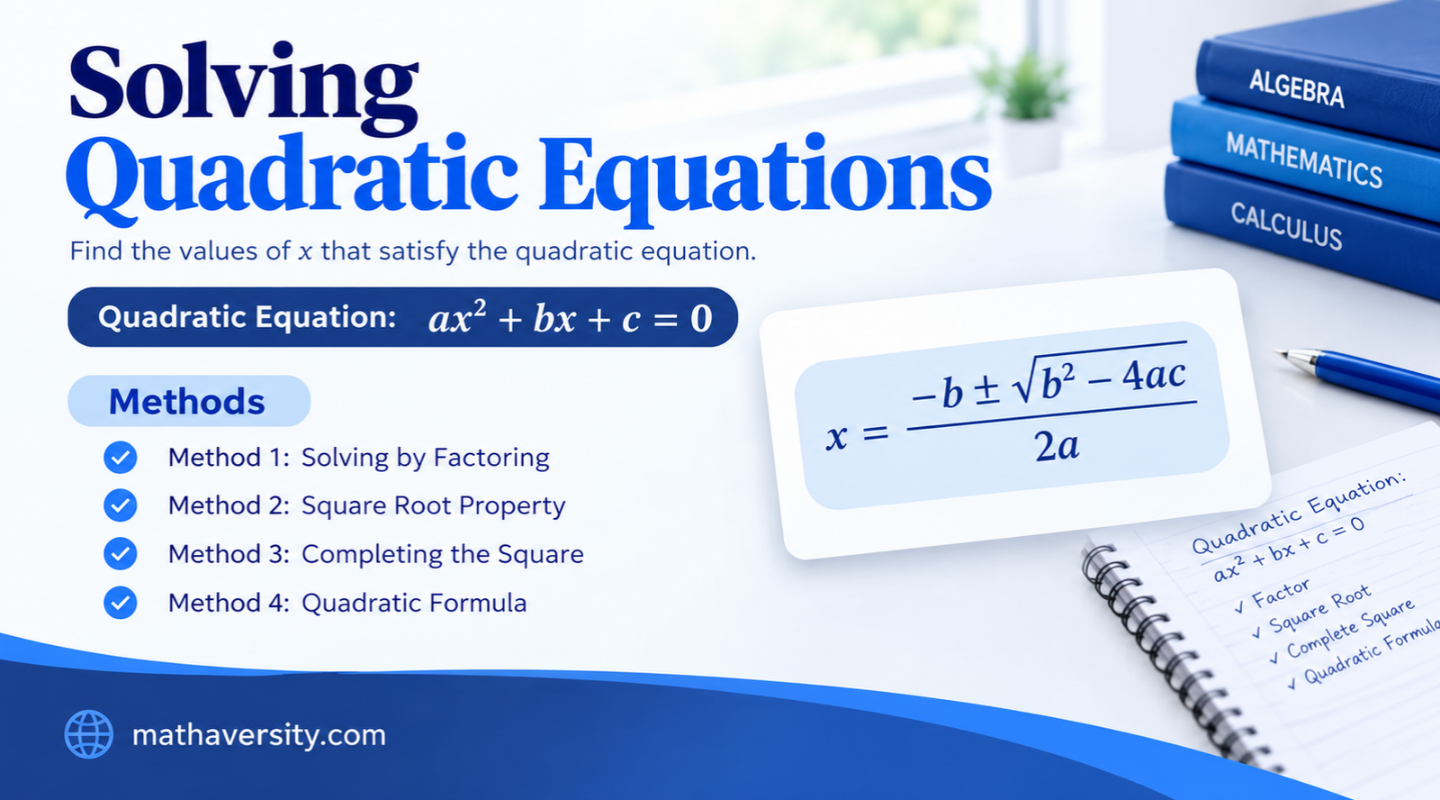
Quadratic equations are one of the most important topics in precalculus. They appear in algebra, graphing, physics, optimization, and many real-world applications. A quadratic equation involves a variable raised to the second power and typically produces two solutions. Students must learn multiple methods for solving quadratic equations because not every equation can be solved efficiently using a single technique.
What is a Quadratic Equation?
A quadratic equation is a polynomial equation of degree two. The general form is:
ax^2 + bx + c = 0
where a \neq 0,a b, and c are constants.
Examples of equations:
x^2 - 5x + 6 = 0,\quad 2x^2 + 7x - 4 = 0
Method 1: Solving by Factoring
Factoring is one of the simplest and fastest ways to solve quadratic equations. This method works best when the quadratic expression can be written as a product of two linear factors. After factoring, we use the zero product property which states that if the product of two expressions is zero, then at least one of them must be zero. This means if:
(x-a)(x-b)=0 then
x-a=0 \quad \text{or} \quad x-b=0
Example
Solve: x^2 - 5x + 6 = 0
Solution:
Step 1: Factor the quadratic expression
(x-2)(x-3)=0
Step 2: Apply zero product property
x-2=0 \quad \text{or} \quad x-3=0
Step 3: Solve
x=2 \quad \text{or} \quad x=3
Method 2: Square Root Property
The square root method is used when the quadratic equation contains only a squared variable and no linear term. The idea is to isolate the squared term and then take the square root of both sides. When taking the square root, we must always include both the positive and negative roots. General form:
x^2=k then x=\pm\sqrt{k}
Example
Solve: x^2-16=0
Solution:
Step 1: Move constant
x^2=16
Step 2: Take square root
x=\pm4
Method 3: Completing the Square
To convert a quadratic expression into a perfect square, we add the square of half of the coefficient of x. This method helps us rewrite the quadratic in squared form, which makes it easier to solve using the square root property.
For an expression of the form: x^2 + bx then x=\pm\sqrt{k}
Take half of the coefficient of x, which is \frac{b}{2}, and then square it: \left(\frac{b}{2}\right)^2
Add this value to the expression to form a perfect square trinomial: x^2 + bx + \left(\frac{b}{2}\right)^2
This can now be written as a squared binomial: \left(x + \frac{b}{2}\right)^2
This process is called completing the square and is useful when factoring is difficult or not possible
Example
Solve: x^2+6x+5=0
Solution:
Step 1: Move constant
x^2+6x=-5
Step 2: Add square of half coefficient
x^2+6x+9=4
Step 3: Perfect square
(x+3)^2=4
Step 4: Square root
x+3=\pm2
Step 5: Solve
x=-1 \quad \text{or} \quad x=-5
Method 4: Quadratic Formula
The quadratic formula is the most general method and works for all quadratic equations. It is especially useful when factoring is difficult or impossible. The formula is derived from completing the square and provides solutions directly by substituting values of a, b, and c.
Formula: x=\dfrac{-b\pm\sqrt{b^2-4ac}}{2a}
Example
Solve: 2x^2+3x-2=0
Solution:
Step 1: Identify values
a=2,\quad b=3,\quad c=-2
Step 2: Substitute
Formula: x=\dfrac{-b\pm\sqrt{b^2-4ac}}{2a}
x=\dfrac{-3\pm\sqrt{9+16}}{4}
Step 3: Simplify
x=\dfrac{-3\pm5}{4}
Step 4: Solve
x=\dfrac12,\quad x=-2
The Discriminant
The discriminant is the expression inside the square root of the quadratic formula. It is used to determine the number and type of solutions of a quadratic equation without solving the entire equation.
For a quadratic equation ax^2 + bx + c = 0 the discriminant is given by D = b^2 - 4ac
The value of the discriminant tells us the nature of the roots:
- If D > 0, the equation has two distinct real solutions.
- If D = 0, the equation has exactly one real solution (repeated root).
- If D < 0, the equation has no real solutions (two complex solutions).
Example
Determine the number of solutions of the equation: 4x^2 - 4x + 1 = 0
Solution:
Step 1: Identify coefficients
a=4,\quad b=-4,\quad c=1
Step 2: Substitute into discriminant formula
D = b^2 - 4ac
D = (-4)^2 - 4(4)(1)
Step 3: Simplify
D = 16 - 16
D = 0
Step 4: Interpret result
Since D = 0, the equation has exactly one real solution.
Practice Questions
Solve the equation by Factoring:
(1) x^2 - 7x + 12 = 0
(2) 2x^2 - 5x - 3 = 0
(3) 3x^2 - x - 2 = 0
Solve the equation by Completing the Square:
(4) x^2 + 8x + 7 = 0
(5) 2x^2 + 8x + 3 = 0
Find all real solutions of the quadratic equation:
(6) 2x^2 - 3x - 2 = 0
(7) 3x^2 + 5x - 2 = 0
(8) 5x^2 - 6x + 1 = 0
Use the discriminant to determine the number of real solutions of the equation. Do not solve the equation.
(9) x^2 - 4x + 4 = 0
(10) 3x^2 - 6x + 5 = 0
(11) 4x^2 + x + 1 = 0
Frequently Asked Questions (FAQs)
Q1. What is a quadratic equation?
A quadratic equation is a polynomial equation of degree two, meaning the highest power of the variable is 2. The standard form of a quadratic equation is ax^2 + bx + c = 0, where a, b, and c are constants and a \neq 0.
Q2. Which method is best for solving quadratic equations?
The best method depends on the form of the quadratic equation. Factoring is usually the fastest method when the expression factors easily. The square root method works well when there is no linear term. Completing the square is useful when factoring is difficult. The quadratic formula is the most reliable method because it works for all quadratic equations, although it may involve more calculations.
Q3. What is the discriminant used for?
The discriminant helps determine the nature of the solutions without solving the equation completely. By calculating b^2 - 4ac, students can quickly identify whether the equation has two real solutions, one real solution, or complex solutions. This is especially useful when analyzing graphs or checking solution types.
Q4. How many solutions can a quadratic equation have?
A quadratic equation can have two real solutions, one real solution, or two complex solutions. The number of solutions depends on the value of the discriminant b^2 - 4ac. If the discriminant is positive, the equation has two distinct real solutions. If it is zero, the equation has one repeated solution. If it is negative, the equation has two complex conjugate solutions.
Conclusion
Solving quadratic equations is a fundamental skill in precalculus and serves as a foundation for more advanced topics such as polynomial functions, graphing parabolas, and calculus applications. Students should become comfortable with all major solving methods including factoring, square root property, completing the square, and the quadratic formula. Each method has its advantages, and choosing the most efficient approach depends on the structure of the equation.
To further strengthen your understanding, you can also practice using our dedicated worksheet available at:
Regular practice with structured worksheets can significantly improve problem-solving skills and conceptual clarity.
Mathaversity is ready to help you get the highest grades if you need
professional, targeted help to fill in the last gaps in your knowledge.