AP Chemistry Score Calculator 2026
AP® Chemistry Score Calculator
Estimate your 2026 AP Chemistry exam score instantly
Multiple Choice
Free Response Questions
Score Breakdown
Predicted AP® Score
Estimated Grade
Enter your raw scores to see your prediction.
This calculator provides an estimate based on commonly used historical AP Chemistry score thresholds. Actual AP scores can vary by exam year.
AP Chemistry Score Calculator 2026: Free & Accurate Score Predictor
Trying to work out what your raw multiple-choice and free-response points actually mean on the 1–5 AP scale? This AP Chemistry score calculator guide covers exactly how the exam is structured, how it's scored, and how your composite converts to a final AP score.
We'll also cover what that score actually gets you in college credit, using the same scoring logic behind the AP Chemistry score calculator widget on this page.
How Is This AP Chemistry Score Calculator Projecting the Scoring Curve?
College Board doesn't release the current year's official scoring worksheet before the exam happens. So this AP Chemistry score calculator projects 2026 cutoffs from the most recent officially released scoring guidelines and the 2025 national score distribution.
Historically, AP Chemistry's composite thresholds shift by only about 2–4 points year to year. That makes last year's confirmed curve the most statistically reliable stand-in until the College Board publishes official 2026 data. We'll update the thresholds here the moment that happens.
2026 AP Chemistry Exam Format & Structure
The AP Chemistry exam runs 3 hours and 15 minutes and is split into two equally weighted sections testing all nine units of the course — conceptual understanding, mathematical problem-solving, experimental design, and data analysis all show up.
AP Chemistry exam format overview
| Section | Format | Time | Questions | Exam Weight |
|---|---|---|---|---|
| Section I | Multiple Choice | 90 minutes | 60 questions | ~50% |
| Section II | Free Response | 105 minutes | 7 questions | ~50% |
Section I: Multiple Choice (90 min, 60 questions)
A mix of stand-alone items and question sets built around a shared stimulus — an experiment description, data table, diagram, or graph. There's no guessing penalty, so answer every question even if you're unsure.
Budget about 1.5 minutes per question. Read the stimulus fully before jumping to the questions. For calculation items, set up the equation and check your units before solving.
Section II: Free Response (105 min, 7 questions)
- Q1 — Experimental Design (10 pts, ~23 min): design an experiment, identify variables, describe a procedure, and analyze results — often built around titrations, calorimetry, or spectrophotometry.
- Q2 — Equation Writing & Reactions (10 pts, ~23 min): write three balanced net ionic equations and answer follow-up questions predicting products or explaining observed behavior.
- Q3 — Quantitative/Computational (10 pts, ~23 min): calculation-heavy, covering stoichiometry, equilibrium, thermodynamics, or kinetics. Show every step and use correct significant figures.
- Q4–Q7 — Short Free Response (4 pts each, ~9 min each): focused concept questions on particulate diagrams, bonding, kinetics, thermodynamics, equilibrium, or electrochemistry.
AP Chemistry Score Calculator: Detailed Scoring Breakdown
Each section is worth roughly half of your composite, which is scaled to a maximum of 100 points before conversion to the 1–5 AP score. This is exactly the math the AP Chemistry score calculator above runs when you move the sliders.
Your raw multiple-choice score (out of 60) is scaled down slightly to a 50-point composite. Your seven free-response answers add up to 46 raw points (10+10+10+4+4+4+4), which also get scaled to a 50-point composite. No penalty applies for a wrong MCQ answer.
Composite point breakdown by component
| Component | Raw Points | Scaled Points | Weight |
|---|---|---|---|
| Multiple Choice (60 questions) | 60 | 50 | 50% |
| Q1 – Experimental Design | 10 | ~10.9 | ~10.9% |
| Q2 – Equations & Reactions | 10 | ~10.9 | ~10.9% |
| Q3 – Quantitative | 10 | ~10.9 | ~10.9% |
| Q4–Q7 – Short FRQ (×4) | 16 | ~17.4 | ~17.4% |
| Total | 106 | 100 | 100% |
The three long FRQs combine for roughly a third of your total score, while MCQ alone accounts for half.
A strong showing on Q3 (the quantitative question) can offset an average multiple-choice performance. It's worth prioritizing calculation practice alongside conceptual review rather than treating FRQ prep as an afterthought.
AP Chemistry Score Calculator Conversion Chart
College Board does not publish an official raw-to-composite conversion table for Chemistry. The ranges below reflect the most recent confirmed national administration with a small buffer applied near each boundary — the same thresholds this AP Chemistry score calculator uses.
Estimated AP Chemistry composite-to-score conversion
| Composite (0–100) | AP Score | Qualification |
|---|---|---|
| 72–100 | 5 | Extremely Well Qualified |
| 58–71 | 4 | Well Qualified |
| 42–57 | 3 | Qualified |
| 27–41 | 2 | Possibly Qualified |
| 0–26 | 1 | No Recommendation |
The curve here is genuinely generous: a 5 only requires clearing about 72% of available composite points, and a 3 needs just 42%.
That's a meaningful gap between "passing" and "perfect," which is exactly why attempting every FRQ sub-part — even with an incomplete answer — is worth far more than leaving it blank.
How the AP Chemistry Curve Works
Your final 1–5 score comes from combining two scaled sections into one composite. That composite is then mapped against a cutoff table College Board resets every year based on how difficult that year's specific questions turned out to be.
The multiple-choice section contributes 50 composite points, and the free-response section contributes the other 50 — three long FRQs at roughly 10.9% each and four short FRQs worth about 4.3% apiece.
This yearly recalibration keeps a 5 in 2026 representing the same level of mastery as a 5 several years ago, even though the actual exam content changes annually. Despite that, AP Chemistry's cutoffs have proven relatively stable historically, typically drifting only 2–4 composite points between administrations.
Pass Rate & Score Distribution Analysis
AP Chemistry has a reputation as one of the tougher AP sciences, but the last several years of official data tell a more encouraging story than that reputation suggests.
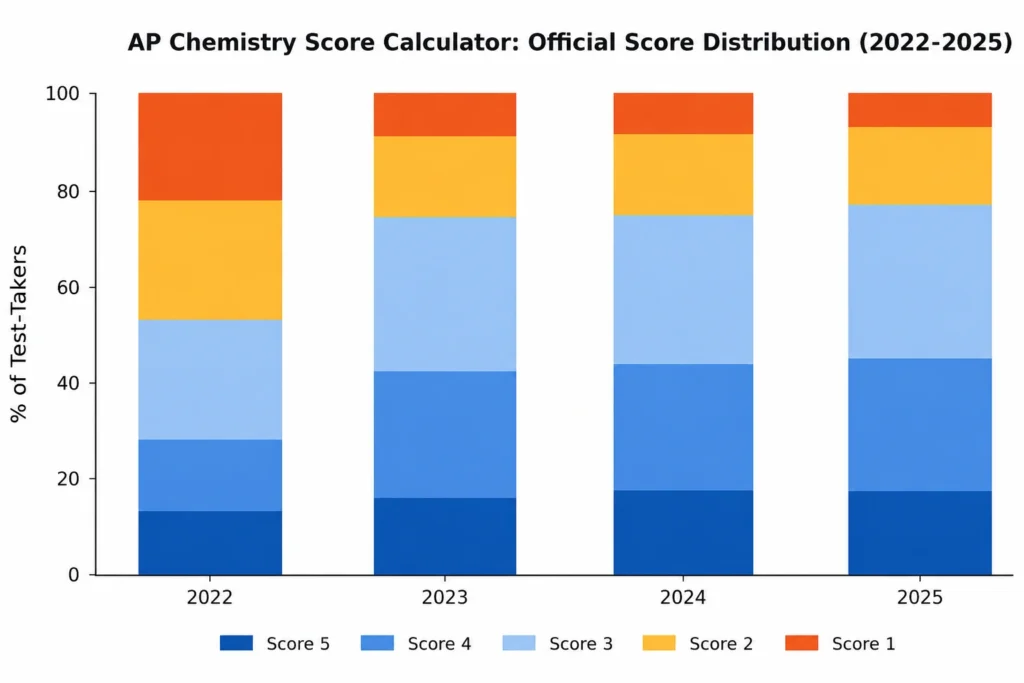
Official AP Chemistry score distribution, 2022–2025
| Score | 2022 | 2023 | 2024 | 2025 |
|---|---|---|---|---|
| 5 | 12.5% | 16.0% | 17.9% | 17.8% |
| 4 | 17.0% | 27.1% | 27.4% | 28.6% |
| 3 | 24.5% | 32.0% | 30.3% | 31.5% |
| 2 | 23.6% | 16.9% | 16.9% | 15.9% |
| 1 | 22.5% | 8.0% | 7.5% | 6.2% |
| Pass Rate (3+) | 54.0% | 75.1% | 75.6% | 77.9% |
The pass rate climbed from 54.0% in 2022 to 77.9% in 2025 — nearly a 24-point jump. The share of students landing a 5 grew from 12.5% to 17.8% over the same window.
Only about 22% of test-takers scored a 1 or 2 in 2025, compared to roughly 46% back in 2022. That points to a considerably stronger overall distribution in recent years than AP Chemistry's older reputation might suggest.
How AP Chemistry Compares to Other AP Sciences
2025 pass rate comparison across AP science exams
| Exam | Pass Rate (3+) | Score of 5 Rate | Mean Score |
|---|---|---|---|
| AP Chemistry | 77.9% | 17.8% | 3.36 |
| AP Biology | ~68% | ~14% | 3.04 |
| AP Physics 1 | ~48% | ~8% | 2.56 |
| AP Environmental Science | ~56% | ~10% | 2.74 |
Studying for a different science exam too? See how the curve compares on our AP Biology Score Calculator.
What Is a Good AP Chemistry Score?
A 3, 4, or 5 counts as a passing score on AP Chemistry. Each carries a College Board qualification label: 3 is "Qualified," 4 is "Well Qualified," and 5 is "Extremely Well Qualified."
A 3 is technically enough to be eligible for college credit, but plenty of schools set their own bar higher and only accept a 4 or 5. So "good enough" really depends on your target institution's specific credit policy — run your numbers through the AP Chemistry score calculator above, then check that school's policy directly.
There's also a rough letter-grade equivalence worth knowing. College Board maps a 5 to roughly an A+/A, a 4 to an A-/B+/B, and a 3 to a B-/C+/C. Only around 17–18% of test-takers earn a 5 in recent years, so don't treat anything short of that as a disappointing result.
What Is the Average AP Chemistry Score?
The mean AP Chemistry score shifts a bit each year based on exam difficulty and that cohort's preparation level. Recent years show a clear upward trend: 3.31 in 2024, 3.26 in 2023, 2.73 in 2022, 2.66 in 2021, and 2.76 in 2020.
Averaged across those five years, that lands right around 2.9–3.0 historically. The two most recent years sit meaningfully above that longer-run average, suggesting either an easier recent curve, better student preparation, or both.
Scored Below a 3 on the AP Chemistry Score Calculator? What That Still Means
A 1 or 2 won't earn college credit, but it isn't wasted effort. Going through an AP Chemistry course and sitting the exam still gives you a real preview of intro-level college coursework.
The study habits, time management, and discipline built along the way carry over regardless of the number you end up with. Research from College Board itself associates AP exam participation — even without a qualifying score — with higher rates of college enrollment and on-time graduation.
If you're undecided on a college major, that exposure to rigorous science coursework can also be genuinely useful context later, whatever field you end up choosing.
AP Chemistry Unit-by-Unit Content Overview
AP Chemistry covers nine units. Unit 3 (Intermolecular Forces & Properties) carries the heaviest weighting by a wide margin, with Unit 8 (Acids & Bases) close behind.
AP Chemistry unit weighting and study priority
| Unit | Exam Weight | Priority | Math Intensity |
|---|---|---|---|
| 1. Atomic Structure & Properties | 7–9% | Medium | Low |
| 2. Molecular & Ionic Compound Structure | 7–9% | Medium | Low |
| 3. Intermolecular Forces & Properties | 18–22% | High | Medium |
| 4. Chemical Reactions | 7–9% | Medium | Medium |
| 5. Kinetics | 7–9% | Medium | High |
| 6. Thermodynamics | 7–9% | High | High |
| 7. Equilibrium | 7–9% | High | High |
| 8. Acids & Bases | 11–15% | High | High |
| 9. Applications of Thermodynamics | 7–9% | Medium | High |
AP Chemistry College Credit & Placement Policy
AP Chemistry is one of the most widely recognized AP exams for college science credit.
Typical AP Chemistry college credit policy by institution type
| Institution Type | Minimum Score | Typical Credit Granted |
|---|---|---|
| Ivy League / Top 20 | 5 | Placement only (credit varies by school) |
| Selective Private Universities | 4 or 5 | 4–8 credits (General Chemistry I, sometimes I+II) |
| Large Public Universities | 3, 4, or 5 | 4–8 credits (General Chemistry) |
| Community Colleges | 3 | 4 credits (General Chemistry I) |
How to Get a 5 on AP Chemistry
- Master stoichiometry first. It underlies more than 60% of all exam questions in some form — mole conversions, limiting reagents, and percent yield should become automatic.
- Memorize the essential relationships even though an equation sheet is provided: PV = nRT, q = mcΔT, pH = −log[H⁺], Henderson-Hasselbalch, ΔG = ΔH − TΔS, and E°cell = E°cathode − E°anode. Instant recall saves real time on exam day.
- Practice particulate diagrams. College Board leans heavily on particle-level representations, and short FRQs frequently ask you to draw or interpret them.
- Drill ICE tables extensively across Kc, Kp, Ka, Kb, and Ksp problems, and know when the simplifying assumption applies versus when you need the quadratic formula.
- Get comfortable reading data — concentration-vs-time graphs, titration curves, PES spectra — since a large share of the MCQ section is stimulus-based.
- Time your FRQ practice with at least 4–5 full released sets: 23 minutes per long FRQ, 9 minutes per short FRQ, graded against the official rubric.
- Prioritize Units 3 and 8. Intermolecular Forces and Acids & Bases together account for nearly a third of the exam.
- Use correct significant figures. AP Chemistry generally expects 3 sig figs unless stated otherwise — mismatched precision costs FRQ points even when the method is right.
What Score Do You Need? Using the AP Chemistry Score Calculator to Reverse-Engineer Your Target
Instead of chasing a flat percentage, work backward from the composite ranges above. A 3 needs roughly 42 of 100 composite points — achievable with a moderate MCQ result plus partial FRQ credit.
A 5 needs about 72 points, which generally requires solid performance across both sections rather than carrying the score on MCQ or FRQ alone.
Plug your raw section estimates into the AP Chemistry score calculator at the top of this page to see your projected composite, then use the unit-priority table above to decide where additional review time will move that number the most.
AP Chemistry FRQ Question Types & Common Scoring Mistakes
General FRQ scoring tips
- Show all work — partial credit is awarded for correct setup even with a wrong final answer.
- Use proper notation: subscripts, superscripts, charges, and phase labels all matter.
- Answer exactly what's asked — "explain" needs a reason, "calculate" needs math shown.
- Never leave a question blank; partial credit is available even for an incomplete attempt.
- Cross out mistakes with a single line rather than erasing — graders only score what isn't crossed out.
Periodic Table Reference: What You Get on Exam Day
College Board provides three reference documents in a sealed packet. Knowing exactly what's included — and what isn't — matters as much as knowing the chemistry itself.
Periodic Table Reference: What You Get on Exam Day
Includes atomic numbers, symbols, names, and atomic masses only. It does not include electron configurations, electronegativity values, ionization energies, or common oxidation states.
You need the general trends memorized: electronegativity and ionization energy increase across a period and up a group; atomic radius increases down a group and right-to-left across a period.
2. Equations & Constants Sheet
Organized by topic: atomic structure (E = hν, c = λν), equilibrium (Kp = Kc(RT)Δn, Henderson-Hasselbalch), thermodynamics/electrochemistry (ΔG° = −RT ln K, ΔG° = −nFE°, Nernst equation), kinetics (integrated rate laws, Arrhenius equation), and gases/solutions (PV = nRT, molarity/molality), plus constants like R, Avogadro's number, and Faraday's constant.
3. Standard Reduction Potentials Table
A table of E° values for common half-reactions, essential for electrochemistry FRQs. The half-reaction with the more positive E° acts as the cathode (reduction); E°cell = E°cathode − E°anode.
What You Must Still Memorize
| Topic | What to Know |
|---|---|
| Periodic Trends | Electronegativity, ionization energy, atomic radius, and electron affinity. |
| Solubility Rules | Solubility rules for common ionic compounds. |
| Strong Acids & Bases | Strong acids: HCl, HBr, HI, HNO₃, H₂SO₄, HClO₃, HClO₄. Strong bases: Group 1 and Group 2 hydroxides. |
| Polyatomic Ions | Common polyatomic ions and their charges. |
| Activity Series | The activity series of metals. |
| VSEPR Geometries | VSEPR geometries and common bond angles. |
| Intermolecular Forces | Relative strengths of intermolecular forces. |
Why Should I Use This AP Chemistry Score Calculator?
Because College Board doesn't publish an official raw-to-composite conversion table for AP Chemistry, this AP Chemistry score calculator is built directly from officially released scoring guidelines and the most recent confirmed national score distribution — not a guess.
Enter your raw MCQ and FRQ scores to see your projected composite and 1–5 estimate. Then use the unit-priority breakdown above to see exactly which section or unit is costing you the most points, and how much improvement in one area would move your final number.
Looking for more official background on the exam itself? See the College Board's official AP Chemistry course page for the full curriculum framework, or browse our full library of AP score calculators if you're juggling more than one exam this year.