AP English Language Score Calculator
AP® English Language Score Calculator
Predict your AP English Language and Composition exam score instantly using current College Board scoring guidelines.
Format note: Starting with the 2026 exam, AP English Language multiple-choice questions have 4 answer choices instead of 5, and the exam is fully digital in Bluebook. The section count (45 MCQ, 3 essays) and 45%/55% weighting are unchanged. See the full study guide for details.
Section I: Multiple Choice
No penalty for incorrect or blank answers — always answer every question.
Section II: Free Response Essays
Estimate your rubric score (0–6) on each essay.
Score Breakdown
Predicted AP® Score
Estimated Grade
Enter your raw scores to see your prediction.
This AP English Language score calculator uses estimated composite cutoffs based on historical AP scoring trends. College Board does not publish exact cutoffs before scores release each July, and the actual curve varies year to year. Verify exam-day details on the official College Board AP English Language page.
AP English Language: The Complete 2026 Study Guide
Everything you need on AP English Language and Composition in one place — exam format, essay rubrics, scoring, score distribution, and study strategy for 2026.
What Is AP English Language and Composition?
AP English Language and Composition ("AP Lang") is College Board's introductory, college-level rhetoric and composition course. Unlike AP English Literature, it deals exclusively with nonfiction — essays, speeches, articles, and other real-world argumentative writing — and asks students to analyze how authors build arguments and to construct strong arguments of their own.
It's one of the most widely taken AP exams in the country, with well over 600,000 students sitting for it each year, which also means score data and released materials are unusually abundant compared to smaller AP subjects.
Exam Format (2026 Digital Update)
The exam runs 3 hours and 15 minutes total and is now delivered fully digitally through College Board's Bluebook app.
| Section | Details |
|---|---|
| Section I — Multiple Choice | 45 questions, 60 minutes, 45% of score. As of 2026: 4 answer choices per question (previously 5). |
| Reading Period | 15 minutes to read Section II source material before writing begins. |
| Section II — Free Response | 3 essays, 2 hours (plus the reading period), 55% of score. |
Section I splits into two question types: roughly 23–25 reading questions that test your ability to analyze rhetorical choices in nonfiction passages, and roughly 20–22 writing questions that ask you to revise and improve a student-written passage. Many students over-focus on the reading questions in practice and underprepare for the writing/revision half, which is worth nearly as much.
How Each Essay Is Scored
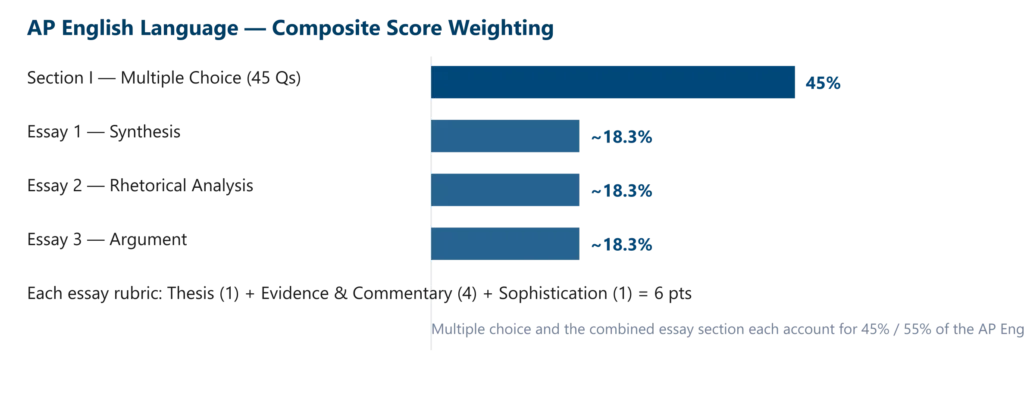
All three essays share the same analytic rubric, scored 0–6:
- Thesis (0–1 point): Is there a clear, defensible thesis that responds directly to the prompt?
- Evidence and Commentary (0–4 points): Does the essay use specific, relevant evidence and explain how that evidence supports the thesis, rather than just listing it?
- Sophistication (0–1 point): Does the essay show a nuanced understanding of the rhetorical situation, complexity, or stylistic control — beyond a competent but formulaic response?
How Your Composite Score Becomes a 1–5
Your raw scores combine into a composite out of 100 using this formula:
- MCQ Scaled Score = (Correct Answers ÷ 45) × 45
- Essay Scaled Score = (Essay 1 + Essay 2 + Essay 3, out of 18) ÷ 18 × 55
- Composite Score = MCQ Scaled + Essay Scaled (out of 100)
Because the essay section carries 55% of the total weight versus 45% for multiple choice, strong essays can carry a mediocre MCQ performance — and weak essays can sink an otherwise strong reading score. College Board finalizes the exact composite-to-AP-score cutoffs after each administration, so treat the table below as a well-informed estimate:
| AP Score | Approx. Composite (out of 100) | Description |
|---|---|---|
| 5 | 75+ | Extremely well qualified |
| 4 | 61–74 | Well qualified |
| 3 | 47–60 | Qualified |
| 2 | 32–46 | Possibly qualified |
| 1 | 0–31 | No recommendation |
Score Distribution & Pass Rate
In the most recent reported administration, the mean AP English Language score was 3.19, with about 74% of students scoring a 3 or higher (5: 13.4%, 4: 28.0%, 3: 32.8%, 2: 16.1%, 1: 9.7%). That's a notable jump over prior years — the five-year average mean score has typically sat closer to 2.86, meaning this was a comparatively stronger year for test-takers overall. Year-to-year swings like this are part of why treating any single year's cutoffs as fixed is a mistake.
What Counts as a Good Score?
A 3 is passing and earns credit at many colleges. A 4 or 5 earns credit at nearly all schools that accept AP credit and is generally what more selective colleges expect. Given the exam's below-3.0 historical average, even a solid 3 reflects above-median performance among test-takers nationally.
How to Score Higher
- Prioritize essay quality over MCQ perfection. Since essays carry 55% of the composite, raising your average essay score by even half a point across all three essays typically moves your composite more than a handful of extra correct MCQ answers.
- Chase the sophistication point deliberately. It's binary — you either earn it or you don't — and earning it consistently across all three essays can shift your final AP score by a full point at the margin. Addressing a counterargument or acknowledging complexity is the most reliable way to earn it.
- Don't neglect the writing/revision MCQ questions. Students tend to over-practice reading comprehension and under-practice the 20–22 revision-style questions, leaving points on the table in an area that's just as heavily weighted.
- Analyze, don't summarize. On the Rhetorical Analysis essay specifically, naming a rhetorical device without explaining its effect on the reader earns little credit — always connect the choice to its purpose.
- Pace at roughly 40 minutes per essay, but stay flexible — a complete, organized essay beats a brilliant but unfinished one.
A 3 is passing and earns credit at many colleges. A 4 or 5 earns credit at nearly all schools that accept AP credit and is generally what more selective colleges expect. Given the exam's below-3.0 historical average, even a solid 3 reflects above-median performance among test-takers nationally.
AP English Language vs. AP English Literature
These two exams are often confused since both fall under "AP English." AP Language and Composition deals exclusively with nonfiction — rhetoric, argumentation, and real-world texts — while AP English Literature and Composition focuses on poetry, prose fiction, and drama. Both share the same 45%/55% MCQ-to-essay weighting and a similar 0–6 essay rubric, but AP Literature's multiple-choice section has 55 questions instead of 45. Students planning to major in a STEM or social-science field where analytical, evidence-based writing matters most often gravitate toward Language; those with a strong interest in literary analysis often prefer Literature — though many schools require Language first regardless of major.
College Credit & Placement
Many colleges award credit for a 3 or higher on AP English Language, often satisfying a first-year composition requirement. More selective schools, or those with their own required writing seminar, may require a 4 or 5, or may grant placement without credit. Because policies vary significantly by institution, always check the specific AP credit policy published by each college you're applying to.
Frequently Asked Questions
Mathaversity's More Tools
Retirement Calculator
Plan your financial future and estimate your retirement savings easily.
Open CalculatorFinal Grade Calculator
Calculate the grade you need on your final exam to reach your target course grade.
Open Calculator