AP Physics 1 Score Calculator 2026
AP® Physics 1 Score Calculator
Predict your 2026 AP Physics 1 exam results instantly
Multiple Choice
Free Response Questions
Score Breakdown
Predicted AP® Score
Estimated Grade
Enter your raw scores to see your prediction.
AP Physics 1 Score Calculator 2026: Free & Accurate Score Predictor
Wondering what your raw multiple-choice and free-response points actually mean on the 1–5 AP scale? This AP Physics 1 score calculator guide covers exactly how the exam is structured, how scoring works, and what your projected score is actually worth in college credit — using the same logic behind the calculator on this page.
AP Physics 1 consistently posts one of the lowest pass rates of any AP exam, so understanding exactly where your points come from matters more here than on most other subjects.
How Is the AP Physics 1 Exam Structured?
The AP Physics 1 exam runs 3 hours total and splits evenly between two sections. Both sections weigh conceptual reasoning and data interpretation more heavily than pure calculation.
| Section | Format | Time | Questions | Exam Weight |
|---|---|---|---|---|
| Section I | Multiple Choice | 1 hr 20 min | 40 questions | 50% |
| Section II | Free Response | 1 hr 40 min | 4 questions | 50% |
Section I: Multiple Choice
40 questions mixing standalone items with question sets built around a shared scenario, graph, or data table. There's no guessing penalty, so this AP Physics 1 score calculator assumes you answer every question — an educated guess only helps.
Section II: Free Response
Unlike most AP sciences, the four Physics 1 FRQs aren't worth equal points — each tests a distinct skill and carries its own point value per the current College Board scoring guidelines:
- Q1 — Mathematical Routines (10 pts): a calculation-heavy problem requiring a clear, justified numerical solution.
- Q2 — Translation Between Representations (12 pts): the highest-value FRQ, asking you to move between graphs, equations, diagrams, and verbal descriptions of the same physical situation.
- Q3 — Experimental Design and Analysis (10 pts): design a procedure, identify variables, and analyze lab-style data.
- Q4 — Qualitative/Quantitative Translation (8 pts): the lowest-value FRQ, testing conceptual reasoning without requiring a full numerical answer.
AP Physics 1 Unit-by-Unit Content Overview
AP Physics 1 covers seven units of algebra-based mechanics. Dynamics and Energy together account for nearly a third of the exam, making them the highest-leverage units to master.
| Unit | Exam Weight | Priority |
|---|---|---|
| 1. Kinematics | 10–15% | Medium |
| 2. Dynamics | 14–17% | High |
| 3. Circular Motion & Gravitation | 9–13% | Medium |
| 4. Energy | 14–17% | High |
| 5. Momentum | 9–13% | Medium |
| 6. Simple Harmonic Motion | 7–9% | Medium |
| 7. Torque & Rotational Motion | 10–16% | High |
How Are We Projecting the Scoring Curve?
College Board has not released a full official scoring worksheet for the current version of AP Physics 1. This AP Physics 1 score calculator projects composite cutoffs from the relative point values and section weighting published in the 2024–2025 scoring guidelines, cross-checked against recent national score distributions.
We'll update these thresholds the moment College Board releases new official scoring data.
Composite Score to AP Score Conversion
| Composite (0–80) | AP Score | Qualification |
|---|---|---|
| 56–80 | 5 | Extremely Well Qualified |
| 43–55 | 4 | Well Qualified |
| 32–42 | 3 | Qualified |
| 20–31 | 2 | Possibly Qualified |
| 0–19 | 1 | No Recommendation |
A 5 requires 70% of available points — noticeably steeper than AP Chemistry's roughly 72% or AP Biology's 78%, but still not a near-perfect run. A 3 needs exactly 40% of the composite.
Why Are AP Physics 1 Scores Curved?
College Board resets composite cutoffs every year through a process called equating, which adjusts for how difficult that specific year's questions turned out to be.
AP Physics 1, like every AP course, is designed to mirror the rigor of an equivalent introductory college course. The scoring guidelines calibrate against that benchmark rather than a fixed percentage, which is why a 5 in 2026 should reflect the same level of mastery as a 5 several years earlier — even though the specific questions are completely different.
AP Physics 1 Score Distribution & Trends (2021–2025)
AP Physics 1 has a well-earned reputation as one of the hardest AP exams, and the national data backs that up.
| Score | % of Students |
|---|---|
| 5 | 10.2% |
| 4 | 17.9% |
| 3 | 19.2% |
| 2 | 26.1% |
| 1 | 26.6% |
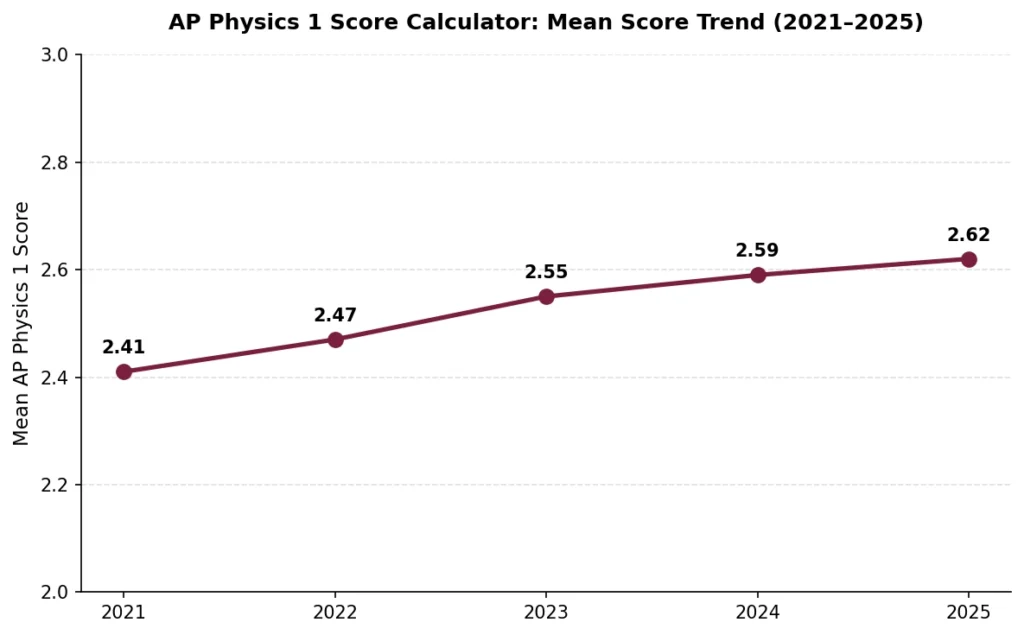
Only about 47.3% of test-takers passed with a 3 or higher — well below most other AP sciences, and a slow but steady improvement from a 2021 pass rate closer to 40%. The mean score has climbed gradually each year: 2.41 (2021), 2.47 (2022), 2.55 (2023), 2.59 (2024), and roughly 2.62 in 2025.
That upward trend likely reflects teachers and students becoming more familiar with the redesigned exam format rather than the test itself getting easier.
What Is a Good AP Physics 1 Score?
A 3 or higher is considered passing, matching College Board's own "Qualified" (3), "Well Qualified" (4), and "Extremely Well Qualified" (5) labels. Given that fewer than half of all test-takers clear a 3, any passing score on this exam is a genuine accomplishment.
Because AP Physics 1's overall distribution skews lower than most AP exams, a 4 here often carries more weight with admissions readers than a 4 on an easier-curved exam — context that's easy to miss if you're only looking at the raw number.
What Is the Average AP Physics 1 Score?
The mean AP Physics 1 score has hovered in the 2.4–2.6 range for the last several years: 2.41 in 2021, 2.47 in 2022, 2.55 in 2023, 2.59 in 2024, and an estimated 2.62 in 2025.
That places the "average" test-taker between a 2 and a 3 — meaningfully lower than AP Biology's roughly 3.0 or AP Chemistry's roughly 3.3 average, underscoring just how demanding this particular exam is relative to other AP sciences.
Scored Below a 3? What That Still Means
Given that more than half of test-takers land a 1 or 2 most years, scoring below a 3 on AP Physics 1 puts you in the majority, not some rare outlier group.
A 1 or 2 won't earn college credit, but completing an algebra-based mechanics course at this level of rigor still demonstrates real quantitative reasoning skills to admissions readers — especially if your transcript shows the course grade held up despite a tough exam curve.
If your target major doesn't require Physics 1 credit specifically, a lower score here is unlikely to meaningfully affect your application on its own.
AP Physics 1 College Credit Policy
| Institution Type | Minimum Score | Typical Credit Granted |
|---|---|---|
| Ivy League / Top 20 | 5 | Placement only (credit varies by school) |
| Selective Private Universities | 4 or 5 | 3–4 credits (Intro Physics I equivalent) |
| Large Public Universities | 3, 4, or 5 | 3–4 credits (Intro Physics I equivalent) |
| Community Colleges | 3 | 3–4 credits (Intro Physics I equivalent) |
How Do I Get a 5 on AP Physics 1?
- Prioritize Dynamics and Energy first. Together they account for up to a third of the exam and appear embedded inside FRQs from other units too.
- Practice Q2-style translation constantly. Worth 12 points — the single highest-value FRQ — it demands fluency moving between graphs, equations, and verbal explanations of the same scenario.
- Draw free-body diagrams for every dynamics problem, even ones that seem simple. Missing forces is the single most common Dynamics error.
- Master experimental design language for Q3: identify independent/dependent variables explicitly, and always propose at least one control.
- Practice writing qualitative explanations without equations for Q4 — conceptual reasoning is graded separately from computational accuracy.
- Use energy conservation as a default first approach to unfamiliar problems before reaching for kinematics equations; it often simplifies multi-step scenarios significantly.
- Time full FRQ sets under real conditions — roughly 25 minutes per question — and grade against official rubrics rather than your own sense of correctness.
FRQ Types & Common Scoring Mistakes
Q1 — Mathematical Routines (10 pts)
A calculation-focused problem requiring a justified numeric answer, usually spanning Dynamics, Energy, or Momentum.
Q2 — Translation Between Representations (12 pts)
The highest-value FRQ. You'll be asked to move fluidly between a graph, an equation, a diagram, and a written explanation of the same physical situation.
Q3 — Experimental Design and Analysis (10 pts)
Design an experiment, identify variables, and analyze the resulting data — frequently involving graph-based error analysis.
Q4 — Qualitative/Quantitative Translation (8 pts)
The lowest-point-value FRQ, but conceptually demanding — it tests whether you understand why something happens, not just how to calculate it.
What's on the Exam-Day Reference Sheet?
College Board provides an equations and constants sheet for use throughout the entire AP Physics 1 exam — on both the multiple-choice and free-response sections.
It includes core kinematics, dynamics, energy, momentum, circular motion, simple harmonic motion, and rotational motion formulas, along with common physical constants like the gravitational constant and standard gravitational acceleration.
Physics 1 vs. Physics 2 vs. Physics C: Mechanics
Choosing the right AP Physics course depends heavily on your math background and intended major.
| Course | Math Level | Topics Covered | Best For |
|---|---|---|---|
| AP Physics 1 | Algebra-based | Mechanics (kinematics through rotational motion) | General science requirement, non-STEM majors, first physics course |
| AP Physics 2 | Algebra-based | Fluids, thermodynamics, electricity/magnetism, optics, modern physics | Students who enjoyed Physics 1 and want broader science exposure |
| AP Physics C: Mechanics | Calculus-based | Mechanics, covered with calculus methods | Engineering and physics majors with a strong calculus background |
When Do AP Physics 1 Scores Come Out?
AP scores are typically released in July, several weeks after the May exam administration. College Board releases scores in batches by region rather than all at once, so exact release dates can vary by a few days depending on where you tested.
Why Should I Use This AP Physics 1 Score Calculator?
Because College Board hasn't published a finalized official scoring worksheet for the current AP Physics 1 format, this AP Physics 1 score calculator is built from the most recent released scoring guidelines and national score distribution data rather than a guess.
Enter your raw MCQ and FRQ scores to see your projected composite and 1–5 estimate instantly, then use the unit-priority breakdown above to see exactly where additional review time would move your score the most. For official course material, see the College Board's official AP Physics 1 course page, or browse our full library of AP score calculators if you're juggling more than one science exam this year.
Why Should I Use This AP Physics 1 Score Calculator?
Because College Board hasn't published a finalized official scoring worksheet for the current AP Physics 1 format, this AP Physics 1 score calculator is built from the most recent released scoring guidelines and national score distribution data rather than a guess.
Enter your raw MCQ and FRQ scores to see your projected composite and 1–5 estimate instantly, then use the unit-priority breakdown above to see exactly where additional review time would move your score the most. For official course material, see the College Board's official AP Physics 1 course page, or browse our full library of AP score calculators if you're juggling more than one science exam this year.
AP Physics 1 Score Calculator: Frequently Asked Questions
Mathaversity's More Tools
Retirement Calculator
Plan your financial future and estimate your retirement savings easily.
Open CalculatorFinal Grade Calculator
Calculate the grade you need on your final exam to reach your target course grade.
Open Calculator